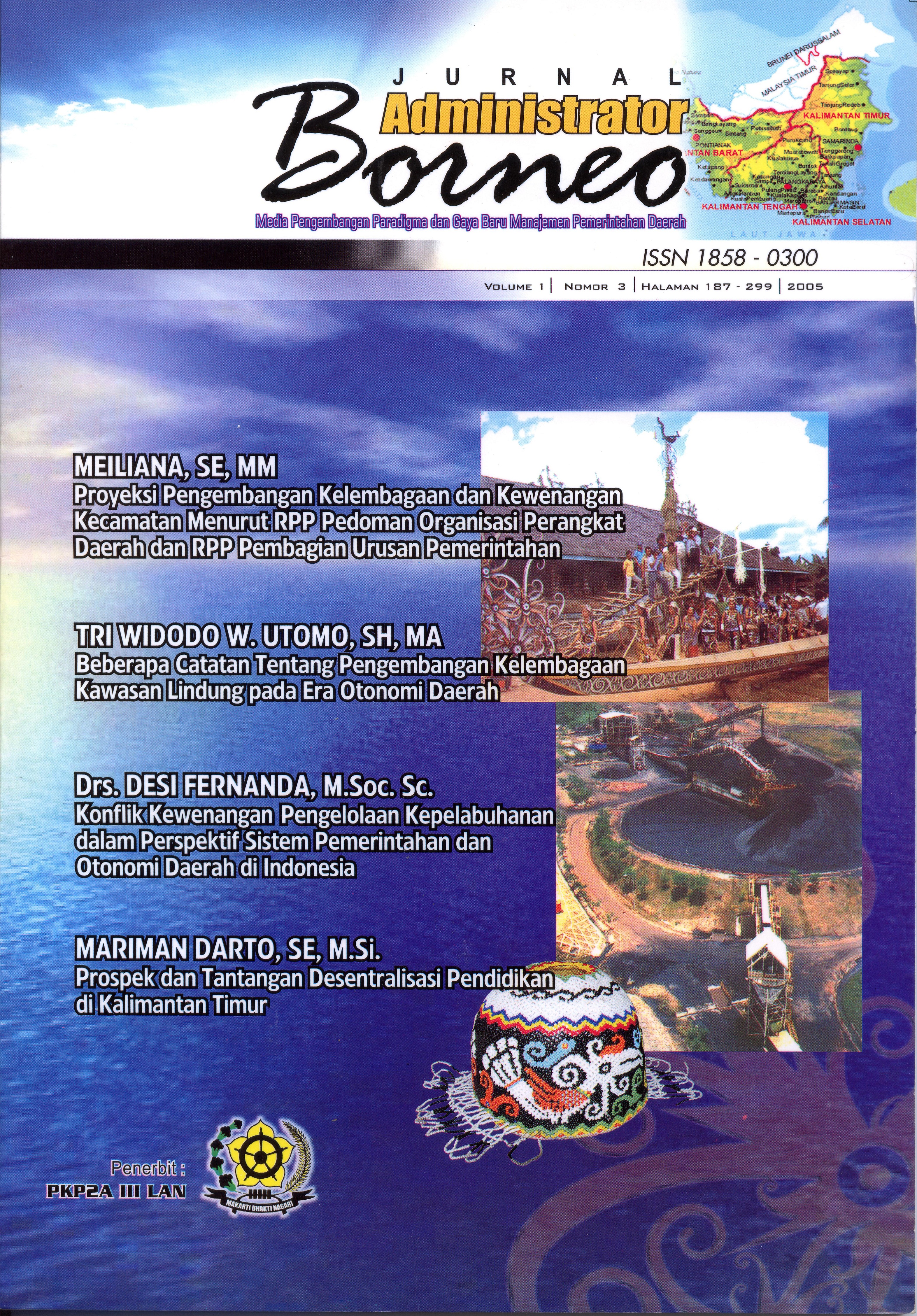
BEBERAPA CATATAN TENTANG PENGEMBANGAN KELEMBAGAAN KAWASAN LINDUNG PADA ERA OTONOMI DAERAH
DOI:
https://doi.org/10.24258/jba.v1i3.10Abstract
The global issue on environmental degradation is becoming solemn concern among national and local governments. One of strategies in overcoming environmental problems, particularly in the shielding / caring areas (kawasan lindung), is to promote special institution in charge of composing plan, implementing programs, controlling and evaluating performance, as well as building strategic alliances among stakeholders to protect and improve the quality of shielding areas. This paper tries to analyze the probability of making new institutions based on “collaborative management” principles. In brief, it offers two models of such institution, namely, upstream – downstream solidarity; and central – regional solidarity.Downloads
Download data is not yet available.
Downloads
Published
2014-01-22
How to Cite
W. Utomo, T. W. (2014). BEBERAPA CATATAN TENTANG PENGEMBANGAN KELEMBAGAAN KAWASAN LINDUNG PADA ERA OTONOMI DAERAH. Jurnal Borneo Administrator, 1(3). https://doi.org/10.24258/jba.v1i3.10
Issue
Section
Articles
License
Copyright (c) 2014 Author(s)

This work is licensed under a Creative Commons Attribution-NonCommercial-ShareAlike 4.0 International License.
Policy for Journals That Offer Open Access
Authors who publish with this journal agree to the following terms:
- Authors retain copyright and grant the journal right of first publication with the work simultaneously licensed under a Creative Commons Attribution-NonCommercial-ShareAlike 4.0 International License that allows others to share the work with an acknowledgement of the work's authorship and initial publication in this journal.
- Authors are able to enter into separate, additional contractual arrangements for the non-exclusive distribution of the journal's published version of the work (e.g., post it to an institutional repository or publish it in a book), with an acknowledgement of its initial publication in this journal.
- Authors are permitted and encouraged to post their work online (e.g., in institutional repositories or on their website) prior to and during the submission process, as it can lead to productive exchanges, as well as earlier and greater citation of published work (See The Effect of Open Access).