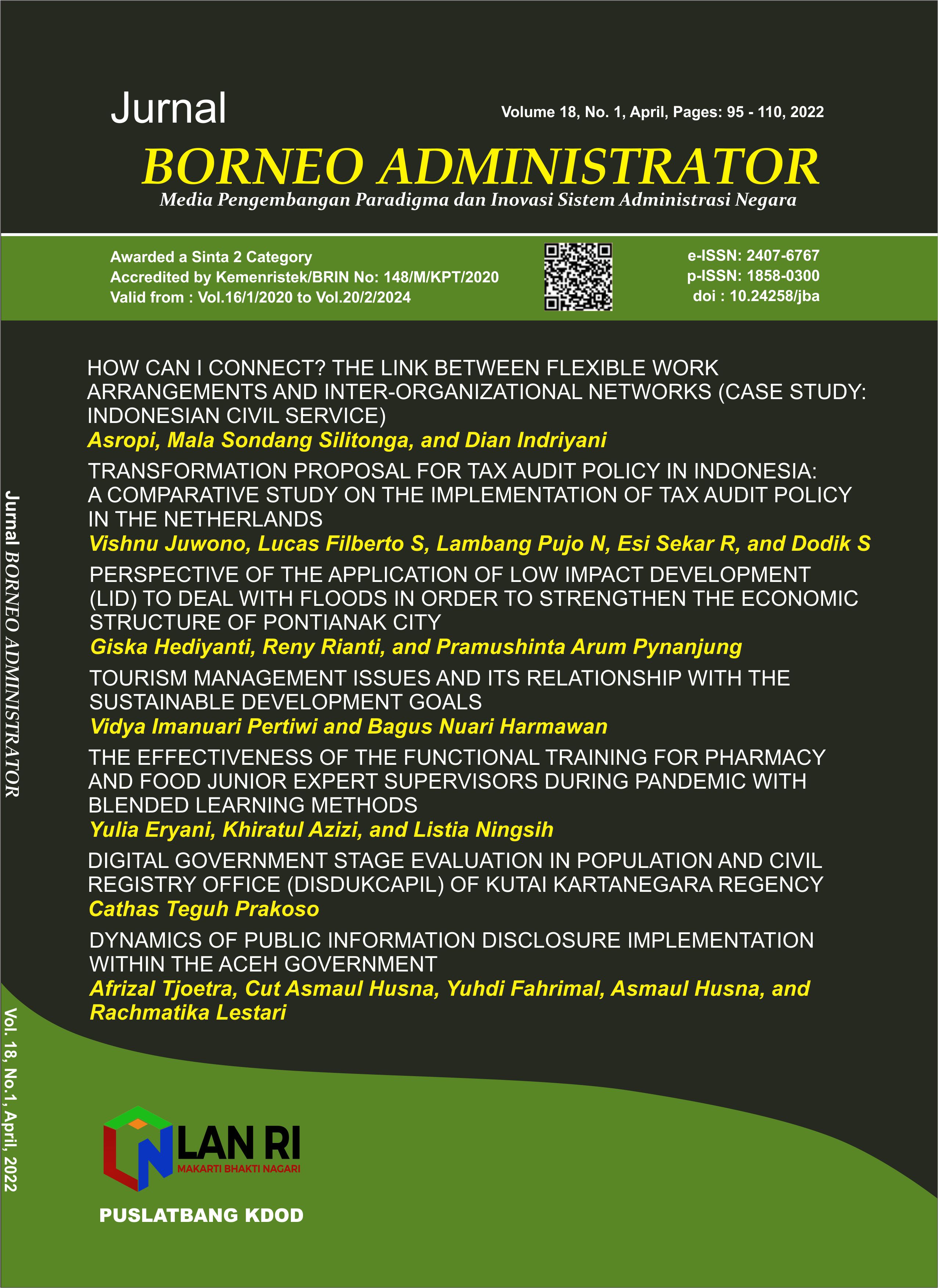
How can I Connect? the Link between Flexible Work Arrangements and Inter-organizational Networks (Case study: Indonesian Civil Service)
DOI:
https://doi.org/10.24258/jba.v18i1.1011Abstract
This study aims to examine how significantly Flexible Work Arrangements (FWA) contribute to the improvement of civil service inter-organizational networks by looking at various factors, including trust, adaptability, information technology readiness, and other control variables. This study uses a mixed-methods design. The quantitative approach uses an online survey of 675 civil servants’ respondents from central and regional agencies. A qualitative approach with in-depth interviews and focus group discussions with local civil service in West Java Province, Central Java Province, and Semarang City. The collected data is then analyzed Path Analysis using SPSS version 25. The research revealed that Flexible Work Arrangements contributed to increasing the influence of the level of trust on the work network. Meanwhile, FWA do not contribute to the effect of adaptability and readiness of information technology on the work network. This is supported by qualitative data which shows that Trust is the main factor to increase the network when implementing FWA in order to create a good network, with high and solid trust, both trust in leaders, colleagues, and stakeholders, then any instruction as soon as possible is realized into a good cooperation network when FWA is realized by developing a Flexible Work Arrangement system
Downloads
Downloads
Published
How to Cite
Issue
Section
License
Copyright (c) 2022 Author(s)

This work is licensed under a Creative Commons Attribution-NonCommercial-ShareAlike 4.0 International License.
Policy for Journals That Offer Open Access
Authors who publish with this journal agree to the following terms:
- Authors retain copyright and grant the journal right of first publication with the work simultaneously licensed under a Creative Commons Attribution-NonCommercial-ShareAlike 4.0 International License that allows others to share the work with an acknowledgement of the work's authorship and initial publication in this journal.
- Authors are able to enter into separate, additional contractual arrangements for the non-exclusive distribution of the journal's published version of the work (e.g., post it to an institutional repository or publish it in a book), with an acknowledgement of its initial publication in this journal.
- Authors are permitted and encouraged to post their work online (e.g., in institutional repositories or on their website) prior to and during the submission process, as it can lead to productive exchanges, as well as earlier and greater citation of published work (See The Effect of Open Access).