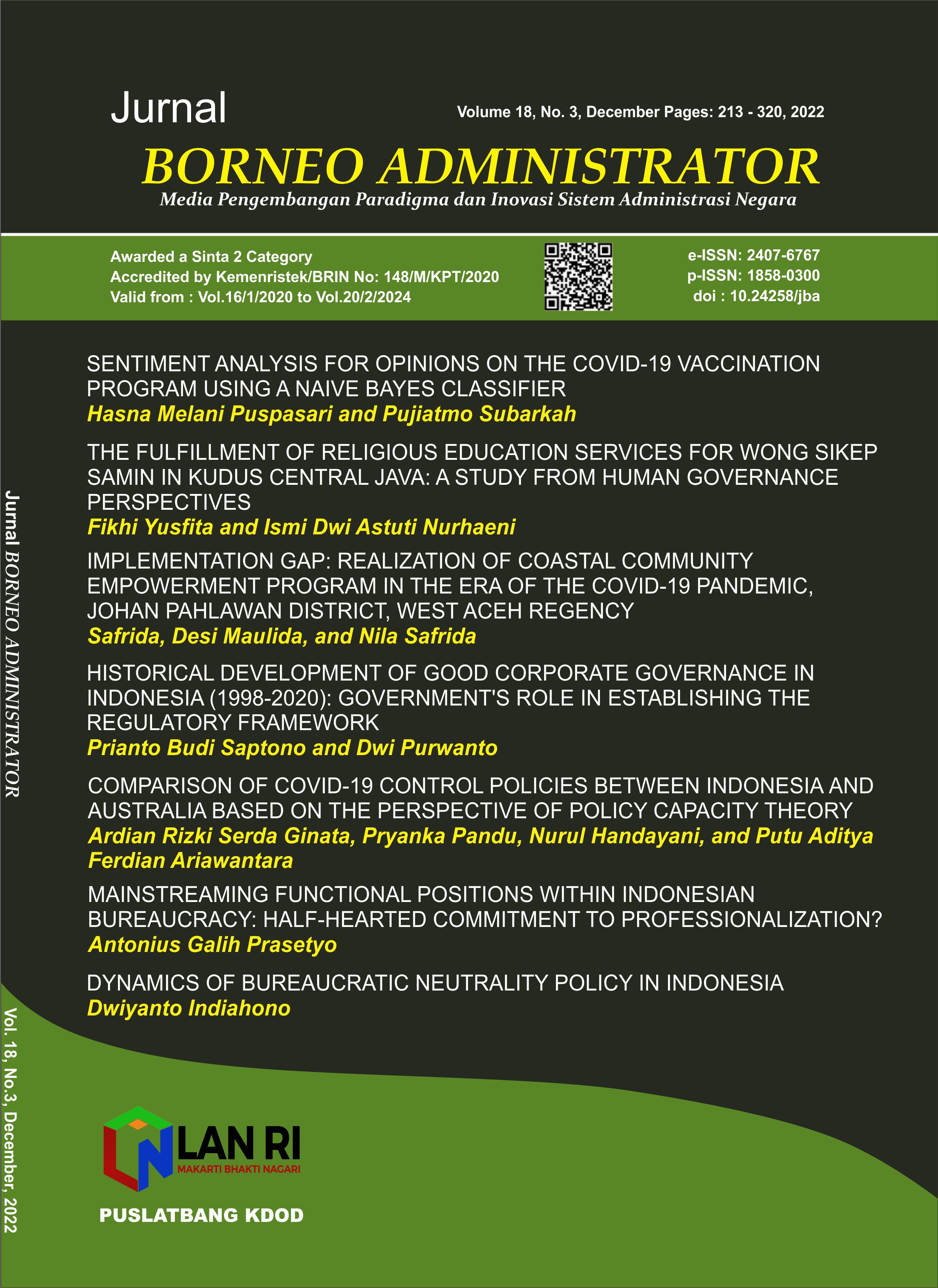
Dynamics of Bureaucratic Neutrality Policy in Indonesia
DOI:
https://doi.org/10.24258/jba.v18i3.1104Abstract
This research reveals the dynamics of relations between civil servants and political parties in Indonesia from the Old Order, the New Order to the Reform Era. This study is an important effort to observe the dynamics of civil servants and political parties in Indonesia and create social learning contributions for the betterment of the country. A qualitative research method with secondary data/literature study was selected. The literature study examined policy documents related to bureaucratic neutrality in the Old Order, New Order, and Reform Era. The study data were collected through documentation, including data from papers related to bureaucratic neutrality in the periods above. The study shows that the idea of bureaucratic neutrality had been initiated since the Old Order, disappeared during the New Order, and was reborn in the Reform Era. The challenge of bureaucratic neutrality was the pull of political parties in the parliamentary system during the Old Order, the power of bureaucracy to be the political supporters of the rulers during the New Order, and the contestation of presidential and regional head elections in the Reform Era, which often tests bureaucratic neutrality
Downloads
Downloads
Published
How to Cite
Issue
Section
License
Policy for Journals That Offer Open Access
Authors who publish with this journal agree to the following terms:
- Authors retain copyright and grant the journal right of first publication with the work simultaneously licensed under a Creative Commons Attribution-NonCommercial-ShareAlike 4.0 International License that allows others to share the work with an acknowledgement of the work's authorship and initial publication in this journal.
- Authors are able to enter into separate, additional contractual arrangements for the non-exclusive distribution of the journal's published version of the work (e.g., post it to an institutional repository or publish it in a book), with an acknowledgement of its initial publication in this journal.
- Authors are permitted and encouraged to post their work online (e.g., in institutional repositories or on their website) prior to and during the submission process, as it can lead to productive exchanges, as well as earlier and greater citation of published work (See The Effect of Open Access).