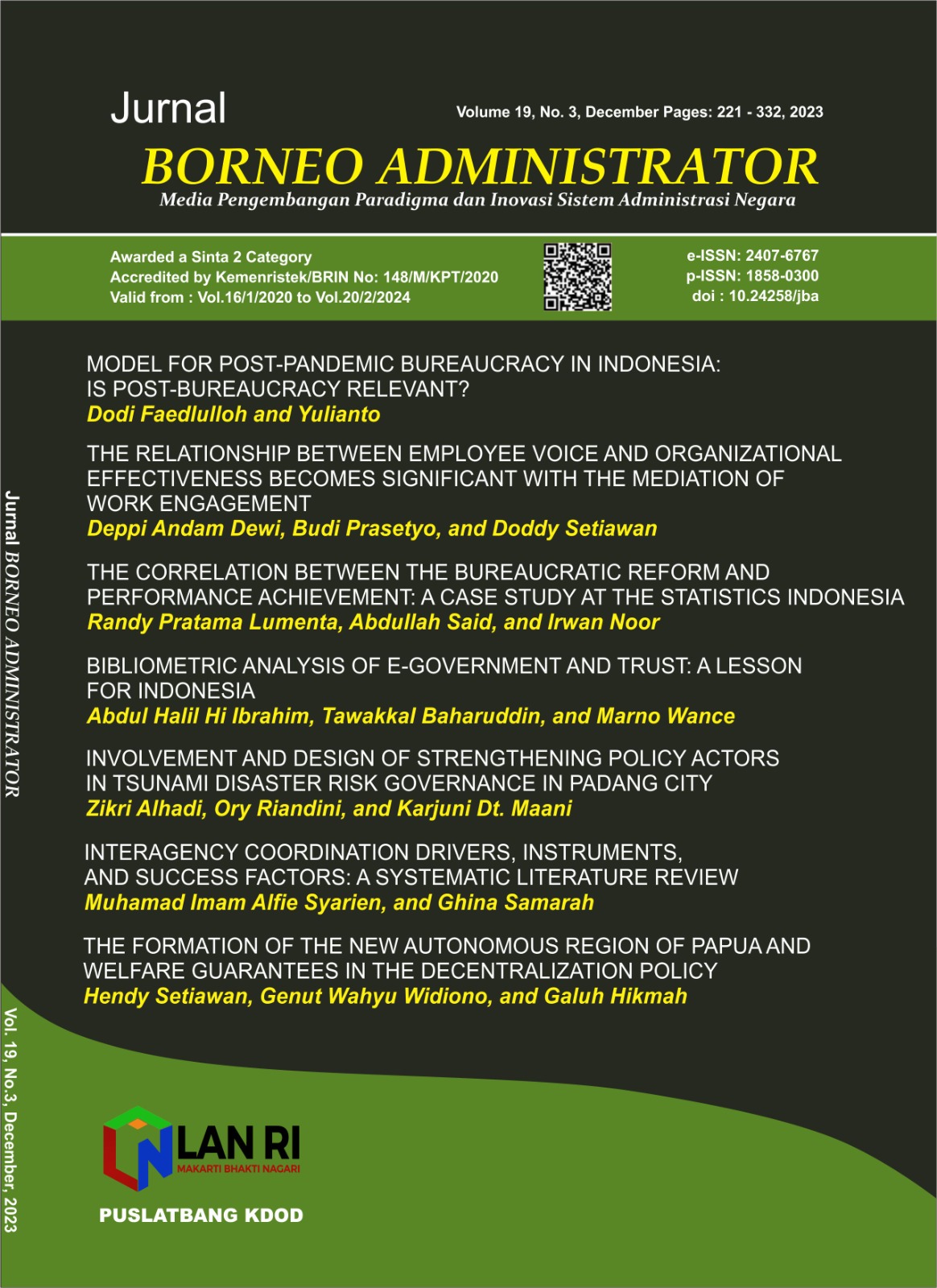
Involvement and Design of Strengthening Policy Actors in Tsunami Disaster Risk Governance in Padang City
DOI:
https://doi.org/10.24258/jba.v19i3.1164Abstract
This paper is based on research that describes the involvement and design of strengthening policy actors in tsunami risk governance in Padang City. This paper also describes the policy design for strengthening disaster risk governance based on these actors' participation in research findings. The approach used in this research is a qualitative method with data collection through in-depth interviews, focus group discussions, and data studies. Data processing and analysis were performed using matrix coding and model design on the NVivo 12 Plus. The research findings illustrate that the involvement of local government actors is at the highest level in disaster risk governance policies in Padang City. Furthermore, non-governmental organisations, communities, vertical governments, digital communities, and business sector actors have successive roles in disaster risk policies. Recommendations for the involvement of local communities can be made by increasing capacity and engaging in disaster risk governance actions. On the other hand, the recommendation of non-governmental organisations (NGOs') participation should be maintained and facilitated by designing regulations that reduce the risk of a tsunami disaster. Local governments are involved in strengthening budgeting, coordination, and partnerships as the leading sector in disaster governance.
Downloads
Downloads
Published
How to Cite
Issue
Section
License
Policy for Journals That Offer Open Access
Authors who publish with this journal agree to the following terms:
- Authors retain copyright and grant the journal right of first publication with the work simultaneously licensed under a Creative Commons Attribution-NonCommercial-ShareAlike 4.0 International License that allows others to share the work with an acknowledgement of the work's authorship and initial publication in this journal.
- Authors are able to enter into separate, additional contractual arrangements for the non-exclusive distribution of the journal's published version of the work (e.g., post it to an institutional repository or publish it in a book), with an acknowledgement of its initial publication in this journal.
- Authors are permitted and encouraged to post their work online (e.g., in institutional repositories or on their website) prior to and during the submission process, as it can lead to productive exchanges, as well as earlier and greater citation of published work (See The Effect of Open Access).