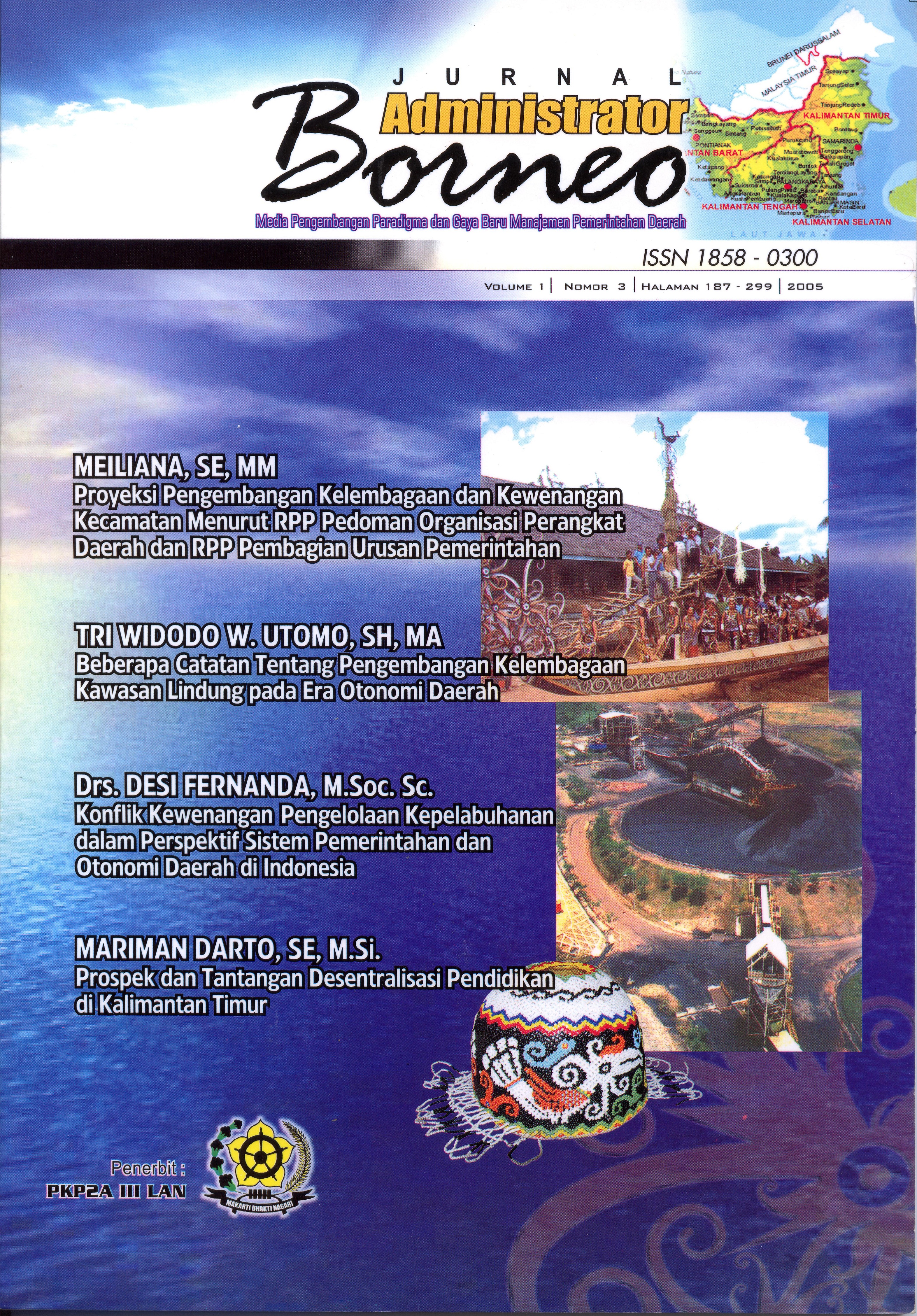
PROSPEK DAN TANTANGAN DESENTRALISASI PENDIDIKAN DI KALIMANTAN TIMUR
DOI:
https://doi.org/10.24258/jba.v1i3.12Abstract
The decentralization of educational functions is one of crucial issues in the current era. The practice of centralized education management in the previous period constituted the main obstacle in recuperating educational quality nation-wide, and simultaneously, has tended to weaken the capacity of local government. In line with the policy of extended decentralization, most of education authorities are supposed to be reassigned to the District/City Government, or even to the school. It is believed to be the best way to generate the following advantages: improving decision-making process; promoting education management based on local content and local characteristics; and empowering the potency of local people. As one of the richest provinces in Indonesia, East Kalimantan Province is demanded to realize such education reform. The main challenge is how to strengthen the role of education in budding quality, relevance, management efficiency, and equity of education access for all community members. How does East Kalimantan Province implement such challenges, and what does decentralization of educational functions look like? This paper tries to scrutinize those queries.Downloads
Download data is not yet available.
Downloads
Published
2014-01-22
How to Cite
Darto, M. (2014). PROSPEK DAN TANTANGAN DESENTRALISASI PENDIDIKAN DI KALIMANTAN TIMUR. Jurnal Borneo Administrator, 1(3). https://doi.org/10.24258/jba.v1i3.12
Issue
Section
Articles
License
Copyright (c) 2014 Author(s)

This work is licensed under a Creative Commons Attribution-NonCommercial-ShareAlike 4.0 International License.
Policy for Journals That Offer Open Access
Authors who publish with this journal agree to the following terms:
- Authors retain copyright and grant the journal right of first publication with the work simultaneously licensed under a Creative Commons Attribution-NonCommercial-ShareAlike 4.0 International License that allows others to share the work with an acknowledgement of the work's authorship and initial publication in this journal.
- Authors are able to enter into separate, additional contractual arrangements for the non-exclusive distribution of the journal's published version of the work (e.g., post it to an institutional repository or publish it in a book), with an acknowledgement of its initial publication in this journal.
- Authors are permitted and encouraged to post their work online (e.g., in institutional repositories or on their website) prior to and during the submission process, as it can lead to productive exchanges, as well as earlier and greater citation of published work (See The Effect of Open Access).