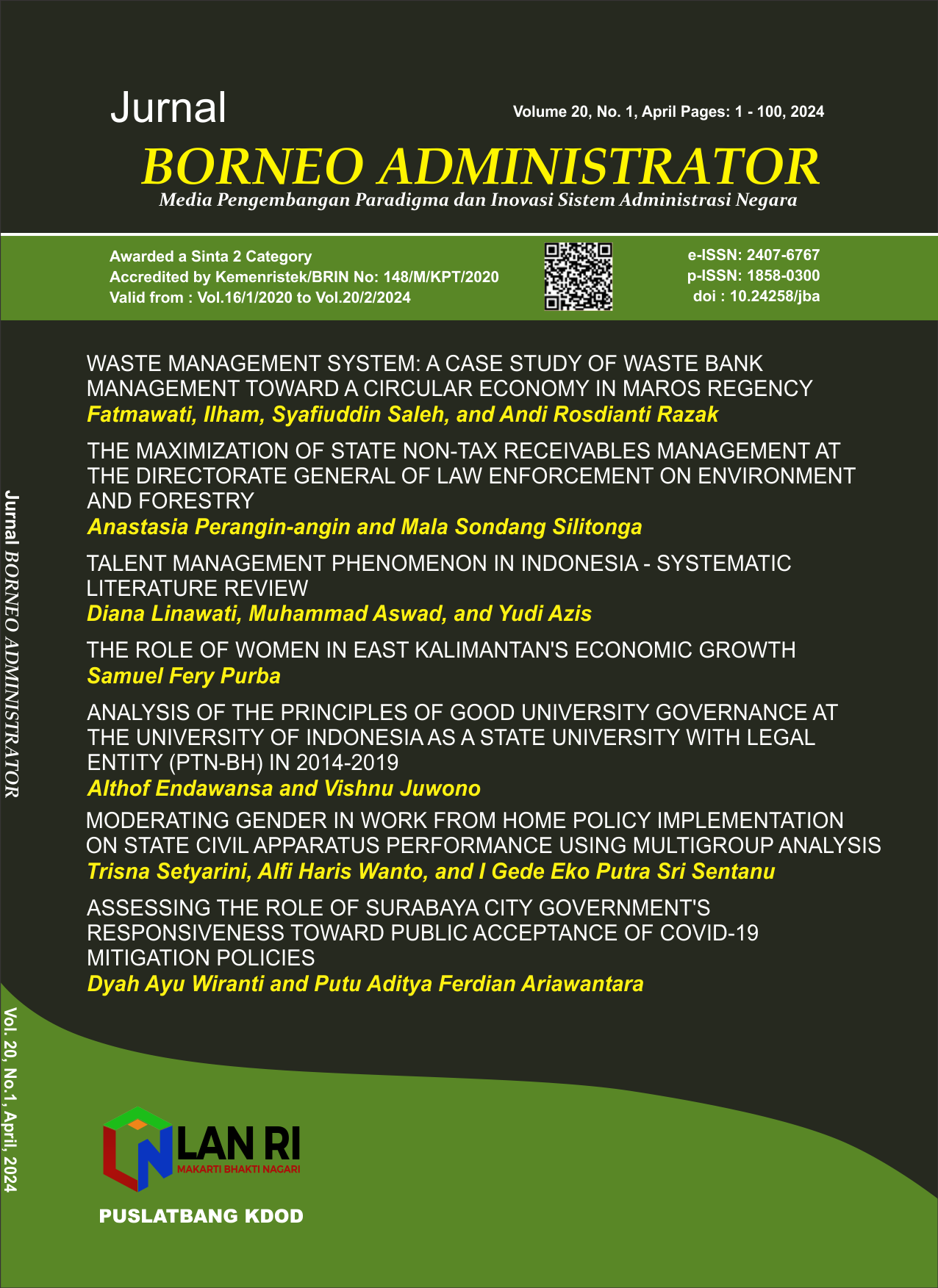
The Maximization of State Non-Tax Receivables Management at The Directorate General of Law Enforcement on Environment and Forestry
DOI:
https://doi.org/10.24258/jba.v20i1.1223Abstract
This research investigates the problems encountered in the receivables management process by outlining the main strategies at the Directorate General of Environmental and Forestry Law Enforcement (Dirjen PHLHK). This research uses a qualitative approach and case study method. The results of this study indicate that the process of managing receivables at Dirjen PHLHK has not been optimal due to the absence of a formal SOP for receivables management, limited human resources, inefficient coordination and cooperation between internal divisions and external institutions, ineffective internal control, and inadequate facilities. Therefore, the efforts to optimize accounts receivable management at Dirjen PHLHK include making formal SOPs, making operational guidelines and technical guidelines for the implementation of receivables management, compiling a more comprehensive workload according to position class, recruiting officers who meet the qualifications of tasks and functions related to accounts receivable management, increasing awareness among related parties, implementing a more active internal control system and developing facilities and infrastructure in the implementation of receivables management by implementing a more sophisticated and sustainable technology system. The implications of the study are thoroughly discussed.
Downloads
Downloads
Published
How to Cite
Issue
Section
License
Policy for Journals That Offer Open Access
Authors who publish with this journal agree to the following terms:
- Authors retain copyright and grant the journal right of first publication with the work simultaneously licensed under a Creative Commons Attribution-NonCommercial-ShareAlike 4.0 International License that allows others to share the work with an acknowledgement of the work's authorship and initial publication in this journal.
- Authors are able to enter into separate, additional contractual arrangements for the non-exclusive distribution of the journal's published version of the work (e.g., post it to an institutional repository or publish it in a book), with an acknowledgement of its initial publication in this journal.
- Authors are permitted and encouraged to post their work online (e.g., in institutional repositories or on their website) prior to and during the submission process, as it can lead to productive exchanges, as well as earlier and greater citation of published work (See The Effect of Open Access).