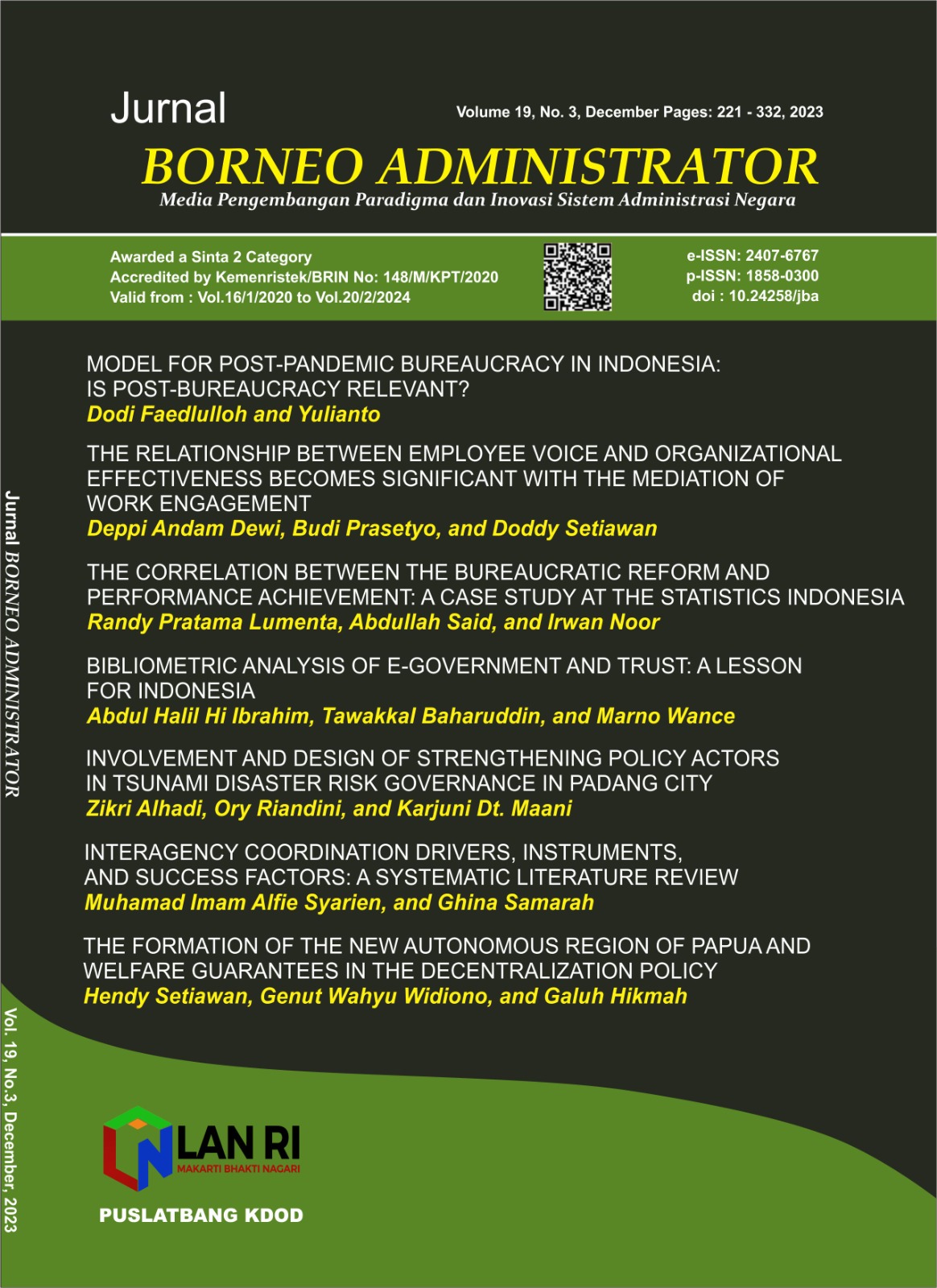
Model for Post-Pandemic Bureaucracy in Indonesia: Is Post-Bureaucracy Relevant?
DOI:
https://doi.org/10.24258/jba.v19i3.1228Abstract
This research aims to investigate alternative post-pandemic bureaucratic models. This research contributes to the theoretical and practical knowledge of appropriate bureaucratic models during the pandemic and its aftermath. This research employed a qualitative method with a constructivist approach through a comprehensive literature review from credible sources, including scientific journals, books, and information from official government websites or international institutions. The results show that post-bureaucracy can be an antithesis and alternative to Indonesia's dominant Weberian bureaucratic paradigm. While the Weberian bureaucracy relies on rigid rules and structures, post-bureaucracy thrives on flexibility, citizencenteredness, open organizational boundaries, and a focus on people. These postbureaucratic characteristics are particularly relevant to the Indonesian context. The practical implication is that the Indonesian government needs to consider the postbureaucratic model to initiate a transformative change in bureaucracy in response to the evolving challenges posed by the pandemic and its aftermath.
Downloads
Downloads
Published
How to Cite
Issue
Section
License
Policy for Journals That Offer Open Access
Authors who publish with this journal agree to the following terms:
- Authors retain copyright and grant the journal right of first publication with the work simultaneously licensed under a Creative Commons Attribution-NonCommercial-ShareAlike 4.0 International License that allows others to share the work with an acknowledgement of the work's authorship and initial publication in this journal.
- Authors are able to enter into separate, additional contractual arrangements for the non-exclusive distribution of the journal's published version of the work (e.g., post it to an institutional repository or publish it in a book), with an acknowledgement of its initial publication in this journal.
- Authors are permitted and encouraged to post their work online (e.g., in institutional repositories or on their website) prior to and during the submission process, as it can lead to productive exchanges, as well as earlier and greater citation of published work (See The Effect of Open Access).