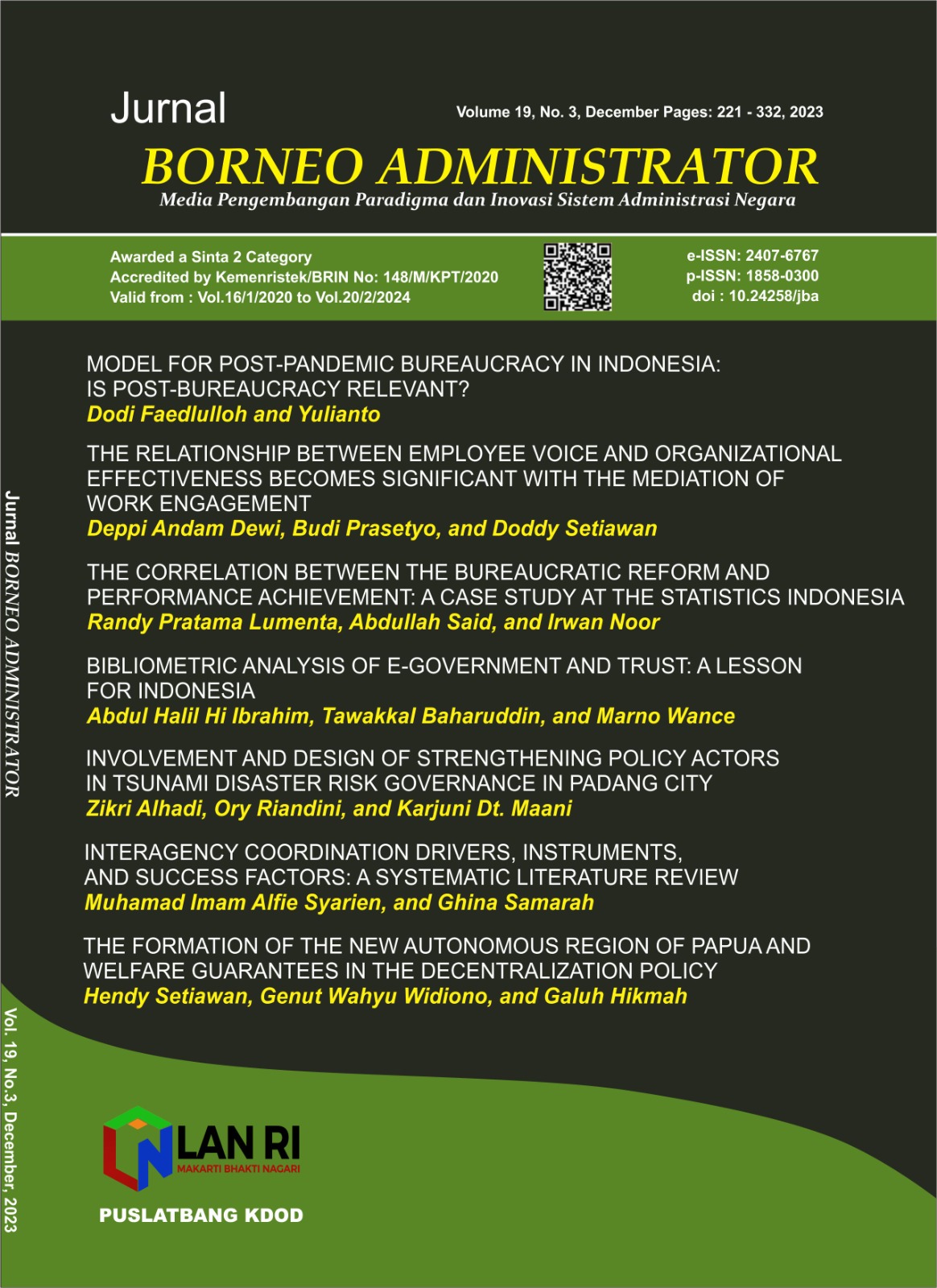
The Correlation Between the Bureaucratic Reform and Performance Achievement: A Case Study at the Statistics Indonesia
DOI:
https://doi.org/10.24258/jba.v19i3.1272Abstract
This study investigates the correlation between bureaucratic reform and performance due to conflicting theories about existing phenomena. In theory, it is posited that implementing bureaucratic reform should enhance performance by addressing various bureaucratic issues, resulting in a positive or directly proportional correlation. However, empirical evidence indicates persistent problems in bureaucratic performance, including public service-related complaints and other issues within the government. The government's proclamation of bureaucratic reform is expected to address these existing problems and facilitate the realization of Indonesia's goal of establishing a world-class government. Understanding the correlation between bureaucratic reform and performance achievement is crucial for designing effective programs to achieve the goals of bureaucratic reform. Given that certain conditions regarding bureaucratic reform within the work units of BPS (Statistics Indonesia) have not yet received national recognition, examining the correlation between bureaucratic reform and performance achievement is of utmost importance for BPS. A quantitative approach with correlation analysis was employed as the analytical method. The study's results reveal a positive correlation between bureaucratic reform and performance achievement, albeit not highly intense. This suggests that the variation in performance, which can be attributed to the implementation of bureaucratic reform, is not highly significant. Consequently, it becomes apparent that other factors beyond bureaucratic reform substantially influence performance at BPS. Therefore, BPS must optimize the implementation of bureaucratic reform to enhance productivity and attain superior performance.
Downloads
Downloads
Published
How to Cite
Issue
Section
License
Policy for Journals That Offer Open Access
Authors who publish with this journal agree to the following terms:
- Authors retain copyright and grant the journal right of first publication with the work simultaneously licensed under a Creative Commons Attribution-NonCommercial-ShareAlike 4.0 International License that allows others to share the work with an acknowledgement of the work's authorship and initial publication in this journal.
- Authors are able to enter into separate, additional contractual arrangements for the non-exclusive distribution of the journal's published version of the work (e.g., post it to an institutional repository or publish it in a book), with an acknowledgement of its initial publication in this journal.
- Authors are permitted and encouraged to post their work online (e.g., in institutional repositories or on their website) prior to and during the submission process, as it can lead to productive exchanges, as well as earlier and greater citation of published work (See The Effect of Open Access).