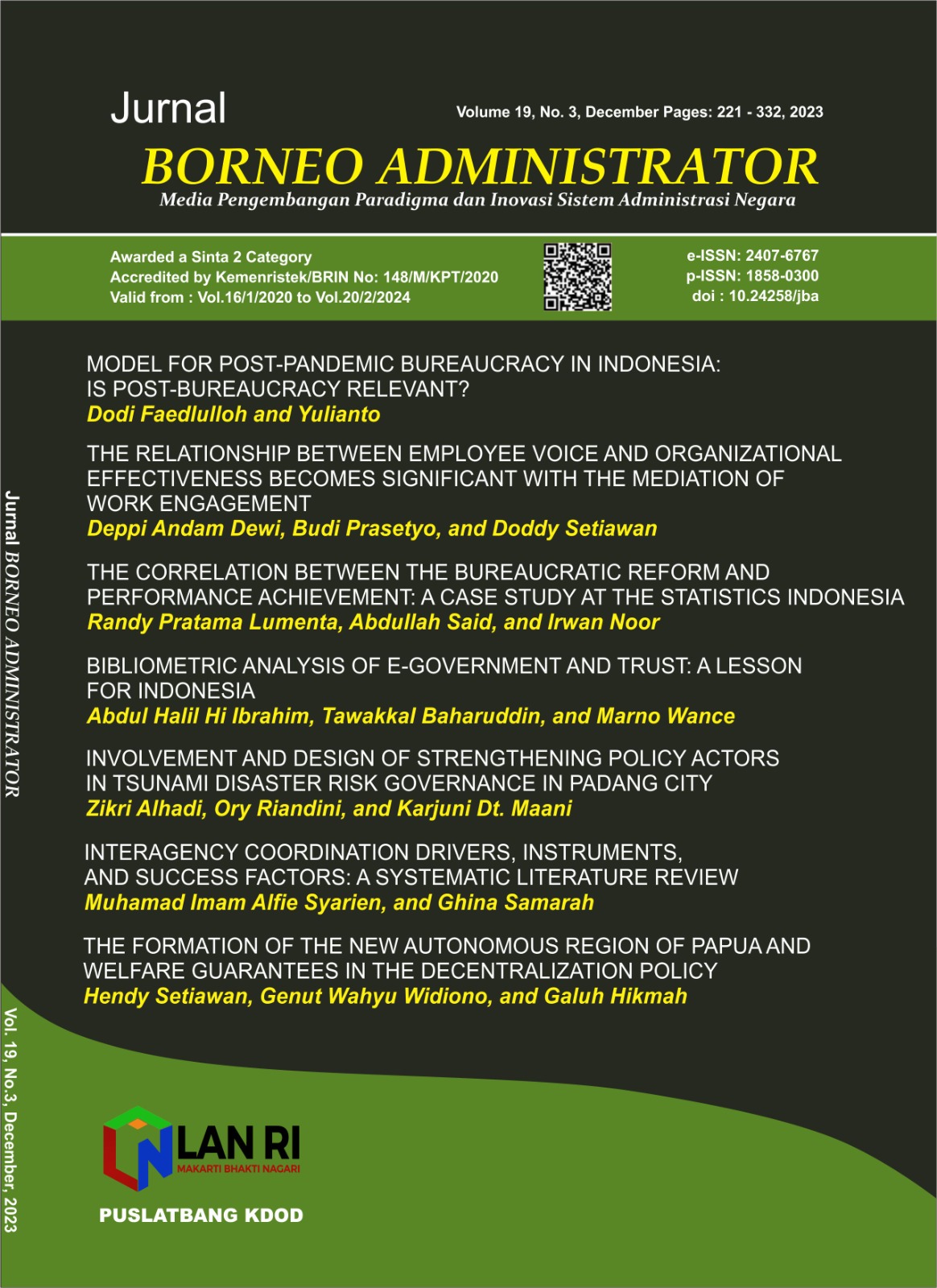
Interagency Coordination Drivers, Instruments, and Success Factors: A Systematic Literature Review
DOI:
https://doi.org/10.24258/jba.v19i3.1296Abstract
Interagency coordination remains a classic and ever-expansive topic in public administration theory. Often considered the key to successful policy or program implementation, coordination also presents its complexities. Research on this subject continues to evolve regarding its sheer numbers, the diversity of locations, problems, and sectors of concern, and the type of government agencies being the subject. This article employed a systematic literature review to identify and analyze coordination drivers, instruments, and critical success factors associated with coordination. The study focused on original articles published from 2010 to 2021 in relevant journals indexed by Scopus. The review revealed that coordination can be driven by problems, institutions, or a combination of both simultaneously. Coordination instruments may involve one or a variety of interventions from governance and structure, systems and processes, policies and agreements, or the engagement of intermediaries. Factors of institutional settings, managerial capacity, and the accuracy of coordination strategies also determine the success of this intervention.
Downloads
Downloads
Published
How to Cite
Issue
Section
License
Policy for Journals That Offer Open Access
Authors who publish with this journal agree to the following terms:
- Authors retain copyright and grant the journal right of first publication with the work simultaneously licensed under a Creative Commons Attribution-NonCommercial-ShareAlike 4.0 International License that allows others to share the work with an acknowledgement of the work's authorship and initial publication in this journal.
- Authors are able to enter into separate, additional contractual arrangements for the non-exclusive distribution of the journal's published version of the work (e.g., post it to an institutional repository or publish it in a book), with an acknowledgement of its initial publication in this journal.
- Authors are permitted and encouraged to post their work online (e.g., in institutional repositories or on their website) prior to and during the submission process, as it can lead to productive exchanges, as well as earlier and greater citation of published work (See The Effect of Open Access).