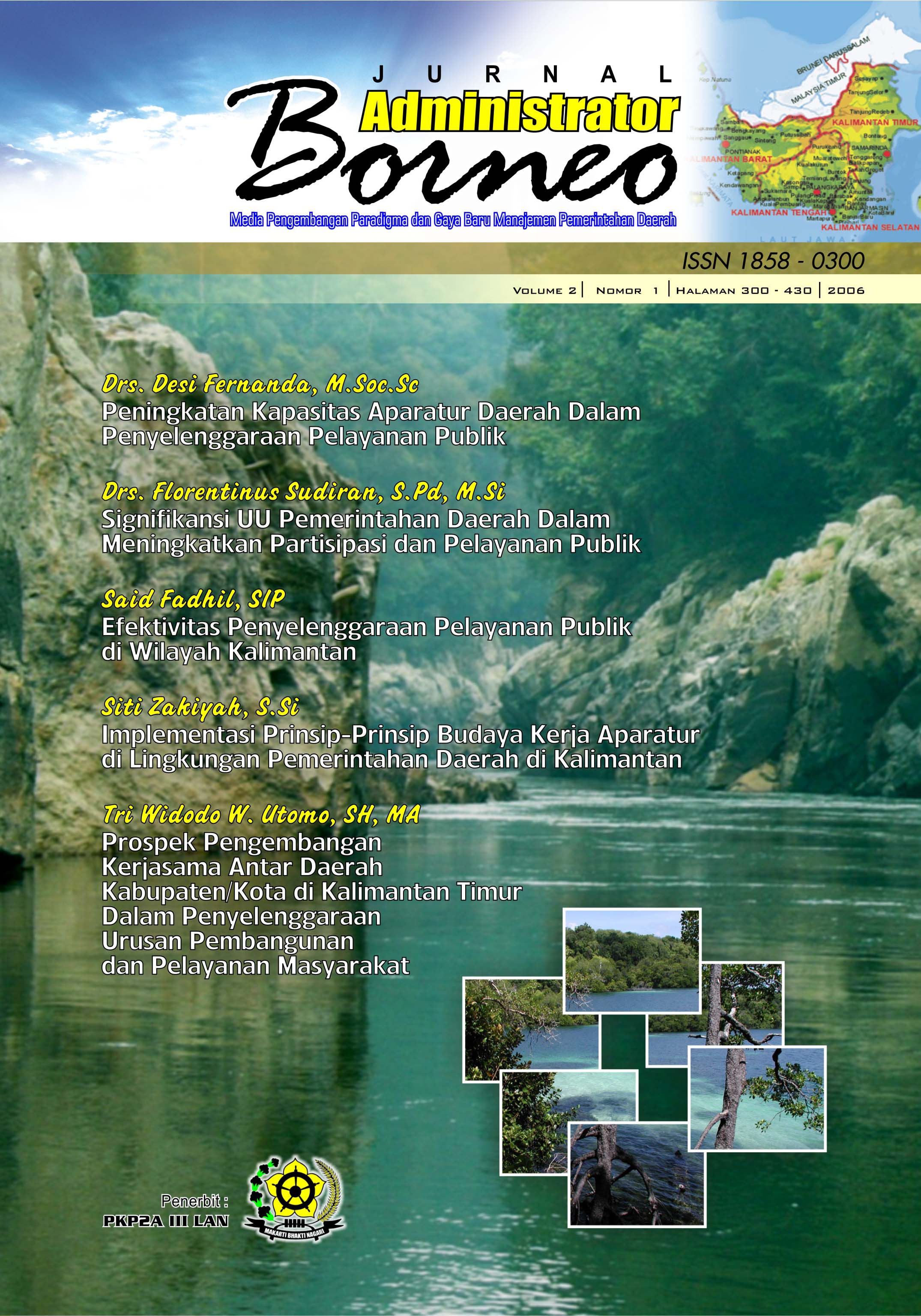
PENINGKATAN KAPASITAS APARATUR DAERAH DALAM PENYELENGGARAAN PELAYANAN PUBLIK
DOI:
https://doi.org/10.24258/jba.v2i1.13Abstract
The main purpose of regional autonomy is delivering better, faster, cheaper and closer public services as well as improving public welfare. To adroitly provide high-quality public service, both government officials and community members need to comprehend the basic concept and scope of services, and the principles of performance measurement regarding deliverance of public service. Besides, philosophical grounds on why government should carry out public services tasks are really matter to be recognized. Based on such common understanding, this paper offers some strategies concerning capacity building for service provider, i.e. government apparatus.Keywords: pelayanan publik, kapasitas aparatur, desentralisasi.
Downloads
Download data is not yet available.
Downloads
How to Cite
Fernanda, D. D. (2014). PENINGKATAN KAPASITAS APARATUR DAERAH DALAM PENYELENGGARAAN PELAYANAN PUBLIK. Jurnal Borneo Administrator, 2(1). https://doi.org/10.24258/jba.v2i1.13
Issue
Section
Articles
License
Copyright (c) 2014 Author(s)

This work is licensed under a Creative Commons Attribution-NonCommercial-ShareAlike 4.0 International License.
Policy for Journals That Offer Open Access
Authors who publish with this journal agree to the following terms:
- Authors retain copyright and grant the journal right of first publication with the work simultaneously licensed under a Creative Commons Attribution-NonCommercial-ShareAlike 4.0 International License that allows others to share the work with an acknowledgement of the work's authorship and initial publication in this journal.
- Authors are able to enter into separate, additional contractual arrangements for the non-exclusive distribution of the journal's published version of the work (e.g., post it to an institutional repository or publish it in a book), with an acknowledgement of its initial publication in this journal.
- Authors are permitted and encouraged to post their work online (e.g., in institutional repositories or on their website) prior to and during the submission process, as it can lead to productive exchanges, as well as earlier and greater citation of published work (See The Effect of Open Access).