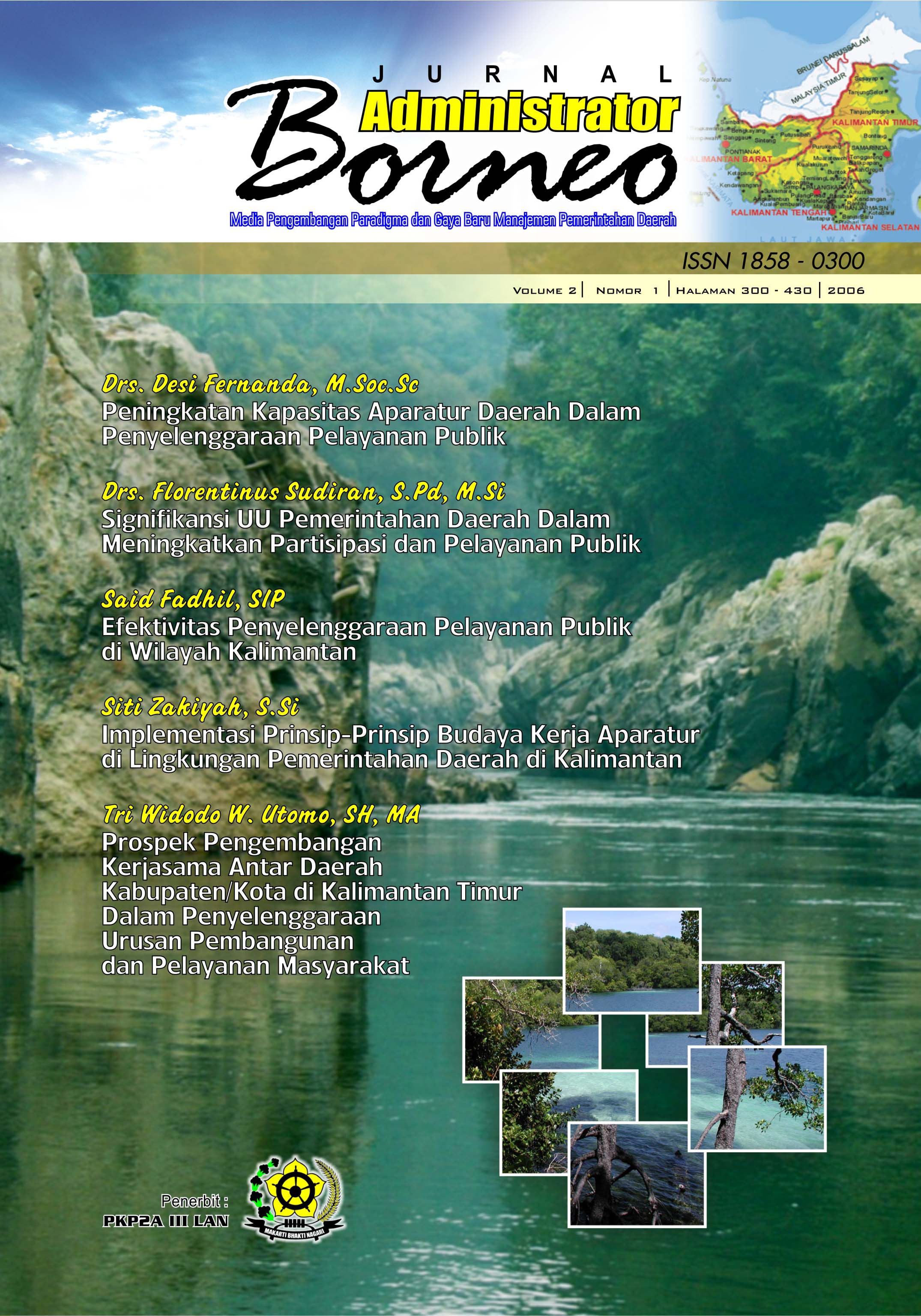
SIGNIFIKANSI UU PEMERINTAHAN DAERAH DALAM MENINGKATKAN PARTISIPASI DAN PELAYANAN PUBLIK
DOI:
https://doi.org/10.24258/jba.v2i1.14Abstract
The major spirit of the regional autonomy laws of 1999 and 2004 is to empower local potencies. The content and implementation of the laws, however, is perceived to be incompatible to the efforts of promoting people’s engagement in the development processes. The autonomy of arranging household affairs, in fact, goes primarily to and conducted by local authorities. Consequently, the laws have failed to realize the idea of community-centered local government. In the future, therefore, public participation should be reconfirmed not as political opportunity offered by government’s compassion, but as basic service embedded in the government’s functions. Based on theoretical framework, this paper elucidates how could regional autonomy law be an enabling instrument of advancing public participation.Keyword: pemerintahan daerah, partisipasi publik
Downloads
Download data is not yet available.
Downloads
How to Cite
Sudiran, F. (2014). SIGNIFIKANSI UU PEMERINTAHAN DAERAH DALAM MENINGKATKAN PARTISIPASI DAN PELAYANAN PUBLIK. Jurnal Borneo Administrator, 2(1). https://doi.org/10.24258/jba.v2i1.14
Issue
Section
Articles
License
Copyright (c) 2014 Author(s)

This work is licensed under a Creative Commons Attribution-NonCommercial-ShareAlike 4.0 International License.
Policy for Journals That Offer Open Access
Authors who publish with this journal agree to the following terms:
- Authors retain copyright and grant the journal right of first publication with the work simultaneously licensed under a Creative Commons Attribution-NonCommercial-ShareAlike 4.0 International License that allows others to share the work with an acknowledgement of the work's authorship and initial publication in this journal.
- Authors are able to enter into separate, additional contractual arrangements for the non-exclusive distribution of the journal's published version of the work (e.g., post it to an institutional repository or publish it in a book), with an acknowledgement of its initial publication in this journal.
- Authors are permitted and encouraged to post their work online (e.g., in institutional repositories or on their website) prior to and during the submission process, as it can lead to productive exchanges, as well as earlier and greater citation of published work (See The Effect of Open Access).