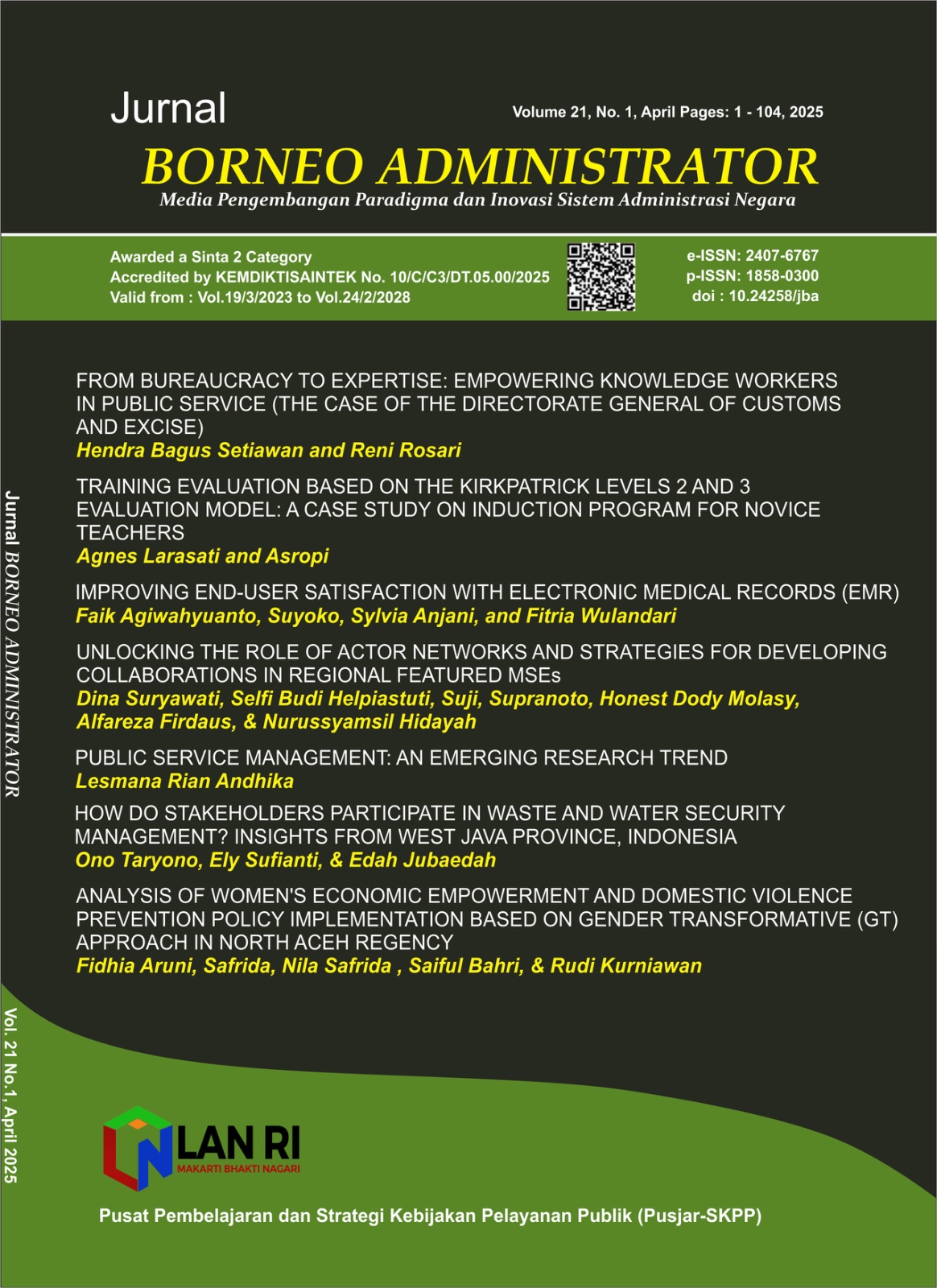
Improving End-User Satisfaction with Electronic Medical Records (EMR)
DOI:
https://doi.org/10.24258/jba.v21i1.1561Abstract
In today's interconnected world, it is widely understood that the effectiveness of health information system, a key component of information technology, depends on user satisfaction. In theory, electronic medical records (EMRs) were just a substitute for paper records; nevertheless, they have brought about substantial changes to the working circumstances of nurses and other professionals in the healthcare business. This study introduces a novel approach to improve user satisfaction within Semarang City context, which could potentially be implemented globally. The impact of modern technology was investigated by applying Aggelidis and Chatzouglou's End User Computing Satisfaction (EUCS) approaches to previous health information system (HIS). As a result, the fundamental model was enhanced by including a new factor known as "technology compatibility." This research aims to develop a perspective that can measure the degree of satisfaction experienced by end users. Italso investigates the influence of technical compatibility component, which was
recently included. Quantitative correlation was chosen as the approach for crosssectional analysis. Approximately 200 participants took part in the study effort. Every single survey question was structured into a five-point Likert scale, which was then reviewed again by specialists from a range of highly specialized fields. The explanatory factor analysis served as the foundation for the final structure of the measuring instrument. PLS-SEM, or partial least structural equation modeling, was used to analyze the data collected by stratified random sampling. As a result, the quality of information, the quality ofsystem, the supporting resources, and the compatibility of technology are all factors that impact user satisfaction. Implementing changes and breakthroughs in information system would increase overall user satisfaction
Downloads
Downloads
Published
How to Cite
Issue
Section
License
Policy for Journals That Offer Open Access
Authors who publish with this journal agree to the following terms:
- Authors retain copyright and grant the journal right of first publication with the work simultaneously licensed under a Creative Commons Attribution-NonCommercial-ShareAlike 4.0 International License that allows others to share the work with an acknowledgement of the work's authorship and initial publication in this journal.
- Authors are able to enter into separate, additional contractual arrangements for the non-exclusive distribution of the journal's published version of the work (e.g., post it to an institutional repository or publish it in a book), with an acknowledgement of its initial publication in this journal.
- Authors are permitted and encouraged to post their work online (e.g., in institutional repositories or on their website) prior to and during the submission process, as it can lead to productive exchanges, as well as earlier and greater citation of published work (See The Effect of Open Access).