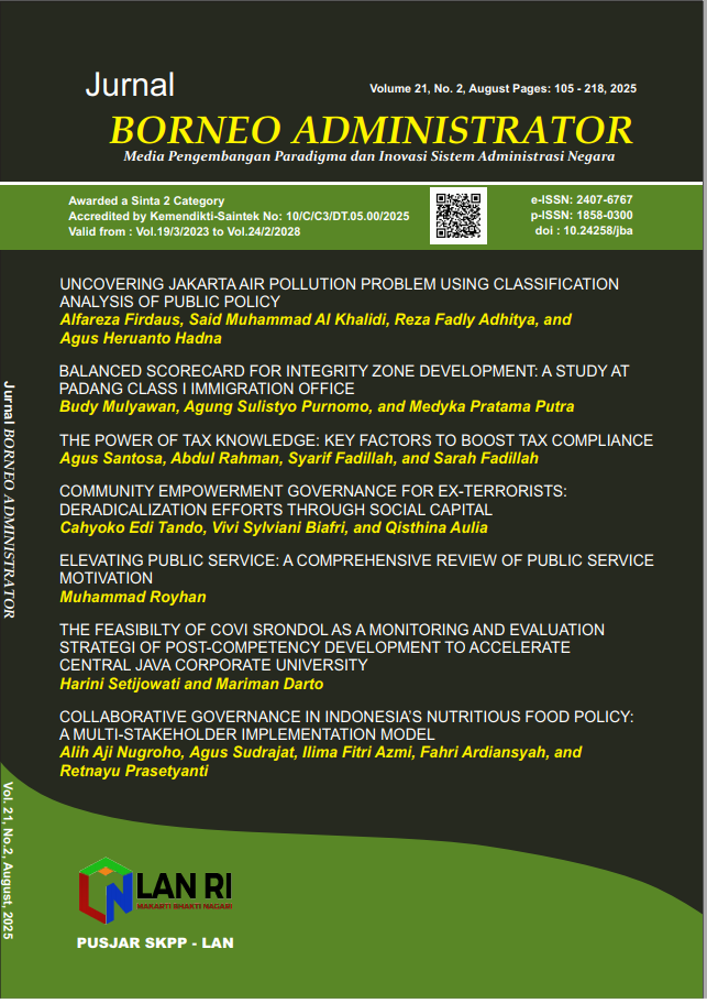
Uncovering Jakarta Air Pollution Problem Using Classification Analysis of Public Policy
DOI:
https://doi.org/10.24258/jba.v21i2.1595Abstract
This research aims to obtain formal problems and policy recommendations related to the air pollution phenomenon in Jakarta. Air pollution is a phenomenon of environmental quality degradation caused by several human activities. In the long run, emission load compounds produced by air pollution have been proven to threaten human survival. This issue needs to be addressed by the government by identifying the root causes and exploring alternative solutions to mitigate and prevent the worst impacts of air pollution. This research uses a qualitative research method of literature study by disseminating research results, reports, and news about air pollution in Jakarta. This research led to the formulation of a formal problem regarding the causes of air pollution in Jakarta, which is attributed to a linear increase in population, coinciding with the development of industries and the growing use of motorized vehicles, resulting in high exhaust emissions. The findings of this research indicate that motorized vehicles are the primary factor contributing to air pollution in Jakarta, as they are the main cause of high levels of air pollution in the city. This was identified using a multi-step process of public policy analysis, from classification analysis to the use of the pros and cons method. To overcome these problems, this research proposes policy recommendations that focus on increasing control over the number of vehicles through effective parking management in public spaces.
Downloads
Downloads
Published
How to Cite
Issue
Section
License
Copyright (c) 2025 Author(s)

This work is licensed under a Creative Commons Attribution-NonCommercial-ShareAlike 4.0 International License.
Policy for Journals That Offer Open Access
Authors who publish with this journal agree to the following terms:
- Authors retain copyright and grant the journal right of first publication with the work simultaneously licensed under a Creative Commons Attribution-NonCommercial-ShareAlike 4.0 International License that allows others to share the work with an acknowledgement of the work's authorship and initial publication in this journal.
- Authors are able to enter into separate, additional contractual arrangements for the non-exclusive distribution of the journal's published version of the work (e.g., post it to an institutional repository or publish it in a book), with an acknowledgement of its initial publication in this journal.
- Authors are permitted and encouraged to post their work online (e.g., in institutional repositories or on their website) prior to and during the submission process, as it can lead to productive exchanges, as well as earlier and greater citation of published work (See The Effect of Open Access).