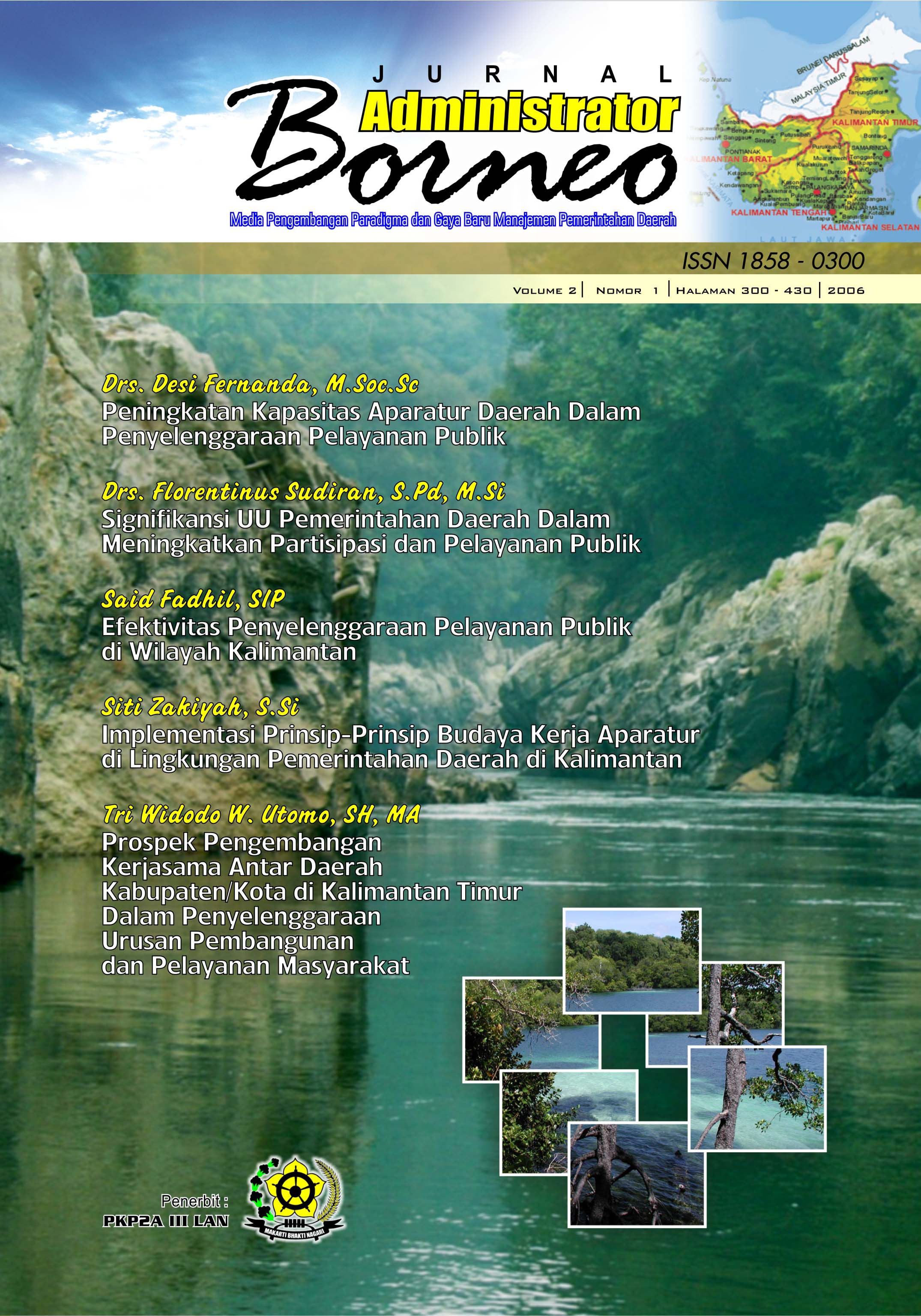
IMPLEMENTASI PRINSIP-PRINSIP BUDAYA KERJA APARATUR DI LINGKUNGAN PEMERINTAH DAERAH DI KALIMANTAN
DOI:
https://doi.org/10.24258/jba.v2i1.16Abstract
Empirical phenomena show that public accountability and government performance is moderately weak. In that sense, the superlative accomplishment of the state bureaucracy in implementing its task and responsibilities depends not only on the intellectual and managerial capacity, but also on the behavior and organizational culture. This implies that capacity building process has to embrace effort of constructing knowledge and skills as well as good attitude, evenly. In order to strengthen the dimension of work culture in a government institution, State Minister for Apparatus Empowerment (MENPAN) has released many policies, particularly Decree No. 25/KEP/M.PAN/4/2002 concerning Guidance of Extending Work Culture for State Apparatus, from which this paper identifies the current condition and analyses the implementation of work culture principles in the local government institutions in Kalimantan region.Keywords: budaya kerja, aparatur daerah, Kalimantan.
Downloads
Download data is not yet available.
Downloads
How to Cite
Zakiyah, S. (2014). IMPLEMENTASI PRINSIP-PRINSIP BUDAYA KERJA APARATUR DI LINGKUNGAN PEMERINTAH DAERAH DI KALIMANTAN. Jurnal Borneo Administrator, 2(1). https://doi.org/10.24258/jba.v2i1.16
Issue
Section
Articles
License
Copyright (c) 2014 Author(s)

This work is licensed under a Creative Commons Attribution-NonCommercial-ShareAlike 4.0 International License.
Policy for Journals That Offer Open Access
Authors who publish with this journal agree to the following terms:
- Authors retain copyright and grant the journal right of first publication with the work simultaneously licensed under a Creative Commons Attribution-NonCommercial-ShareAlike 4.0 International License that allows others to share the work with an acknowledgement of the work's authorship and initial publication in this journal.
- Authors are able to enter into separate, additional contractual arrangements for the non-exclusive distribution of the journal's published version of the work (e.g., post it to an institutional repository or publish it in a book), with an acknowledgement of its initial publication in this journal.
- Authors are permitted and encouraged to post their work online (e.g., in institutional repositories or on their website) prior to and during the submission process, as it can lead to productive exchanges, as well as earlier and greater citation of published work (See The Effect of Open Access).