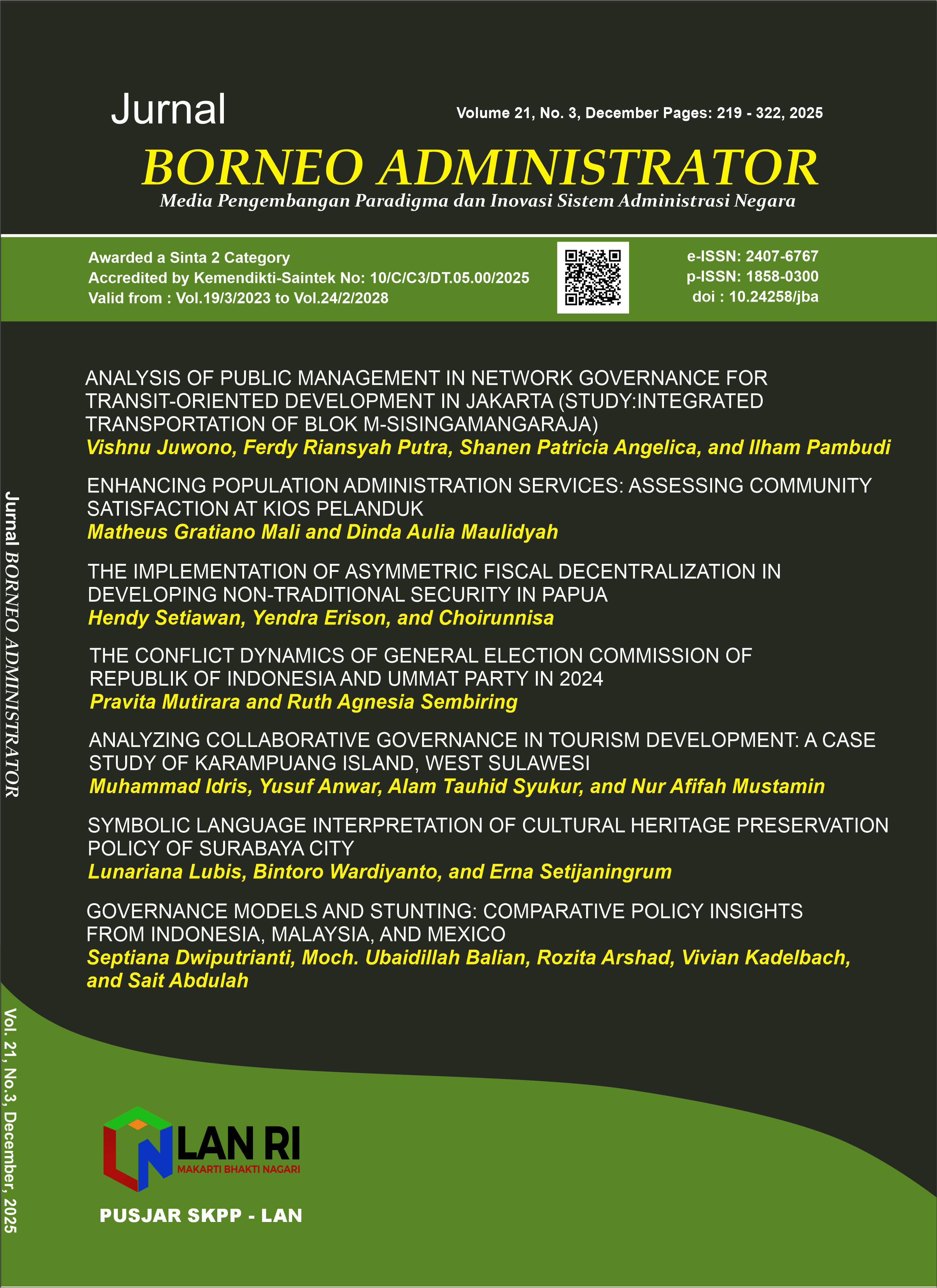
Analysis of Public Management in Network Governance for Transit-Oriented Development in Jakarta (Study: Integrated Transportation of Blok M - Sisingamangaraja)
DOI:
https://doi.org/10.24258/jba.v21i3.1620Abstract
The Provincial Government of DKI Jakarta is transitioning from Car-Oriented Development (COD) to Transit-Oriented Development (TOD), requiring effective public management in network governance to ensure transportation integration. However, challenges such as spatial flexibility, building regulations, incentives, and institutional coordination persist. This study analyzes public management within network governance in TOD areas, focusing on the Blok M-Sisingamangaraja corridor using Mu & de Jong’s (2016) framework. Employing a post-positivist qualitative approach, data collection includes in-depth interviews with ten informants and literature reviews. Findings indicate that network governance
implementation in TOD management is not entirely optimal, with three key gaps: (1) Awareness of the plurality of perceptions, interests, and objectives, (2) Metagovernance, process management, and network structuring, and (3) Searching for common ground. These challenges hinder effective collaboration between stakeholders, including the government, private sector, and local communities. The study concludes that enhanced public management strategies are needed to strengthen TOD governance in Jakarta, with recommendations including increasing stakeholder awareness, improving public participation, and establishing clear regulatory frameworks to enhance institutional coordination
Downloads
Downloads
Published
How to Cite
Issue
Section
License
Copyright (c) 2025 Author(s)

This work is licensed under a Creative Commons Attribution-NonCommercial-ShareAlike 4.0 International License.
Policy for Journals That Offer Open Access
Authors who publish with this journal agree to the following terms:
- Authors retain copyright and grant the journal right of first publication with the work simultaneously licensed under a Creative Commons Attribution-NonCommercial-ShareAlike 4.0 International License that allows others to share the work with an acknowledgement of the work's authorship and initial publication in this journal.
- Authors are able to enter into separate, additional contractual arrangements for the non-exclusive distribution of the journal's published version of the work (e.g., post it to an institutional repository or publish it in a book), with an acknowledgement of its initial publication in this journal.
- Authors are permitted and encouraged to post their work online (e.g., in institutional repositories or on their website) prior to and during the submission process, as it can lead to productive exchanges, as well as earlier and greater citation of published work (See The Effect of Open Access).