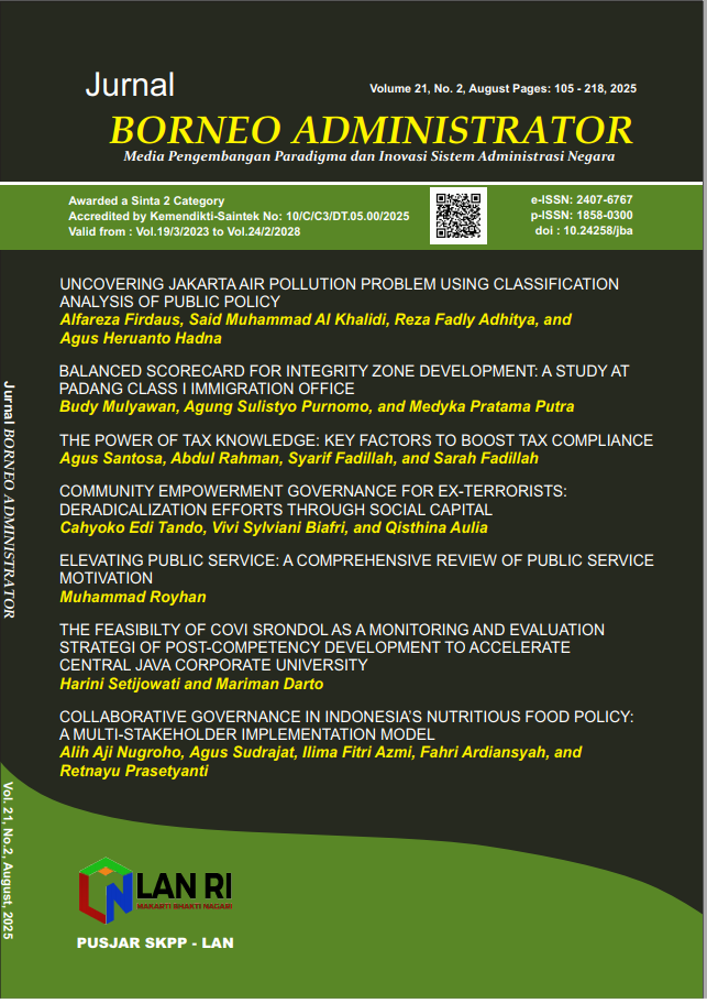
Community Empowerment Governance for Ex-Terrorists: Deradicalization Efforts Through Social Capital
DOI:
https://doi.org/10.24258/jba.v21i2.1624Abstract
Terrorism is an extraordinary crime that has a profoundly negative impact on society,
with the Cirebon area having the highest red-zone level in West Java Province. This
region is highly vulnerable to the spread of radical ideologies and terrorist activities
within the community. Ex-terrorists get difficulty in finding job after imprisonment
and face negative stigma from the society. Therefore, community governance
through empowerment of ex-terrorists is required. The research employs a qualitative
method, collecting data through interviews with six informants. The results of this
study indicate that, according to social capital theory, which encompasses three
dimensions, the process for ex-terrorist convicts involves soft-power strategies in the
form of microeconomic empowerment conducted by the Social Identification
(Idensos) Team and the Class 1 Probation Office (Bapas) in Cirebon. This approach
is applied because all of them are members of JAD, which has low economic
conditions. The second dimension, bridging, involves these former convicts actively
participating in community service activities, remaining open, and no longer
isolating themselves as part of efforts to eliminate societal stigma. The third
dimension, linking, involves collaboration with private companies in the agricultural
sector, including mentorship for agricultural activities. Looking forward, challenges
identified include the lack of local regulations in Cirebon aimed at preventing
terrorism and post-sentence rehabilitation, as well as the limited presence of counterterrorism activities in the media. These two challenges could provide useful input for future research.
Downloads
Downloads
Published
How to Cite
Issue
Section
License
Copyright (c) 2025 Author(s)

This work is licensed under a Creative Commons Attribution-NonCommercial-ShareAlike 4.0 International License.
Policy for Journals That Offer Open Access
Authors who publish with this journal agree to the following terms:
- Authors retain copyright and grant the journal right of first publication with the work simultaneously licensed under a Creative Commons Attribution-NonCommercial-ShareAlike 4.0 International License that allows others to share the work with an acknowledgement of the work's authorship and initial publication in this journal.
- Authors are able to enter into separate, additional contractual arrangements for the non-exclusive distribution of the journal's published version of the work (e.g., post it to an institutional repository or publish it in a book), with an acknowledgement of its initial publication in this journal.
- Authors are permitted and encouraged to post their work online (e.g., in institutional repositories or on their website) prior to and during the submission process, as it can lead to productive exchanges, as well as earlier and greater citation of published work (See The Effect of Open Access).