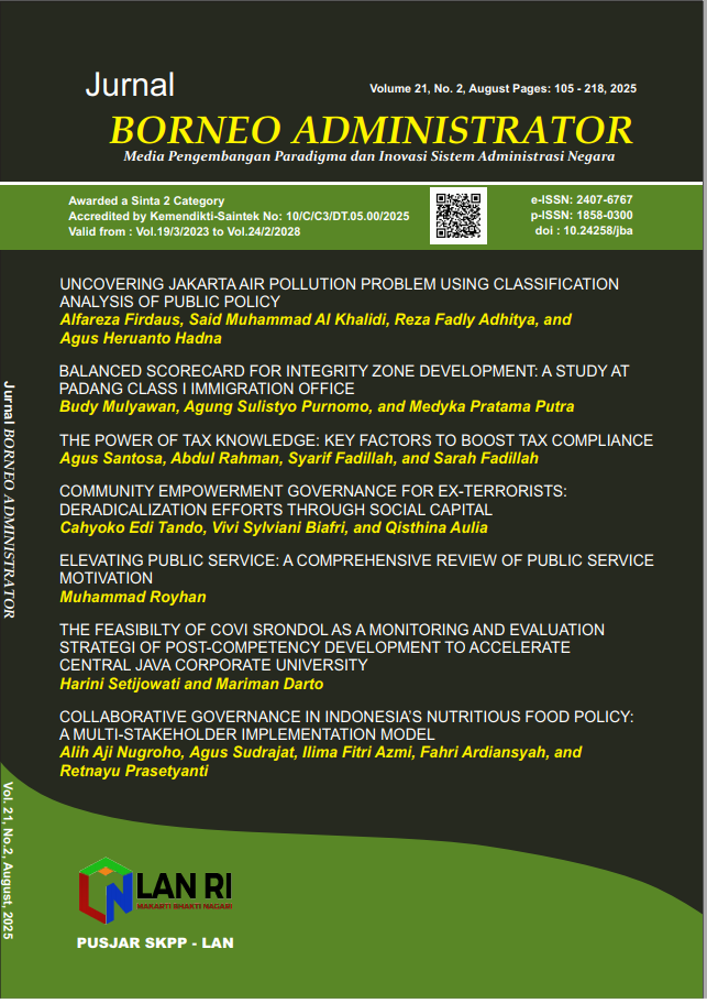
The Feasibility of COVI Srondol as a Monitoring and Evaluation Strategy of Post-Competency Development to Accelerate Central Java Corporate University
DOI:
https://doi.org/10.24258/jba.v21i2.1636Abstract
The monitoring and evaluation (M&E) of post-competency development (postcomdev) are essential for assessing its benefits and impacts, typically conducted by training organizers. A prior survey found that most health human resources (HR) participants created follow-up plans under their supervisors' guidance and documented their involvement using simple checklists. However, there is no systematic monitoring of post-comdev, nor are there updated procedures in place. To address these issues, COVI Srondol (Collaboration for monitoring and evaluation of post-competency development, a Strategy supported by Information and Technology, initiated in Srondol) will be designed as an alternative approach. This research explores the feasibility of developing the COVI Srondol strategy as a guideline for post-comdev M&E in accelerating the Central Java Corporate University (Jateng Corpu). Using a mixed-method approach, the authors identified the M&E models applied in 36 health offices, across Central Java and integrated them with qualitative analysis results from selected informants using purposive and snowball sampling techniques. The findings indicate that, despite a limited understanding of Jateng Corpu among informants, 50% agreed that post-comdev M&E could accelerate its development. While most health HR informants (64%) conducted post-comdev evaluations, these did not fully assess effectiveness or impact. Institutions such as the Regional Civil Service Agency (BKD), the Central Java Regional Human Resources Development Agency (BPSDMD), and the Health Training Center (Bapelkes) perform annual evaluations but lack proper monitoring
mechanisms. Thus, the COVI Srondol strategy presents an opportunity to be
developed as a comprehensive framework to enhance post-comdev M&E, ultimately supporting Jateng Corpu.
Downloads
Downloads
Published
How to Cite
Issue
Section
License
Copyright (c) 2025 Author(s)

This work is licensed under a Creative Commons Attribution-NonCommercial-ShareAlike 4.0 International License.
Policy for Journals That Offer Open Access
Authors who publish with this journal agree to the following terms:
- Authors retain copyright and grant the journal right of first publication with the work simultaneously licensed under a Creative Commons Attribution-NonCommercial-ShareAlike 4.0 International License that allows others to share the work with an acknowledgement of the work's authorship and initial publication in this journal.
- Authors are able to enter into separate, additional contractual arrangements for the non-exclusive distribution of the journal's published version of the work (e.g., post it to an institutional repository or publish it in a book), with an acknowledgement of its initial publication in this journal.
- Authors are permitted and encouraged to post their work online (e.g., in institutional repositories or on their website) prior to and during the submission process, as it can lead to productive exchanges, as well as earlier and greater citation of published work (See The Effect of Open Access).