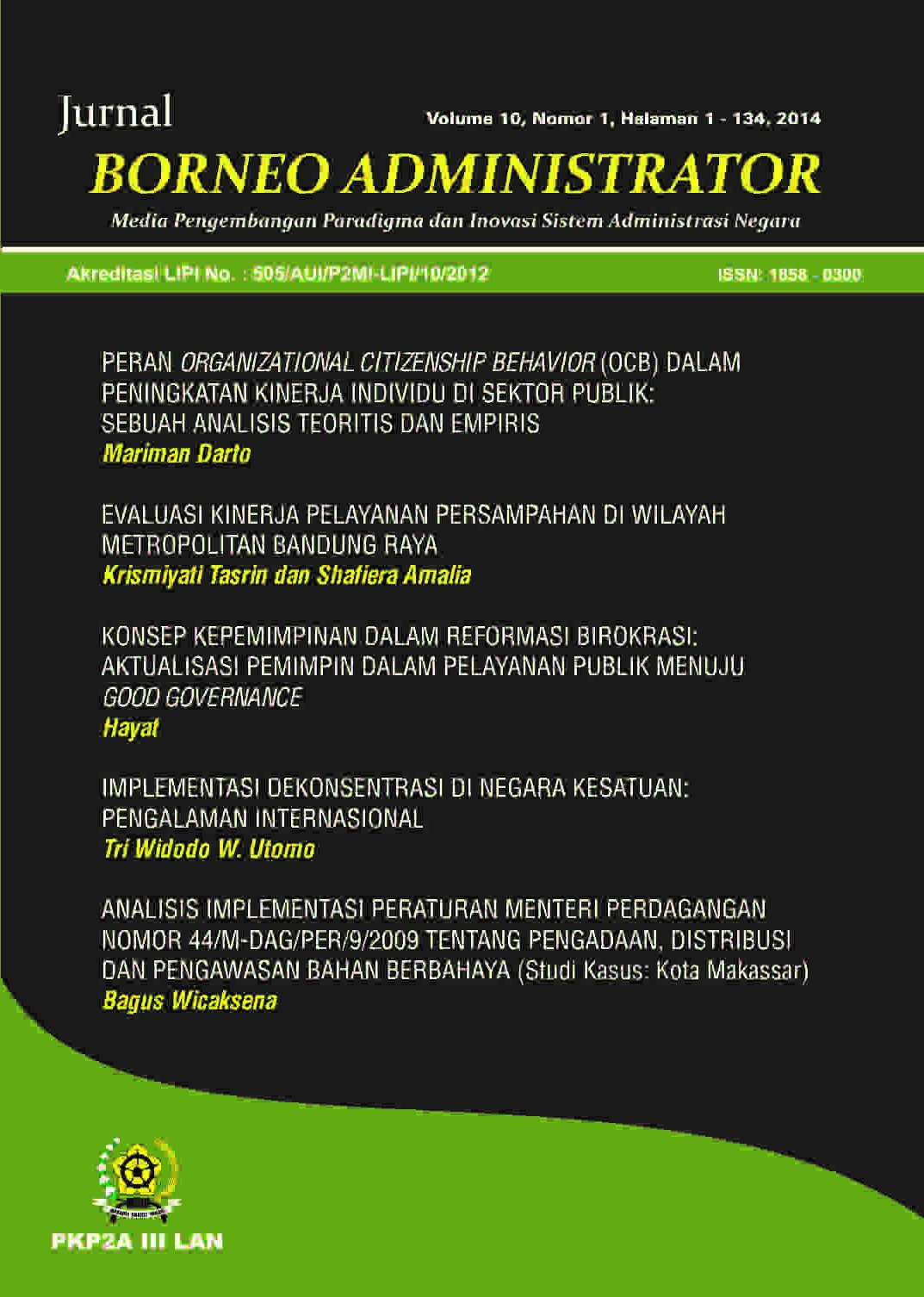
IMPLEMENTASI DEKONSENTRASI DI NEGARA KESATUAN: PENGALAMAN INTERNASIONAL (THE IMPLEMENTATION OF DECONCENTRATION IN THE UNITARY STATES : INTERNATIONAL EXPERIENCES)
DOI:
https://doi.org/10.24258/jba.v10i1.165Abstract
There is an assumption that instead of decentralization (devolution), unitary states prefer to choose deconcentration (administrative decentralization) as a tool to manage central-local government relationship. However, international experiences show that degree of decentralization varies among countries. Basically, this paper tries to elucidate the association between deconcentration and unitary states and provide some empirical evidences on the implementation of deconcentration in various countries. It also proposes three possible models of deconcentration for unitary states, and concludes with some notes to be considered in reformulating Indonesia's policy on decentralization. The method being deployed in this article is completely documentary studies. K uncris: deconcentration, decentralization, unitary states.
Ada sebuah asumsi bahwa negara dengan bentuk kesatuan lebih cenderung menerapkan dekonsentrasi atau desentralisasi administratif sebagai instrumen dalam mengelola hubungan pemerintah pusat dan daerah. Meskipun demikian, pengalaman internasional menunjukkan bahwa derajat desentralisasi di berbagai negara sangat beragam. Atas dasar itu, makalah ini bertujuan untuk menggali dan menganalisis hubungan antara dekonsentrasi dengan bentuk negara kesatuan, dan menyajikan bukti-bukti empiris tentang implementasi dekonsentrasi di berbagai negara. Tulisan ini juga menawarkan tiga model alternatif dekonsentrasi untuk negara kesatuan, serta memberikan catatan-
catatan yang dapat dipertimbangkan dalam merumuskan kembali kebijakan desentralisasi di Indonesia. Adapun metode yang digunakan sepenuhnya mendasarkan pada analisis dokumen. Kata Kunci : dekonsentrasi, desentralisasi, negara kesatuan.
Downloads
Downloads
How to Cite
Issue
Section
License
Copyright (c) 2014 Author(s)

This work is licensed under a Creative Commons Attribution-NonCommercial-ShareAlike 4.0 International License.
Policy for Journals That Offer Open Access
Authors who publish with this journal agree to the following terms:
- Authors retain copyright and grant the journal right of first publication with the work simultaneously licensed under a Creative Commons Attribution-NonCommercial-ShareAlike 4.0 International License that allows others to share the work with an acknowledgement of the work's authorship and initial publication in this journal.
- Authors are able to enter into separate, additional contractual arrangements for the non-exclusive distribution of the journal's published version of the work (e.g., post it to an institutional repository or publish it in a book), with an acknowledgement of its initial publication in this journal.
- Authors are permitted and encouraged to post their work online (e.g., in institutional repositories or on their website) prior to and during the submission process, as it can lead to productive exchanges, as well as earlier and greater citation of published work (See The Effect of Open Access).