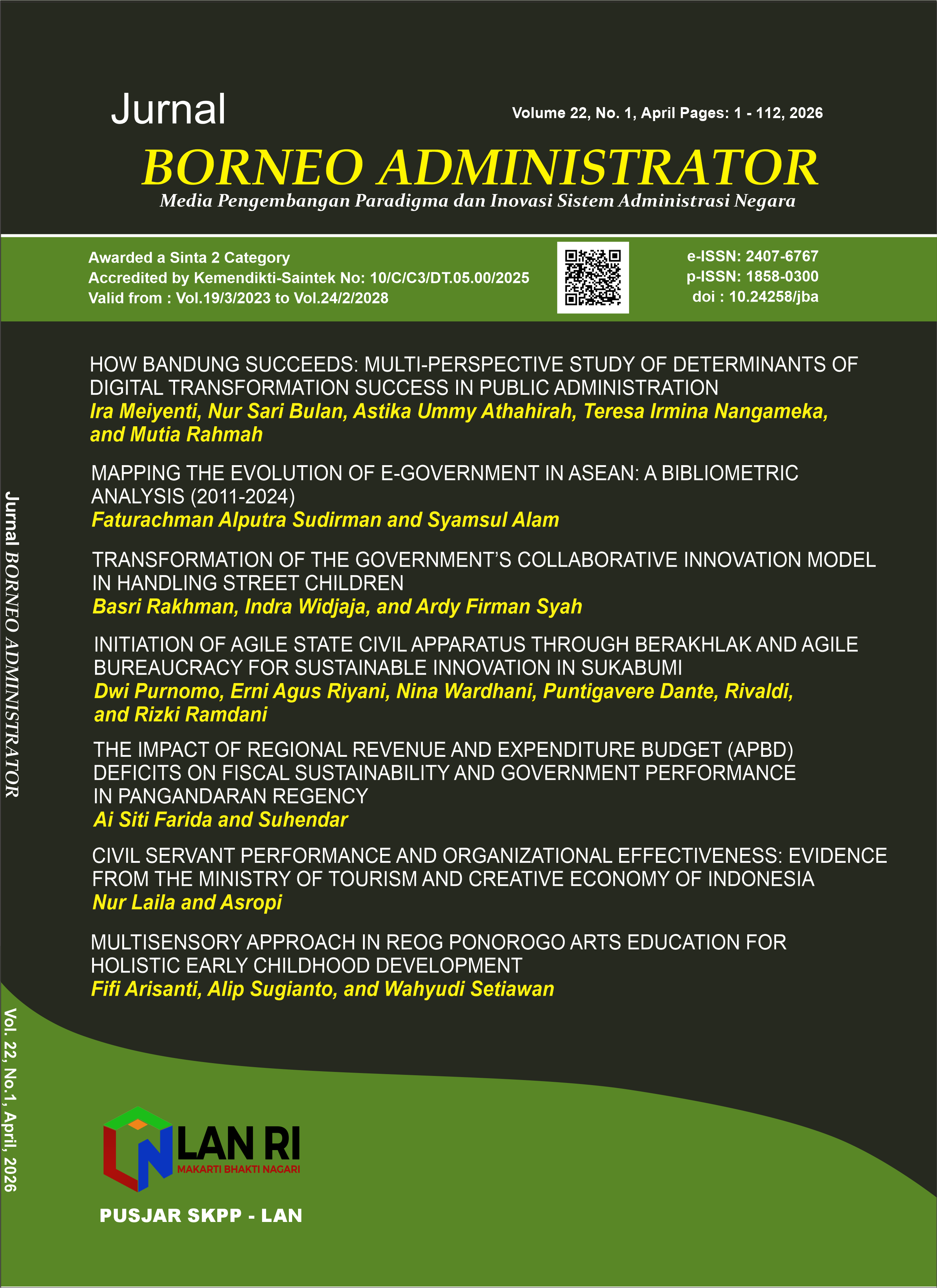
Civil Servant Performance and Organizational Effectiveness from the Ministry of Tourism and Creative Economy of Indonesia
DOI:
https://doi.org/10.24258/jba.v22i1.1655Abstract
The purpose of this study is to explain the causes of problems that occur in the performance assessment of ASN employees at the Ministry of Tourism and Creative Economy/Tourism and Creative Economy Agency by using Kaswan's theory on the elements of performance assessment, namely that performance assessment can be said to be ideal if it contains performance standards, measurable performance measures, and no assessment errors occur. Based on these elements, the author then formulates a problem-solving strategy. This study uses a qualitative approach with data collection methods through in-depth interviews and documentation studies. The collected data are then processed through data reduction, presentation, and conclusion drawing. Based on the results of the study, it was concluded that the performance evaluation did not use clear performance standards; the Employee Performance Target (SKP) document listed no clear performance measures; and there were still assessment errors closely related to the element of leadership subjectivity. The author's strategy is to change the performance assessment method to a 360-degree system, so that performance can be assessed more objectively, as it is seen from various evaluators.
Downloads
Downloads
Published
How to Cite
Issue
Section
License
Copyright (c) 2026 Author(s)

This work is licensed under a Creative Commons Attribution-NonCommercial-ShareAlike 4.0 International License.
Policy for Journals That Offer Open Access
Authors who publish with this journal agree to the following terms:
- Authors retain copyright and grant the journal right of first publication with the work simultaneously licensed under a Creative Commons Attribution-NonCommercial-ShareAlike 4.0 International License that allows others to share the work with an acknowledgement of the work's authorship and initial publication in this journal.
- Authors are able to enter into separate, additional contractual arrangements for the non-exclusive distribution of the journal's published version of the work (e.g., post it to an institutional repository or publish it in a book), with an acknowledgement of its initial publication in this journal.
- Authors are permitted and encouraged to post their work online (e.g., in institutional repositories or on their website) prior to and during the submission process, as it can lead to productive exchanges, as well as earlier and greater citation of published work (See The Effect of Open Access).