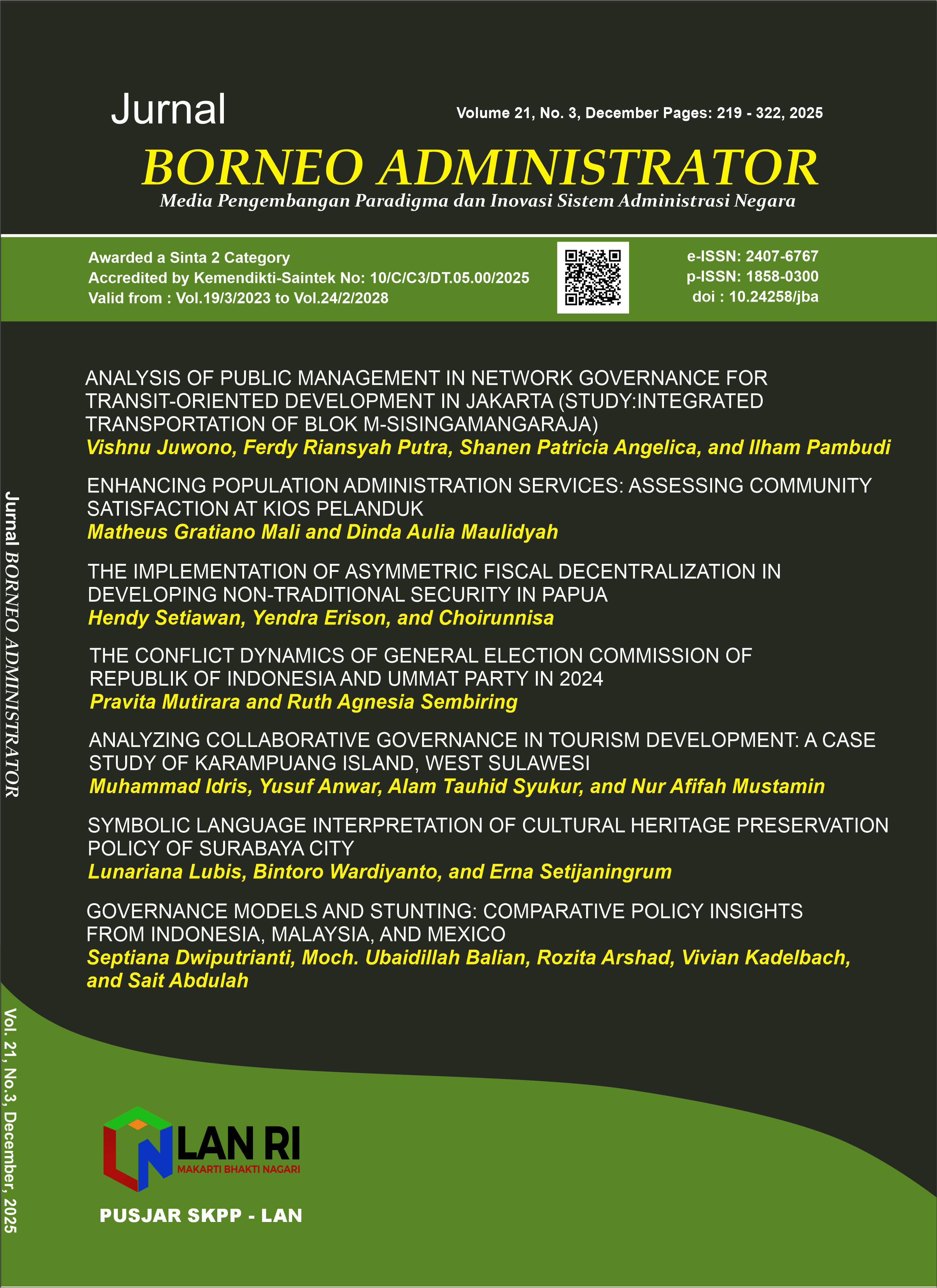
Symbolic Language Interpretation of Cultural Heritage Preservation Policy of Surabaya City
DOI:
https://doi.org/10.24258/jba.v21i3.1656Abstract
This study explores the symbolic use of language in Surabaya's cultural heritage preservation policies using the Interpretive Policy Analysis (IPA) approach. It analyzes policy documents and interviews with stakeholders and communities related to Hotel Majapahit, Tugu Pahlawan, and Tanjung Perak Main Harbormaster Building. The findings highlight how language in policy is not merely communicative but symbolic, reflecting community values, beliefs, and emotional ties to heritage. The paradigm shift in policy, from conservative to progressive and localistic approaches, is reflected in the change from "object" to "area", which expands the meaning of cultural heritage from physical aspects to social and environmental contexts. This study contributes theoretically to public policy and practically recommends inclusive language strategies for heritage policy.
Downloads
Downloads
Published
How to Cite
Issue
Section
License
Copyright (c) 2025 Author(s)

This work is licensed under a Creative Commons Attribution-NonCommercial-ShareAlike 4.0 International License.
Policy for Journals That Offer Open Access
Authors who publish with this journal agree to the following terms:
- Authors retain copyright and grant the journal right of first publication with the work simultaneously licensed under a Creative Commons Attribution-NonCommercial-ShareAlike 4.0 International License that allows others to share the work with an acknowledgement of the work's authorship and initial publication in this journal.
- Authors are able to enter into separate, additional contractual arrangements for the non-exclusive distribution of the journal's published version of the work (e.g., post it to an institutional repository or publish it in a book), with an acknowledgement of its initial publication in this journal.
- Authors are permitted and encouraged to post their work online (e.g., in institutional repositories or on their website) prior to and during the submission process, as it can lead to productive exchanges, as well as earlier and greater citation of published work (See The Effect of Open Access).