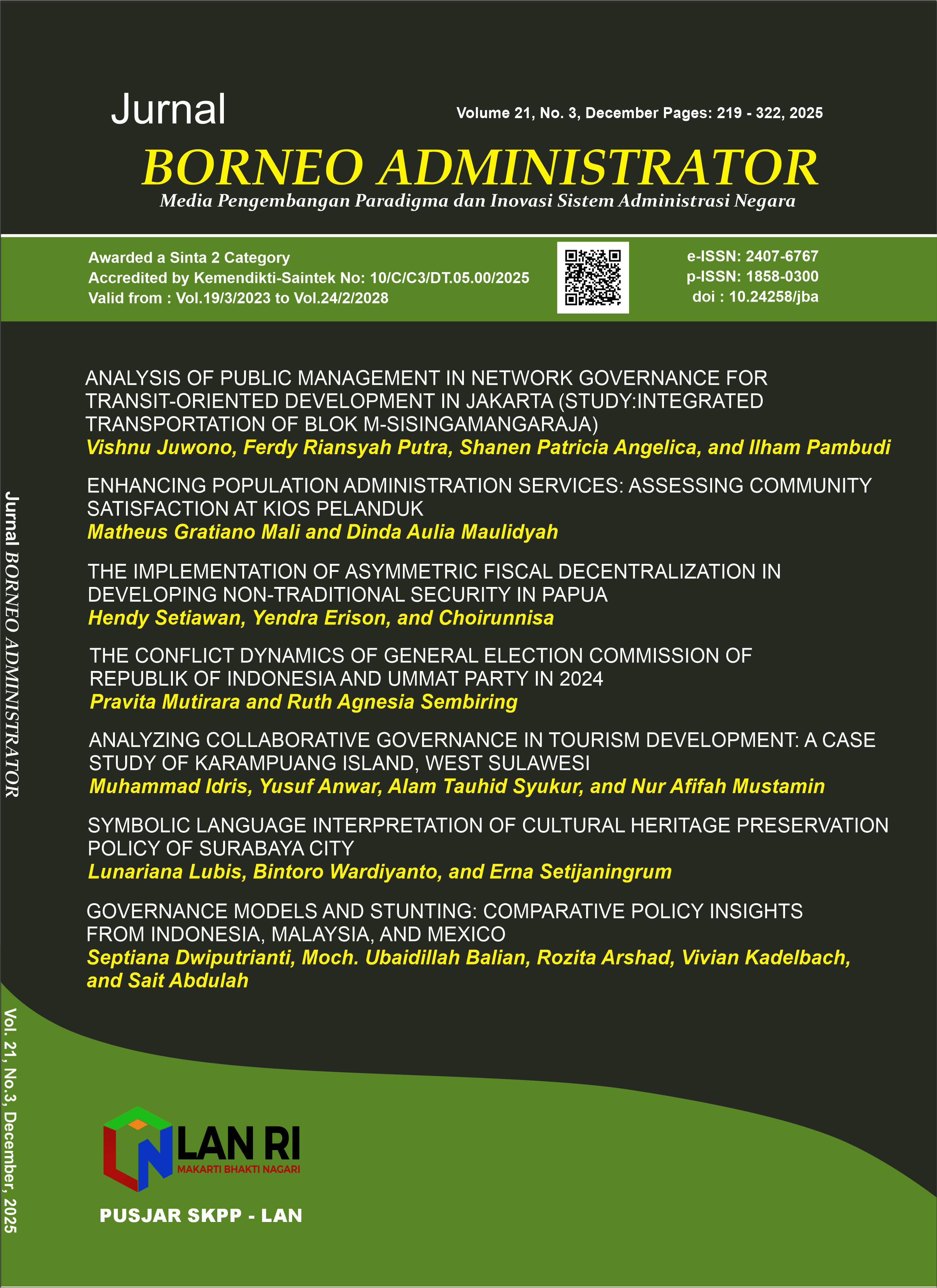
The Conflict Dynamics of General Election Commission of Republic of Indonesia and Ummat Party in 2024
DOI:
https://doi.org/10.24258/jba.v21i3.1672Abstract
This research discusses disputes in the 2024 General Election process involving Ummat Party, the General Election Commission of Republic of Indonesia (KPU), and Election Supervisory Agency of Republic of Indonesia (Bawaslu RI). This research also examines the dynamics of the conflict between the General Election Commission of Republic of Indonesia (KPU) and Ummat Party because of Decree of KPU number 528 of 2022 and the inconsistency of data and information. Ummat Party’s dissatisfaction led to fraud in its membership across two provinces. Tensions escalated as Ummat Party openly rejected the decision, only to end when it was declared eligible to contest the 2024 General Election. According to the research results, there was a miscommunication during the selection of political parties, and the dispute intensified due to fraud allegations. Therefore, to understand the reasons and effects of the administration of the 2024 General Election, the dynamics of this disagreement were analysed. This study finds that the fundamental causes of the dispute are data discrepancies, miscommunication, and a perceived lack of transparency during the factual verification. Nevertheless, the General Election Commission of the Republic of Indonesia (KPU) demonstrated its dedication to transparency and objectivity, adhering to electoral principles and existing regulations. This case highlights the vital significance of data accuracy and effective communication in preserving the integrity and public confidence in electoral processes. This qualitative research used interviews and documentation. The data analyses were performed using Conflict Theory, particularly the application of conflict wheel indicators. The informants were representatives of the General Election Commission of Republic of Indonesia (KPU) and the Election Supervisory Agency of the Republic of Indonesia (Bawaslu RI). At the same time, Ummat Party refused to be interviewed.
Downloads
Downloads
Published
How to Cite
Issue
Section
License
Copyright (c) 2025 Author(s)

This work is licensed under a Creative Commons Attribution-NonCommercial-ShareAlike 4.0 International License.
Policy for Journals That Offer Open Access
Authors who publish with this journal agree to the following terms:
- Authors retain copyright and grant the journal right of first publication with the work simultaneously licensed under a Creative Commons Attribution-NonCommercial-ShareAlike 4.0 International License that allows others to share the work with an acknowledgement of the work's authorship and initial publication in this journal.
- Authors are able to enter into separate, additional contractual arrangements for the non-exclusive distribution of the journal's published version of the work (e.g., post it to an institutional repository or publish it in a book), with an acknowledgement of its initial publication in this journal.
- Authors are permitted and encouraged to post their work online (e.g., in institutional repositories or on their website) prior to and during the submission process, as it can lead to productive exchanges, as well as earlier and greater citation of published work (See The Effect of Open Access).