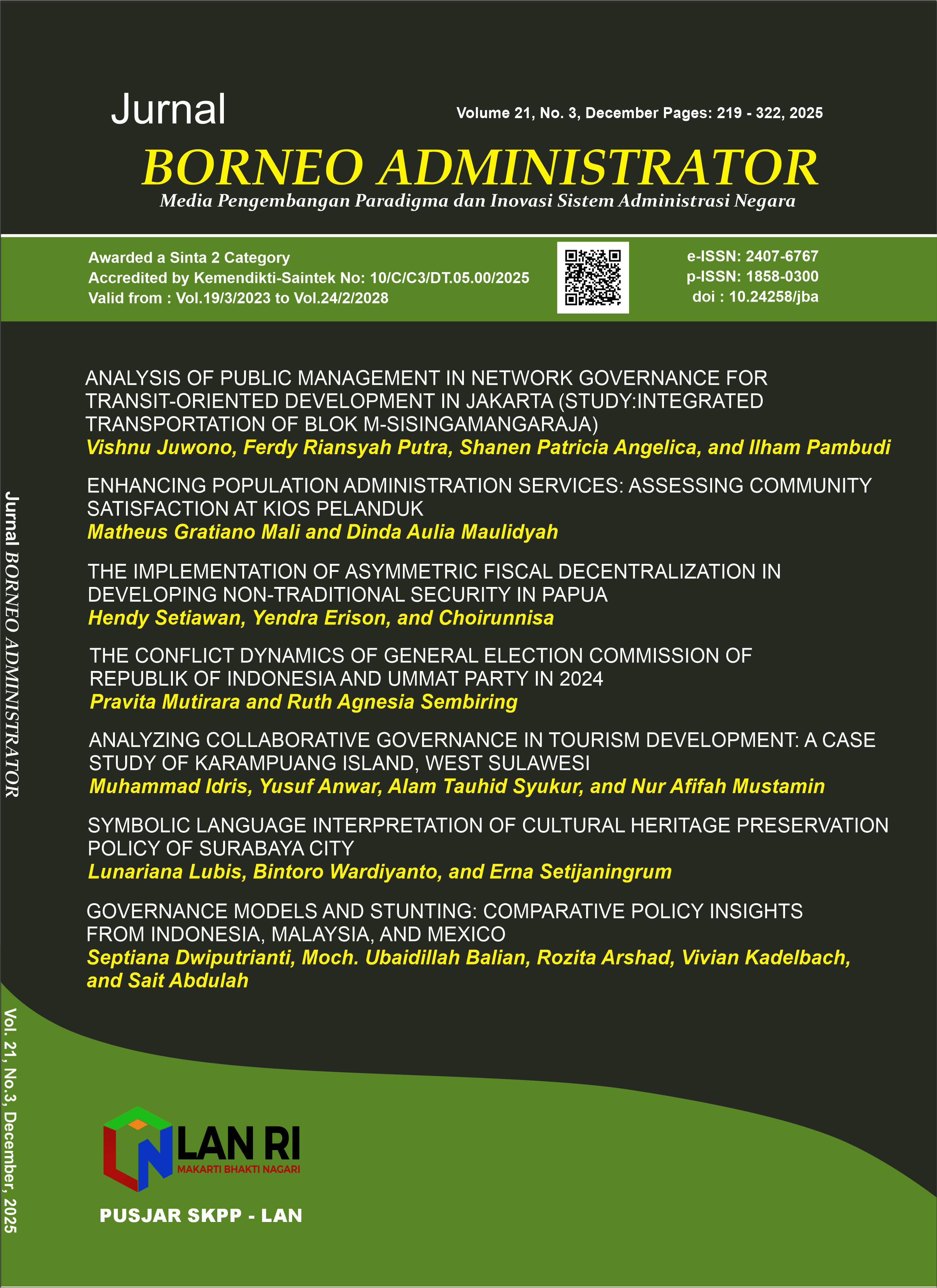
The Implementation of Asymmetric Fiscal Decentralization in Developing Non-Traditional Security in Papua
DOI:
https://doi.org/10.24258/jba.v21i3.1685Abstract
This article aims to discuss the relevance of implementing asymmetric fiscal decentralization in building non-traditional security in Papua. For over two decades, Papua has had a special autonomy status. Under the legal basis of Law Number 21 of 2001 concerning Special Autonomy for Papua, which was followed in 2002 by the asymmetric fiscal decentralization policy of the Central Government, it provides space for Papua to improve and develop non-traditional forms of security that are more dynamic and welfare-oriented. This study uses a qualitative method with a documentary analysis approach. This study utilizes accurate document data, which is analyzed using existing techniques. The results of the study indicate that the asymmetric fiscal decentralization policy has not been fully implemented in developing non-traditional forms of security (human security). This was identified as an area where numerous human security problems persist, ranging from unfulfilled food needs to a weak social life within society, including poverty and low human development. All of which are markers that such security problems are a nontraditional threat to Papua. Therefore, the state must review the special autonomy policy that can create non-traditional security and is oriented towards the welfare of Papua
Downloads
Downloads
Published
How to Cite
Issue
Section
License
Copyright (c) 2025 Author(s)

This work is licensed under a Creative Commons Attribution-NonCommercial-ShareAlike 4.0 International License.
Policy for Journals That Offer Open Access
Authors who publish with this journal agree to the following terms:
- Authors retain copyright and grant the journal right of first publication with the work simultaneously licensed under a Creative Commons Attribution-NonCommercial-ShareAlike 4.0 International License that allows others to share the work with an acknowledgement of the work's authorship and initial publication in this journal.
- Authors are able to enter into separate, additional contractual arrangements for the non-exclusive distribution of the journal's published version of the work (e.g., post it to an institutional repository or publish it in a book), with an acknowledgement of its initial publication in this journal.
- Authors are permitted and encouraged to post their work online (e.g., in institutional repositories or on their website) prior to and during the submission process, as it can lead to productive exchanges, as well as earlier and greater citation of published work (See The Effect of Open Access).