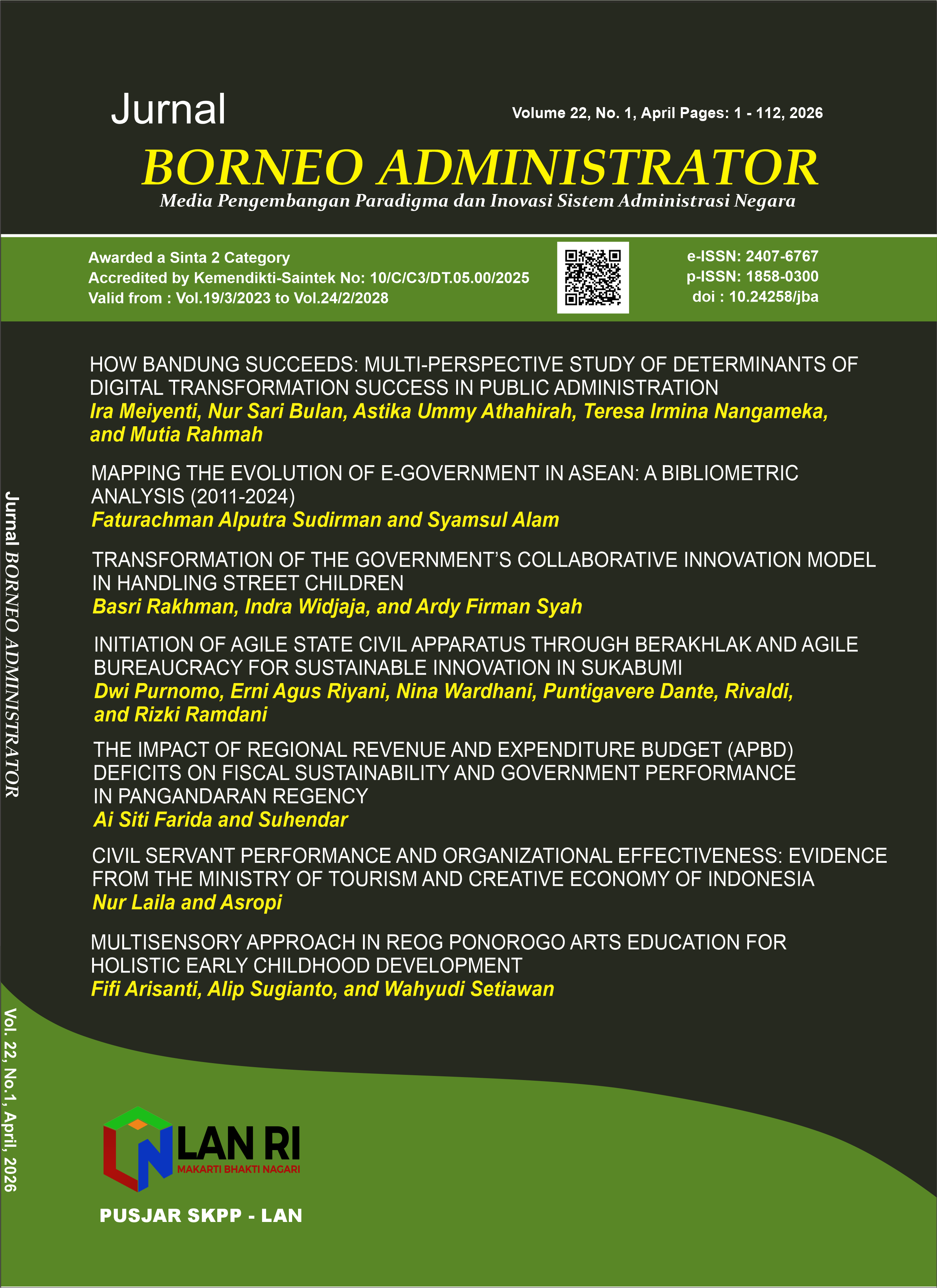
The Impact of Regional Revenue and Expenditure Budget (APBD) Deficits on Fiscal Sustainability and Government Performance in Pangandaran Regency
DOI:
https://doi.org/10.24258/jba.v22i1.1689Abstract
The deficit in the Regional Revenue and Expenditure Budget (APBD) poses a critical challenge to fiscal sustainability in Pangandaran Regency. This study aims to analyse the impact of the APBD deficit on local governance by examining the causes, implications, and potential strategies to improve fiscal stability. A descriptive qualitative approach was used, with document analysis as the main method. Data were collected from official documents of the Pangandaran Regency Government, including regional regulations related to the 2021–2025 APBD, as well as from academic literature published on Google Scholar, academic portals, and other reliable sources between 2010 and 2025. The study results show
that the APBD deficit in Pangandaran follows a recurring pattern, with the highest level reaching 35.50% of total revenue in 2023. This region remains heavily dependent on transfers from the central government, which account for more than 77% of its annual revenue. Expenditures are mostly directed towards personnel and operational costs, while capital expenditures are trending downward. From the perspective of Public Finance Theory, Fiscal Decentralization Theory, and Fiscal Sustainability Theory, this condition poses a risk to regional fiscal capacity and may hamper long-term economic development. To address these challenges, this study recommends practical strategies: optimizing Local Own-Source Revenue (PAD) through tourism and creative industries; reallocating expenditures toward productive capital investments; and implementing performance-based budgeting to strengthen fiscal discipline. The contribution of this study lies in providing theoretical insights and concrete policy recommendations in public administration, particularly in strengthening regional fiscal independence and resilience in managing recurring budget deficits.
Downloads
Downloads
Published
How to Cite
Issue
Section
License
Copyright (c) 2026 Author(s)

This work is licensed under a Creative Commons Attribution-NonCommercial-ShareAlike 4.0 International License.
Policy for Journals That Offer Open Access
Authors who publish with this journal agree to the following terms:
- Authors retain copyright and grant the journal right of first publication with the work simultaneously licensed under a Creative Commons Attribution-NonCommercial-ShareAlike 4.0 International License that allows others to share the work with an acknowledgement of the work's authorship and initial publication in this journal.
- Authors are able to enter into separate, additional contractual arrangements for the non-exclusive distribution of the journal's published version of the work (e.g., post it to an institutional repository or publish it in a book), with an acknowledgement of its initial publication in this journal.
- Authors are permitted and encouraged to post their work online (e.g., in institutional repositories or on their website) prior to and during the submission process, as it can lead to productive exchanges, as well as earlier and greater citation of published work (See The Effect of Open Access).