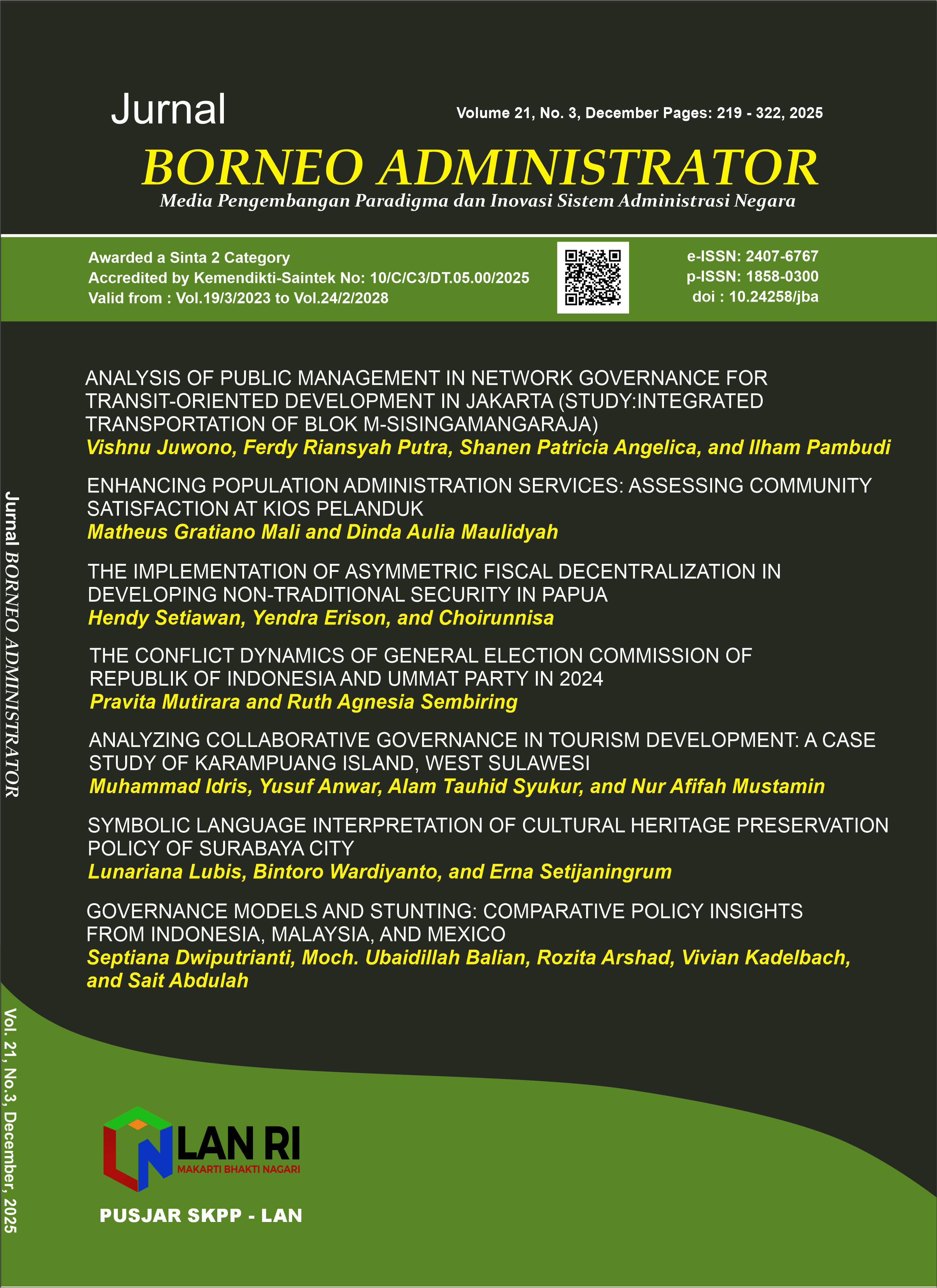
Analyzing Collaborative Governance in Tourism Development: A Case Study of Karampuang Island, West Sulawesi
DOI:
https://doi.org/10.24258/jba.v21i3.1707Abstract
Tourism is a strategic sector for regional development; however, the management of flagship destinations in developing regions frequently encounters challenges related to weak stakeholder coordination, limited infrastructure, and insufficient community participation. Karampuang Island in West Sulawesi possesses significant natural and cultural tourism potential, yet its development has not been optimally managed due to low inter-agency synergy and limited stakeholder engagement. This study aims to analyze the implementation of the pentahelix collaborative governance model, comprising government, private sector, academia, community or non-governmental organizations, and media, in the development of Karampuang Island as a tourism destination. A qualitative descriptive approach was employed, using in-depth interviews, field observations, and document analysis. The findings indicate that cross-sector collaboration has contributed to improvements in accessibility and public facilities, as reflected in the construction of Plaza Karampuang and the establishment of twelve micro, small, and medium enterprise kiosks. Nevertheless, formal coordination mechanisms remain weak due to the absence of inter-agency memorandums of understanding, limiting sustained collaboration. Private sector involvement in promotion and investment is still minimal, while academic contributions are largely confined to community service programs. Community participation has increased through the Tourism Awareness Group, although communication with government actors remains suboptimal. Media actors have actively promoted the destination, yet digital marketing strategies have not been maximized. In conclusion, the pentahelix model has the potential to strengthen tourism governance on Karampuang Island, provided it is supported by formal coordination platforms, community capacity building, and integrated digital marketing strategies to ensure sustainable tourism development and local community welfare.
Downloads
Downloads
Published
How to Cite
Issue
Section
License
Copyright (c) 2025 Author(s)

This work is licensed under a Creative Commons Attribution-NonCommercial-ShareAlike 4.0 International License.
Policy for Journals That Offer Open Access
Authors who publish with this journal agree to the following terms:
- Authors retain copyright and grant the journal right of first publication with the work simultaneously licensed under a Creative Commons Attribution-NonCommercial-ShareAlike 4.0 International License that allows others to share the work with an acknowledgement of the work's authorship and initial publication in this journal.
- Authors are able to enter into separate, additional contractual arrangements for the non-exclusive distribution of the journal's published version of the work (e.g., post it to an institutional repository or publish it in a book), with an acknowledgement of its initial publication in this journal.
- Authors are permitted and encouraged to post their work online (e.g., in institutional repositories or on their website) prior to and during the submission process, as it can lead to productive exchanges, as well as earlier and greater citation of published work (See The Effect of Open Access).