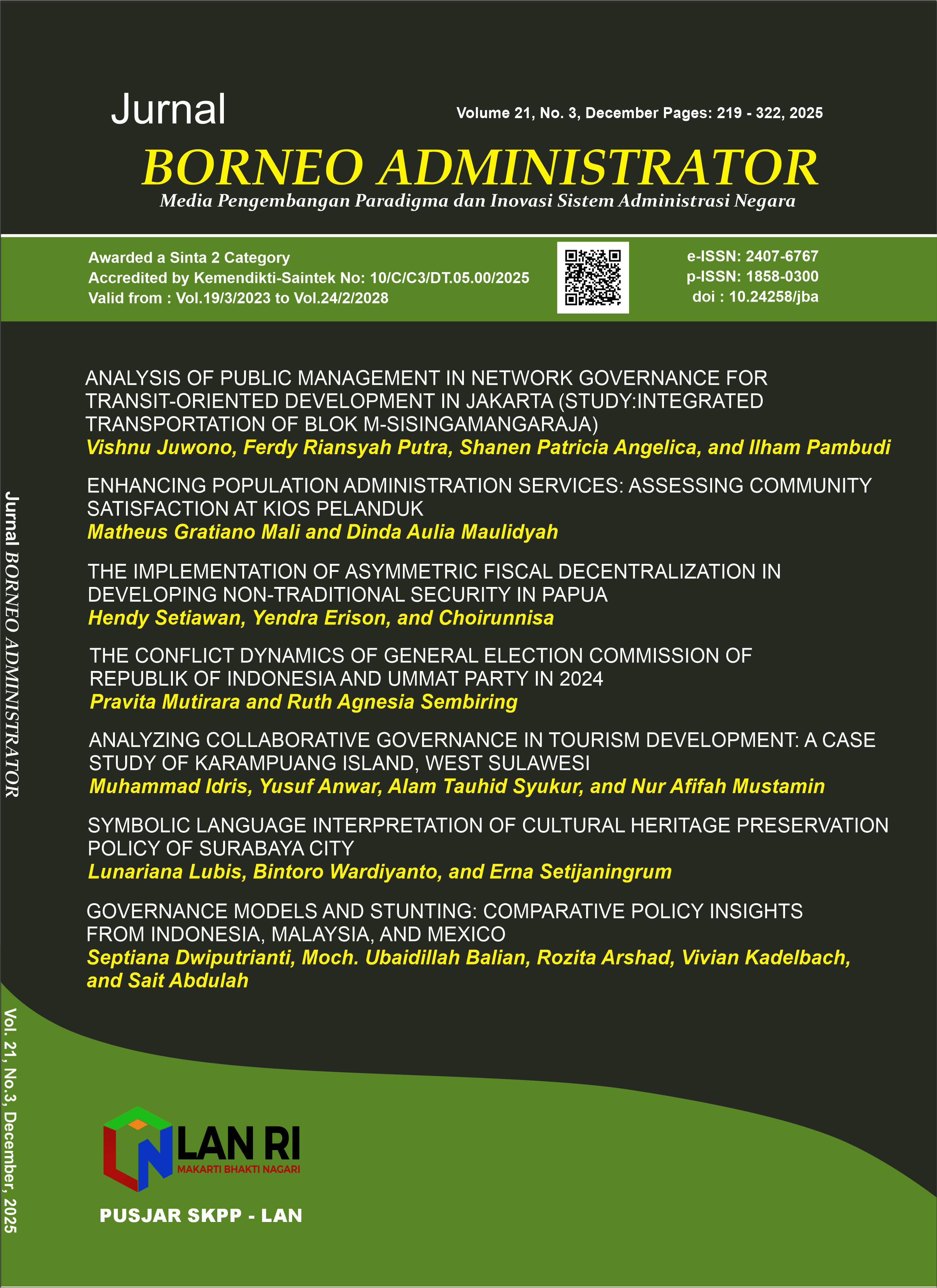
Governance Models and Stunting: Comparative Policy Insights from Indonesia, Malaysia, and Mexico
DOI:
https://doi.org/10.24258/jba.v21i3.1710Abstract
162 million children worldwide are affected by stunting, which has serious societal repercussions (WHO, 2021). In order to identify institutional drivers of success, this study compares the governance styles used to address stunting in Mexico (hybrid), Malaysia (centralised), and Indonesia (decentralised). Through a qualitative examination of 45 coverage documents (2015–2023) and 72 stakeholder interviews, we find that Malaysia's NPAN uses cross-regional cooperation to reduce stunting by 12%, while Indonesia's bureaucratic fragmentation hinders implementation. The importance of network engagement is emphasized in Mexico's PENSAN application. By showing how adaptive frameworks that are adapted to local capacities improve fitness outcomes, the study advances the idea of collaborative governance. Malaysia is a prime example of a collaborative governance model that involves a few
stakeholders and improves its national nutrition strategy. Mexico's comprehensive strategy, which combines health and social regulations, underscores the significance of community engagement in public health initiatives. A comparative analysis of stunting incidence indicates that Indonesia (20.0%) and Malaysia (24.3%) face significant challenges in reducing stunting rates, whereas Mexico (13.9%) has made greater progress in this area. This study gives contribution to the study of public administration by illustrating how centralized (Malaysia), decentralized (Indonesia), and hybrid (Mexico) governance systems influence the effectiveness of health interventions. It provides critical insights for policymakers and practitioners, advocating for inclusive stakeholder participation and the necessity of context specific solutions. This study redefines discussions on decentralization in global health governance and fills the gap on cross-national governance analyses in stunting policy. This study indicates that policymakers ought to promote institutional flexibility and participatory design to attain SDG objectives.
Downloads
Downloads
Published
How to Cite
Issue
Section
License
Copyright (c) 2025 Author(s)

This work is licensed under a Creative Commons Attribution-NonCommercial-ShareAlike 4.0 International License.
Policy for Journals That Offer Open Access
Authors who publish with this journal agree to the following terms:
- Authors retain copyright and grant the journal right of first publication with the work simultaneously licensed under a Creative Commons Attribution-NonCommercial-ShareAlike 4.0 International License that allows others to share the work with an acknowledgement of the work's authorship and initial publication in this journal.
- Authors are able to enter into separate, additional contractual arrangements for the non-exclusive distribution of the journal's published version of the work (e.g., post it to an institutional repository or publish it in a book), with an acknowledgement of its initial publication in this journal.
- Authors are permitted and encouraged to post their work online (e.g., in institutional repositories or on their website) prior to and during the submission process, as it can lead to productive exchanges, as well as earlier and greater citation of published work (See The Effect of Open Access).