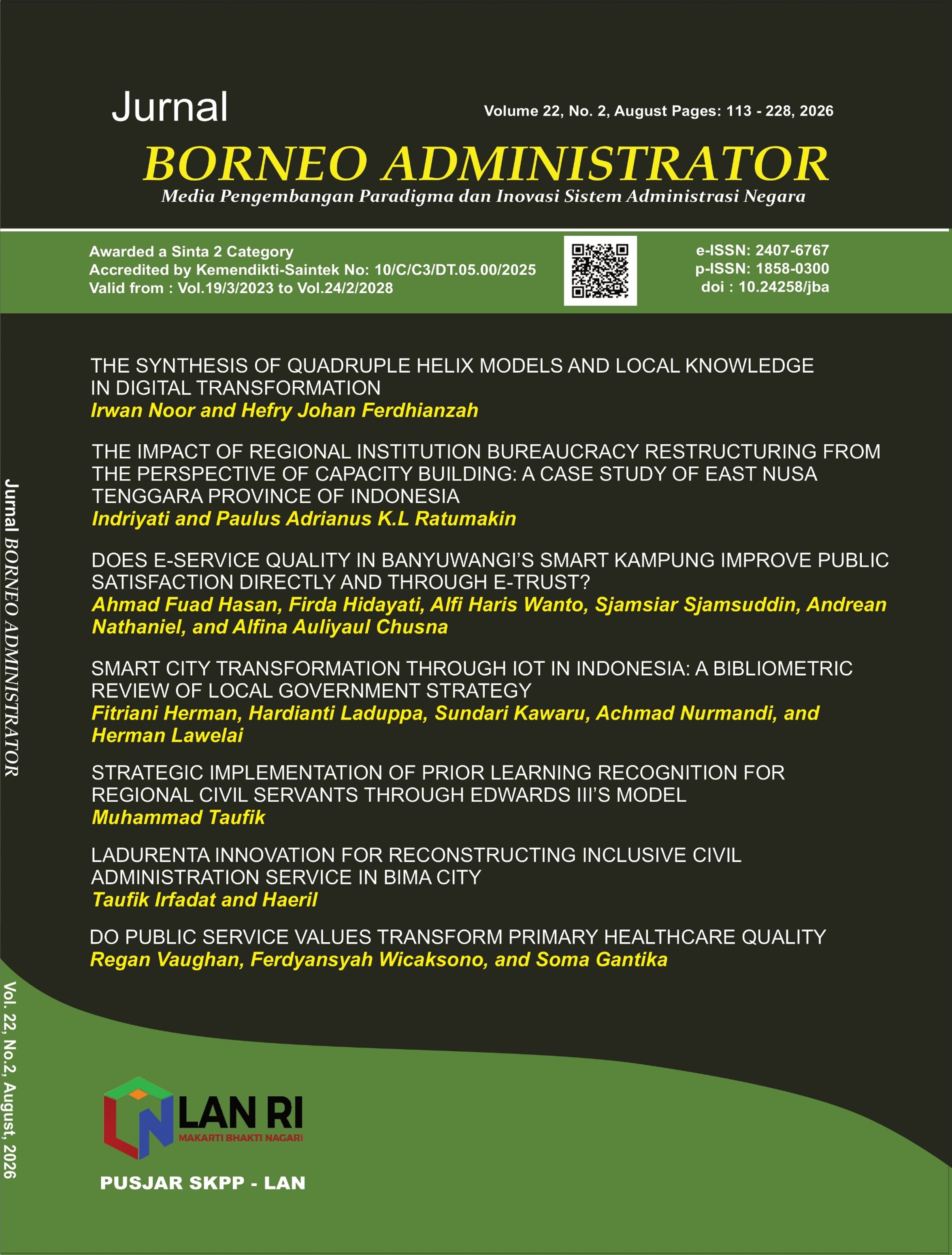
Does E-Service Quality in Banyuwangi’s Smartkampung Improve Public Satisfaction Directly and Through E-Trust?
DOI:
https://doi.org/10.24258/jba.v22i2.1719Abstract
Rapid developments in information technology require local governments to strengthen the quality of electronic public services; however, empirical studies examining how e-service quality shapes public satisfaction through e-trust in the context of local e-government applications remain limited. This study addresses this gap by analyzing the Smartkampung Banyuwangi super-application, one of the most
advanced e-government implementations in Indonesia, to identify how e-service quality influences public satisfaction directly and indirectly through e-trust. Using an explanatory quantitative design, data were collected from 166 residents who used the Smartkampung application and analyzed using Partial Least Squares–Structural Equation Modeling (PLS-SEM). The findings demonstrate that e-service quality
significantly affects e-trust (β = 0.773; p < 0.001) and public satisfaction (β = 0.520; p < 0.001). E-trust also significantly influences satisfaction (β = 0.338; p < 0.001) and mediates the relationship between e-service quality and satisfaction (indirect effect β = 0.261; p < 0.001), with the model explaining 65.7% of the variance in satisfaction (R² = 0.657). The study contributes theoretically by extending e-service
quality and trust frameworks within village-level e-government services. In practice, the findings highlight the importance of improving system availability, efficiency, and data security to strengthen users’ trust and enhance satisfaction with digital public service delivery.
Downloads
Downloads
Published
How to Cite
Issue
Section
License
Copyright (c) 2026 Author(s)

This work is licensed under a Creative Commons Attribution-NonCommercial-ShareAlike 4.0 International License.
Policy for Journals That Offer Open Access
Authors who publish with this journal agree to the following terms:
- Authors retain copyright and grant the journal right of first publication with the work simultaneously licensed under a Creative Commons Attribution-NonCommercial-ShareAlike 4.0 International License that allows others to share the work with an acknowledgement of the work's authorship and initial publication in this journal.
- Authors are able to enter into separate, additional contractual arrangements for the non-exclusive distribution of the journal's published version of the work (e.g., post it to an institutional repository or publish it in a book), with an acknowledgement of its initial publication in this journal.
- Authors are permitted and encouraged to post their work online (e.g., in institutional repositories or on their website) prior to and during the submission process, as it can lead to productive exchanges, as well as earlier and greater citation of published work (See The Effect of Open Access).