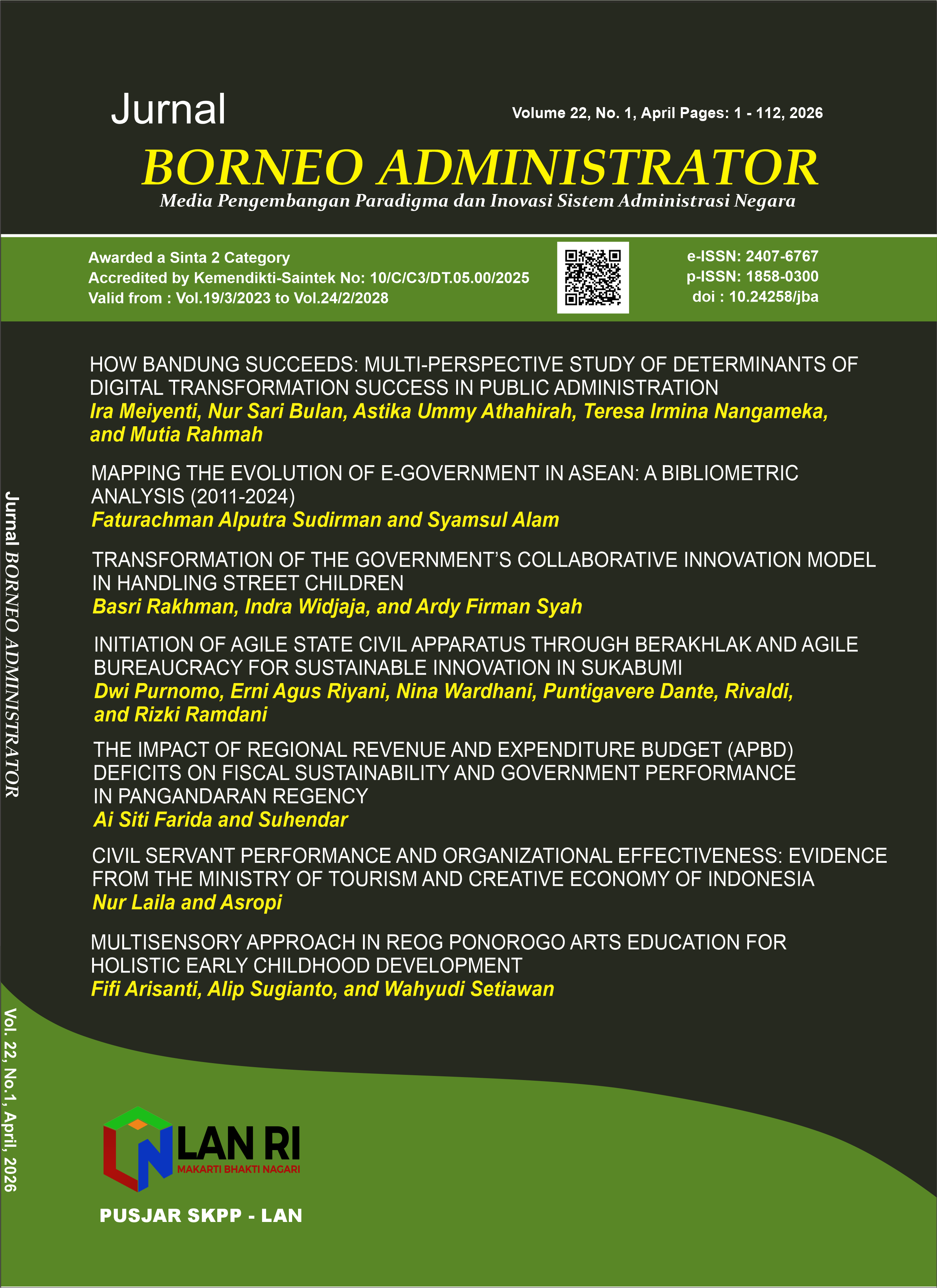
Initiation of Agile State Civil Apparatus through BerAKHLAK and Agile Bureaucracy for Sustainable Innovation in Sukabumi
DOI:
https://doi.org/10.24258/jba.v22i1.1726Abstract
This study addresses the challenge of accelerating bureaucratic innovation in local governments amid rigid organisational cultures and limited intergenerational synergy. Focusing on the City of Sukabumi, the research explores how the internalisation of BerAKHLAK values intersects with the implementation of Agile Bureaucracy to shape adaptive and innovative public service behaviour. While both frameworks have been promoted in Indonesia’s civil service reform agenda, few studies have analysed their combined effect at the municipal level. Employing a mixed-methods approach—quantitative surveys (n = 35) and focus group discussions with OPD stakeholders—this study finds a significant positive
correlation (r = 0.551; p < 0.05) between value internalisation and organisational innovation capacity. Key enabling factors include leadership, cross-sector collaboration, and flexible structures, while hierarchical rigidity and generational divides act as barriers. The study contributes to public administration literature by offering an integrated framework that links values-based governance and agile organisational practices. Practically, it provides reform insights for mid-sized city governments seeking to foster more responsive, collaborative, and innovative bureaucracies. Sukabumi’s experience offers a relevant model for other second-tier cities facing similar governance and innovation challenges in decentralised public administration systems.
Downloads
Downloads
Published
How to Cite
Issue
Section
License
Copyright (c) 2026 Author(s)

This work is licensed under a Creative Commons Attribution-NonCommercial-ShareAlike 4.0 International License.
Policy for Journals That Offer Open Access
Authors who publish with this journal agree to the following terms:
- Authors retain copyright and grant the journal right of first publication with the work simultaneously licensed under a Creative Commons Attribution-NonCommercial-ShareAlike 4.0 International License that allows others to share the work with an acknowledgement of the work's authorship and initial publication in this journal.
- Authors are able to enter into separate, additional contractual arrangements for the non-exclusive distribution of the journal's published version of the work (e.g., post it to an institutional repository or publish it in a book), with an acknowledgement of its initial publication in this journal.
- Authors are permitted and encouraged to post their work online (e.g., in institutional repositories or on their website) prior to and during the submission process, as it can lead to productive exchanges, as well as earlier and greater citation of published work (See The Effect of Open Access).