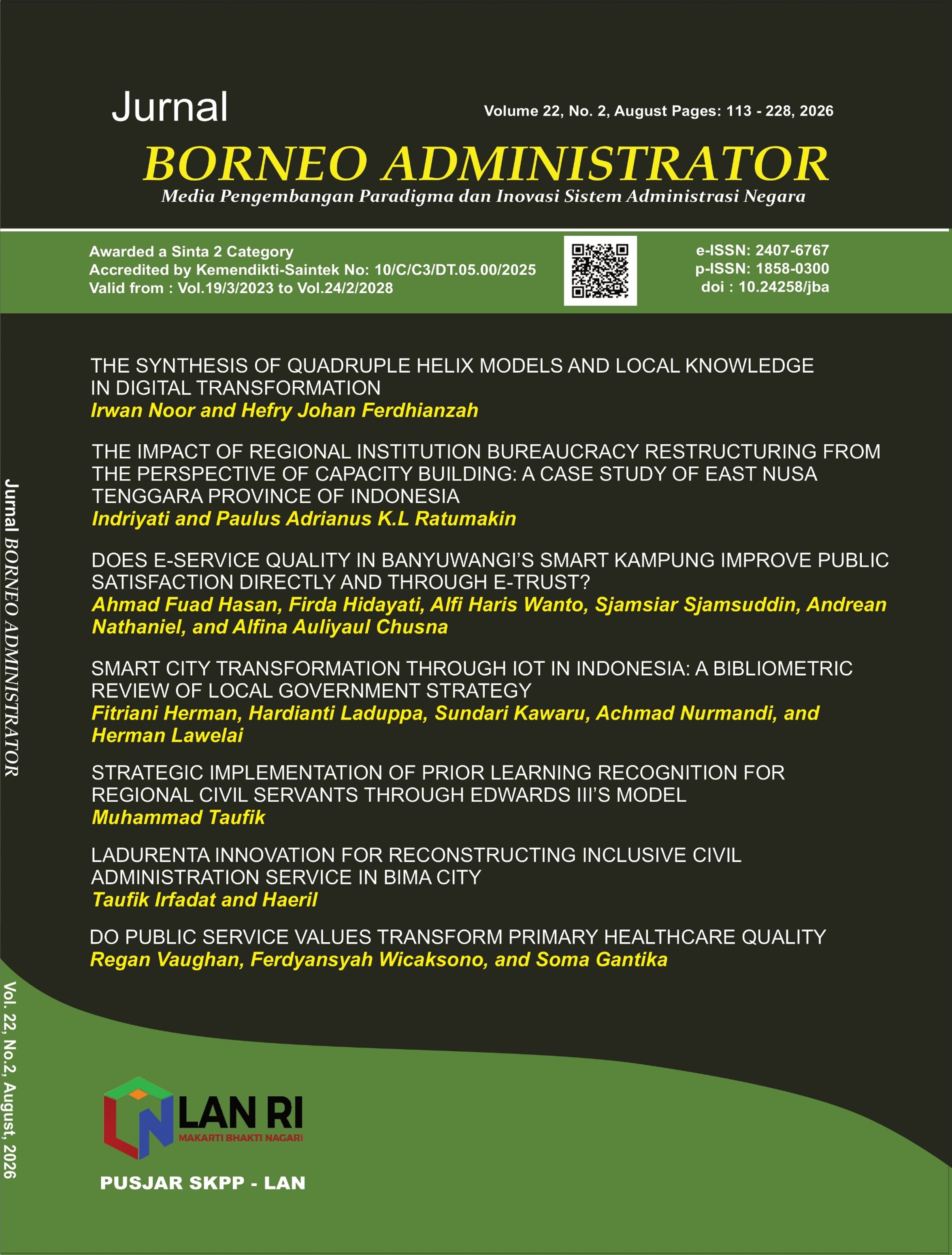
The Synthesis of Quadruple Helix Models and Local Knowledge in Digital Transformation
DOI:
https://doi.org/10.24258/jba.v22i2.1734Abstract
Digital transformation initiatives in Indonesia often encounter challenges when implemented through top-down, technocratic approaches that overlook local sociocultural contexts. In a culturally diverse nation, aligning innovation with local realities becomes essential for sustainability and inclusivity. While collaborative models like the Quadruple Helix (QH) are gaining traction, limited research examines the integration of local knowledge systems into formal innovation frameworks in Global South settings. This study bridges the QH model, comprising government, academia, industry, and civil society, with local knowledge to develop an inclusive, culturally embedded digital innovation framework. Employing a mixed-method sequential explanatory design, the research was conducted in Malang City, Indonesia. Quantitative data were gathered from 400 respondents across QH sectors, followed by 16 in-depth qualitative interviews. Analysis utilized Structural Equation Modeling (SEM) and NVivo-based thematic analysis. SEM results indicate that QH collaboration intensity significantly enhances the effectiveness of digital transformation (β = 0.487, p < 0.001), with this relationship further strengthened by local knowledge integration (β = 0.376, p < 0.001). Socio-cultural context moderates both relationships (β = 0.312 and β = 0.289, p < 0.001). Qualitative findings underscore trust-building, reciprocal communication, and cultural sensitivity as critical mechanisms. This study pioneers a culturally embedded framework that reconceptualizes digital transformation as a socio-technical dialogue, positioning local communities as equal knowledge producers. It advances public administration theory and offers actionable pathways for designing community-based, participatory, and contextually appropriate digital policies, ensuring technology serves local needs.
Downloads
Downloads
Published
How to Cite
Issue
Section
License
Copyright (c) 2026 Author(s)

This work is licensed under a Creative Commons Attribution-NonCommercial-ShareAlike 4.0 International License.
Policy for Journals That Offer Open Access
Authors who publish with this journal agree to the following terms:
- Authors retain copyright and grant the journal right of first publication with the work simultaneously licensed under a Creative Commons Attribution-NonCommercial-ShareAlike 4.0 International License that allows others to share the work with an acknowledgement of the work's authorship and initial publication in this journal.
- Authors are able to enter into separate, additional contractual arrangements for the non-exclusive distribution of the journal's published version of the work (e.g., post it to an institutional repository or publish it in a book), with an acknowledgement of its initial publication in this journal.
- Authors are permitted and encouraged to post their work online (e.g., in institutional repositories or on their website) prior to and during the submission process, as it can lead to productive exchanges, as well as earlier and greater citation of published work (See The Effect of Open Access).