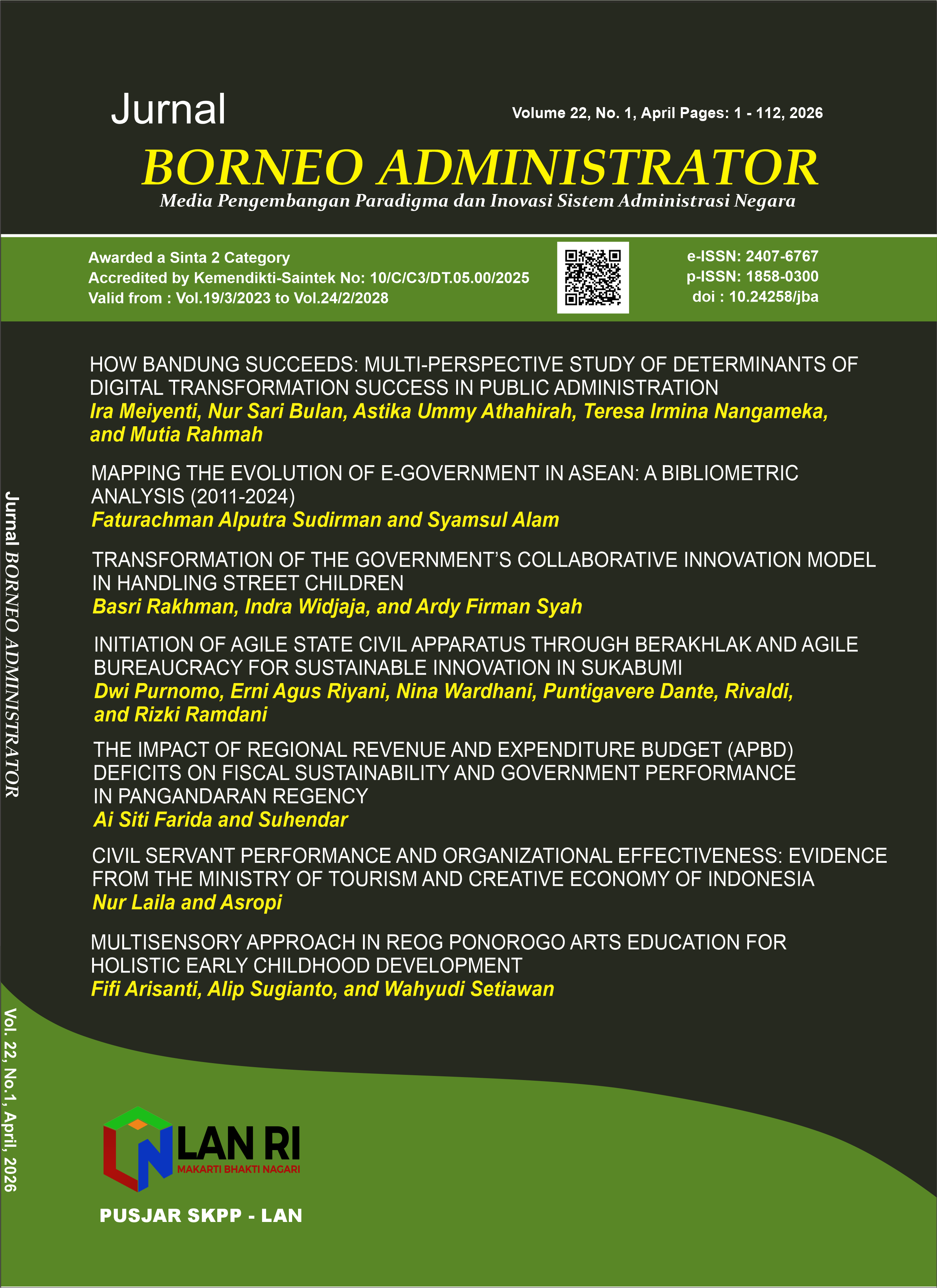
How Bandung Succeeds: Multi-Perspective Study of Determinants of Digital Transformation Success in Public Administration
DOI:
https://doi.org/10.24258/jba.v22i1.1738Abstract
Digital transformation is the main focus in the development of public administration, including in Indonesia. The Electronic-Based Government System (SPBE) implementation at the regional level still faces constraints in human resources, budget, and infrastructure. Bandung City serves as an ideal model of successful SPBE and Smart City implementation. A holistic assessment of the success of digital
transformation in public administration was performed in this research by combining theoretical approaches (Stakeholder Theory, RBV, and Innovation Diffusion) and practical approaches in the field. This study employed an explanatory sequential mixed methods design, involving 75 quantitative survey respondents and 30 qualitative interview informants at the Bandung City Diskominfo. The data were analyzed using descriptive statistical techniques and thematic analysis. Five key factors, namely (1) Expectations of employees/implementing employees, (2) Expectations of ICT technical operators, (3) Organizational culture, (4) Relative profitability, and (5) Digital leadership were found as the significant factors. The holistic approach successfully integrated multiple theories and field practices in responding to criticisms of previous studies on technical-social focus inequality. The results provide more effective and contextual strategic guidance for local governments to improve the implementation of digital transformation in the public sector.
Downloads
Downloads
Published
How to Cite
Issue
Section
License
Copyright (c) 2026 Author(s)

This work is licensed under a Creative Commons Attribution-NonCommercial-ShareAlike 4.0 International License.
Policy for Journals That Offer Open Access
Authors who publish with this journal agree to the following terms:
- Authors retain copyright and grant the journal right of first publication with the work simultaneously licensed under a Creative Commons Attribution-NonCommercial-ShareAlike 4.0 International License that allows others to share the work with an acknowledgement of the work's authorship and initial publication in this journal.
- Authors are able to enter into separate, additional contractual arrangements for the non-exclusive distribution of the journal's published version of the work (e.g., post it to an institutional repository or publish it in a book), with an acknowledgement of its initial publication in this journal.
- Authors are permitted and encouraged to post their work online (e.g., in institutional repositories or on their website) prior to and during the submission process, as it can lead to productive exchanges, as well as earlier and greater citation of published work (See The Effect of Open Access).