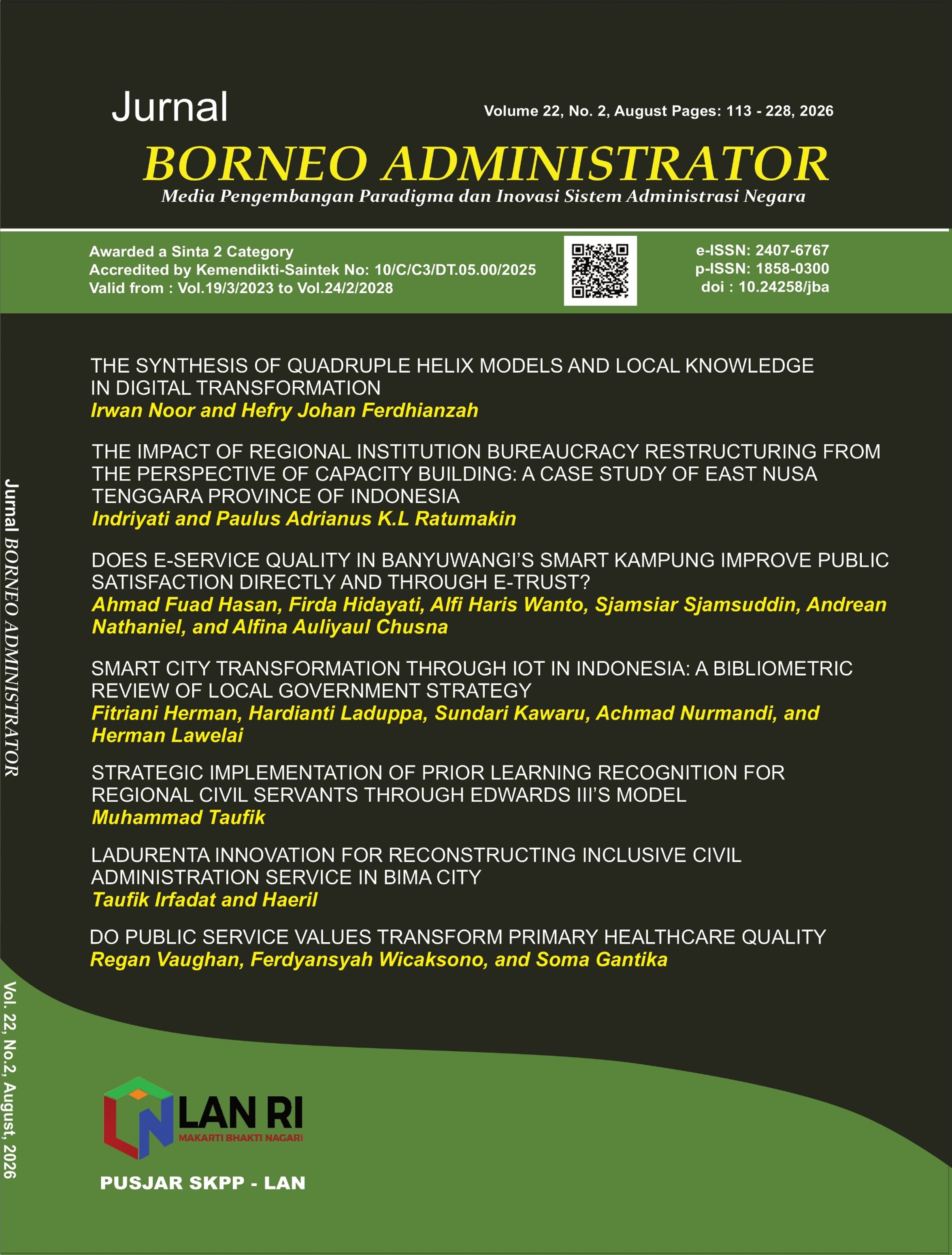
The Impact of Regional Institutional Bureaucracy Restructuring from The Perspective of Capacity Building: A Case Study of East Nusa Tenggara Province of Indonesia
DOI:
https://doi.org/10.24258/jba.v22i2.1750Abstract
This study aims to analyze the impact of restructuring regional institutional bureaucracy from a capacity-building perspective, focusing on the case of the East Nusa Tenggara Provincial Government, a border region adjacent to Timor-Leste. In the context of institutional reform, this research evaluates the implementation strategies, processes, and outcomes of regional organizational restructuring in border
areas, where Government Regulation (PP) No. 18 of 2016 lacks provisions for border affairs management, creating unique coordination challenges with the Ministry of Home Affairs. The research employs a qualitative approach, using data collected through interviews with 11 key informants, observations, and documentation spanning 2016-2024. The results indicate that restructuring follows right-sizing principles, reducing the regional apparatus from 42 to 38 units while strategically accommodating border coordination functions. However, the primary challenge in building bureaucratic capacity lies in the lack of strong political commitment from local leadership. Critically, following border governance resolution, public service innovations surged from zero (pre-2022) to 122 innovations during 2023-2024. This study proposes a four-dimensional capacity-building framework for border provinces, adding Geopolitical Institutional Adaptation as a fourth dimension to the conventional dimensions. To achieve effective institutional reform, synergy between reform policies, geopolitical considerations, and institutional capacity is required to create an efficient bureaucracy responsive to public needs.
Downloads
Downloads
Published
How to Cite
Issue
Section
License
Copyright (c) 2026 Author(s)

This work is licensed under a Creative Commons Attribution-NonCommercial-ShareAlike 4.0 International License.
Policy for Journals That Offer Open Access
Authors who publish with this journal agree to the following terms:
- Authors retain copyright and grant the journal right of first publication with the work simultaneously licensed under a Creative Commons Attribution-NonCommercial-ShareAlike 4.0 International License that allows others to share the work with an acknowledgement of the work's authorship and initial publication in this journal.
- Authors are able to enter into separate, additional contractual arrangements for the non-exclusive distribution of the journal's published version of the work (e.g., post it to an institutional repository or publish it in a book), with an acknowledgement of its initial publication in this journal.
- Authors are permitted and encouraged to post their work online (e.g., in institutional repositories or on their website) prior to and during the submission process, as it can lead to productive exchanges, as well as earlier and greater citation of published work (See The Effect of Open Access).