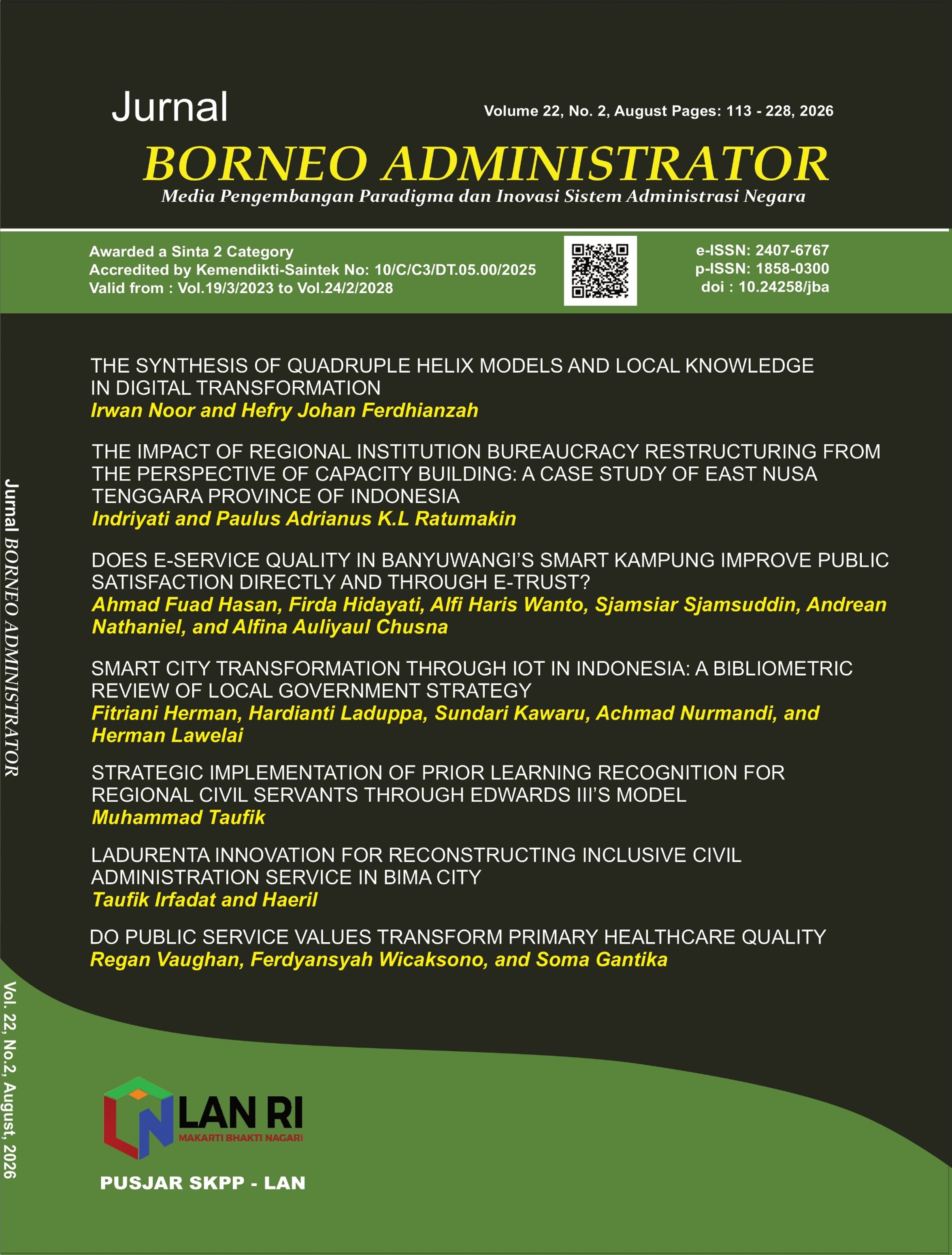
Ladurenta Innovation for Reconstructing Inclusive Civil Administration Service in Bima City
DOI:
https://doi.org/10.24258/jba.v22i2.1754Abstract
This innovation offers an active and responsive approach by targeting marginalized groups such as the elderly, people with disabilities, and individuals with mental disorders in Bima City. The service covers the basic administrative processes of registration and issuance, as well as the on-site distribution of population documents. The purpose of this study is to examine how inclusive services function as a public service innovation for the vulnerable population in Bima City and how effective the program is in ensuring equal access to identity. Despite advances in digital facilities, challenges remain that hinder biometric data recording and document issuance. This qualitative study uses observation, interviews, and documentation. Data analysis includes data collection, presentation, reduction, and conclusion/verification. The limitation of this study is the difficulty in communicating with persons with
disabilities and individuals with mental disorders. The findings show that an identity document can be issued after biometric recording is complete. However, civil registration services in Bima City still face significant difficulties, especially in reaching vulnerable groups. Technical problems, such as unstable internet or power outages, are serious obstacles. Social and cultural factors, such as people’s unwillingness to participate due to health concerns, also contribute to delays in service delivery.
Downloads
Downloads
Published
How to Cite
Issue
Section
License
Copyright (c) 2026 Author(s)

This work is licensed under a Creative Commons Attribution-NonCommercial-ShareAlike 4.0 International License.
Policy for Journals That Offer Open Access
Authors who publish with this journal agree to the following terms:
- Authors retain copyright and grant the journal right of first publication with the work simultaneously licensed under a Creative Commons Attribution-NonCommercial-ShareAlike 4.0 International License that allows others to share the work with an acknowledgement of the work's authorship and initial publication in this journal.
- Authors are able to enter into separate, additional contractual arrangements for the non-exclusive distribution of the journal's published version of the work (e.g., post it to an institutional repository or publish it in a book), with an acknowledgement of its initial publication in this journal.
- Authors are permitted and encouraged to post their work online (e.g., in institutional repositories or on their website) prior to and during the submission process, as it can lead to productive exchanges, as well as earlier and greater citation of published work (See The Effect of Open Access).