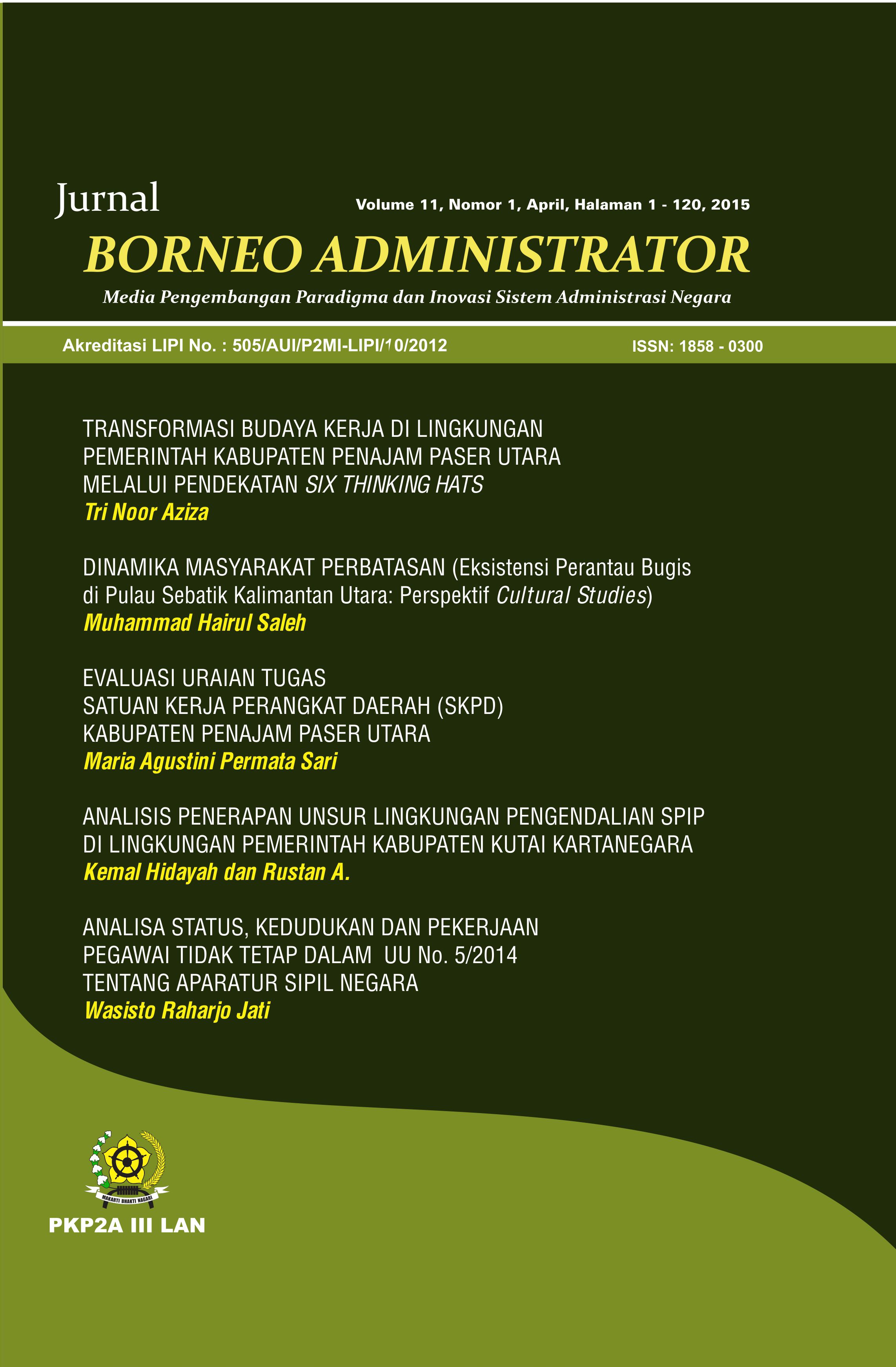
DINAMIKA MASYARAKAT PERBATASAN (Eksistensi Perantau Bugis di Pulau Sebatik Kalimantan Utara: Perspektif Cultural Studies)(THE DYNAMICS OF BORDER SOCIETY (The Existence of Bugis Migrants in Sebatik Island North Kalimantan: Perspective of Cultural Studies))
DOI:
https://doi.org/10.24258/jba.v11i1.184Abstract
This article basically aim to give a description about the existence of Bugis migrants on the Sebatik island by focusing on the ability of Bugis migrants in creating and managing the economic resources linked with the talent to build relationships, both economically and socially as an effort to participate in the development of Sebatik Island. The research method used is descriptive qualitative, in which data and related information are collected through literature study and empirical research that are concerned about the border's issues, particularly the border of Indonesia and Malaysia. Another technique used is depth interviews with the Bugis migrants. These studies suggest that Bugis migrants in Sebatik Islandare immigrants who have a dream to improve their living standards. With the principle of "hard work will bring maximum results" and supported by the ability to survive and always prepared to face the challenge, Bugis migrants has controlled most economic resources and become an important actor for the existence of society and development in Sebatik Island. Interaction among fellow of Bugis migrants in Sebatik Island, as well as interaction with immigrants from other regions and indigenous people, is the social capital that is crucial for the success of the Bugis migrants in Sebatik Island.
Keywords : Sebatik Island, Bugis Migrants, Border Communities, Social Dynamics
Artikel ini pada dasarnya ingin memberikan gambaran mengenai eksistensi perantau Bugis di Pulau Sebatik dengan fokus pada kemampuan perantau Bugis dalam menciptakan dan mengelola sumber-sumber ekonomi yang dibarengi dengan kemampuan membangun relasi, baik ekonomi maupun sosial sebagai upaya turut berpartisipasi dalam pembangunan di Pulau Sebatik. Metode penelitian yang digunakan adalah deskriptif kualitatif, dimana untuk mendapatkan data dan informasi terkait, dilakukan pengumpulan data melalui studi pustaka dari buku-buku dan tulisan-tulisan hasil penelitian yang concern dengan perbatasan, khususnya perbatasan Indonesia dengan Malaysia. Teknik lain yang digunakan adalah melalui wawancara dengan warga perantau Bugis yang menjadi pelaku. Hasil studi ini menunjukkan bahwa Migran Bugis di Pulau Sebatik merupakan perantau-perantau yang memiliki mimpi untuk meningkatkan taraf hidupnya. Dengan memegang teguh prinsip “kerja keras akan membawa hasil yang maksimal” serta didukung oleh kemampuan untuk bertahan dan selalu siap menghadapi tantangan menjadikan Perantau Bugis sebagian besar menguasai sumber-sumber ekonomi dan menjadi aktor penting bagi keberlangsungan hidup masyarakat dan pembangunan di Pulau Sebatik. Interaksi antar sesama perantau Bugis di Pulau Sebatik, serta interaksi dengan perantau dari wilayah lain dan masyarakat asli, merupakan modal sosial yang sangat menentukan bagi kesuksesan perantau Bugis di Pulau Sebatik
Kata Kunci : Pulau Sebatik, Perantau Bugis, Masyarakat Perbatasan, Dinamika Sosial
Downloads
Downloads
How to Cite
Issue
Section
License
Copyright (c) 2015 Author(s)

This work is licensed under a Creative Commons Attribution-NonCommercial-ShareAlike 4.0 International License.
Policy for Journals That Offer Open Access
Authors who publish with this journal agree to the following terms:
- Authors retain copyright and grant the journal right of first publication with the work simultaneously licensed under a Creative Commons Attribution-NonCommercial-ShareAlike 4.0 International License that allows others to share the work with an acknowledgement of the work's authorship and initial publication in this journal.
- Authors are able to enter into separate, additional contractual arrangements for the non-exclusive distribution of the journal's published version of the work (e.g., post it to an institutional repository or publish it in a book), with an acknowledgement of its initial publication in this journal.
- Authors are permitted and encouraged to post their work online (e.g., in institutional repositories or on their website) prior to and during the submission process, as it can lead to productive exchanges, as well as earlier and greater citation of published work (See The Effect of Open Access).