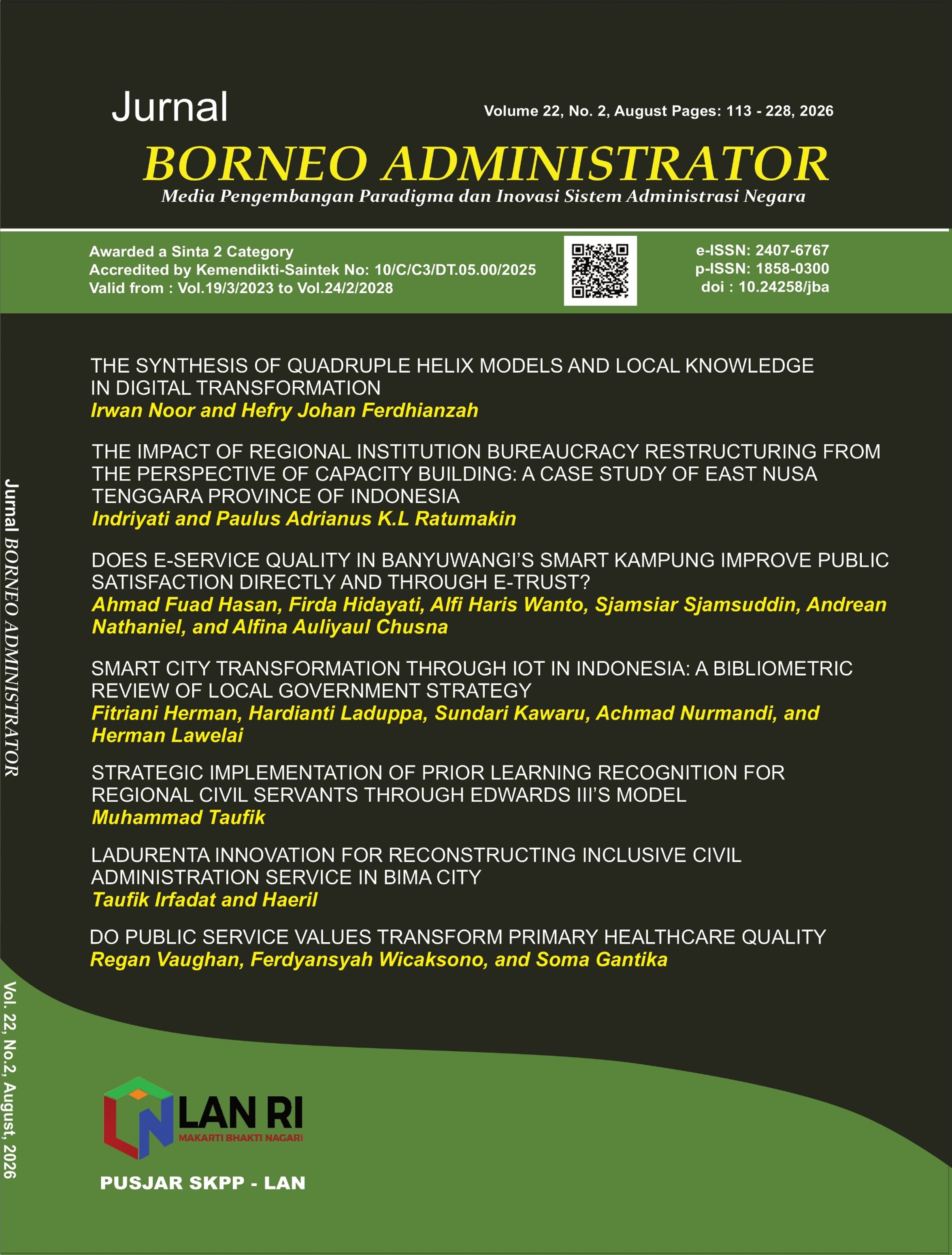
Strategic Implementation of Prior Learning Recognition for Regional Civil Servants Through Edwards III’s Model
DOI:
https://doi.org/10.24258/jba.v22i2.1927Abstract
Prior Learning Recognition (RPL) has emerged as a strategic instrument in Indonesia’s bureaucratic reform agenda, yet its implementation within regional government remains fragmented. This study applies Edwards III’s policy implementation model, comprising communication, resources, disposition, and bureaucratic structure, to critically analyze institutional readiness and governance constraints in the adoption of RPL. A qualitative content analysis of 42 regulatory, strategic, and academic documents reveals persistent challenges: inconsistent policy communication, limited assessor capacity, inadequate digital infrastructure, uneven leadership commitment, and the absence of standardized operational procedures. These constraints highlight that RPL barriers are structural and organizational rather than merely technical. The study contributes theoretically by extending Edwards III’s framework to competency recognition in public administration, empirically by mapping institutional dynamics of RPL in regional bureaucracies, and practically by offering strategic recommendations for talent management and merit system reform. By bridging classical implementation theory with contemporary human resource innovation, this research advances understanding of RPL as a policy instrument for
accelerating bureaucratic transformation in Indonesia’s decentralized governance system.
Downloads
Downloads
Published
How to Cite
Issue
Section
License
Copyright (c) 2026 Author(s)

This work is licensed under a Creative Commons Attribution-NonCommercial-ShareAlike 4.0 International License.
Policy for Journals That Offer Open Access
Authors who publish with this journal agree to the following terms:
- Authors retain copyright and grant the journal right of first publication with the work simultaneously licensed under a Creative Commons Attribution-NonCommercial-ShareAlike 4.0 International License that allows others to share the work with an acknowledgement of the work's authorship and initial publication in this journal.
- Authors are able to enter into separate, additional contractual arrangements for the non-exclusive distribution of the journal's published version of the work (e.g., post it to an institutional repository or publish it in a book), with an acknowledgement of its initial publication in this journal.
- Authors are permitted and encouraged to post their work online (e.g., in institutional repositories or on their website) prior to and during the submission process, as it can lead to productive exchanges, as well as earlier and greater citation of published work (See The Effect of Open Access).