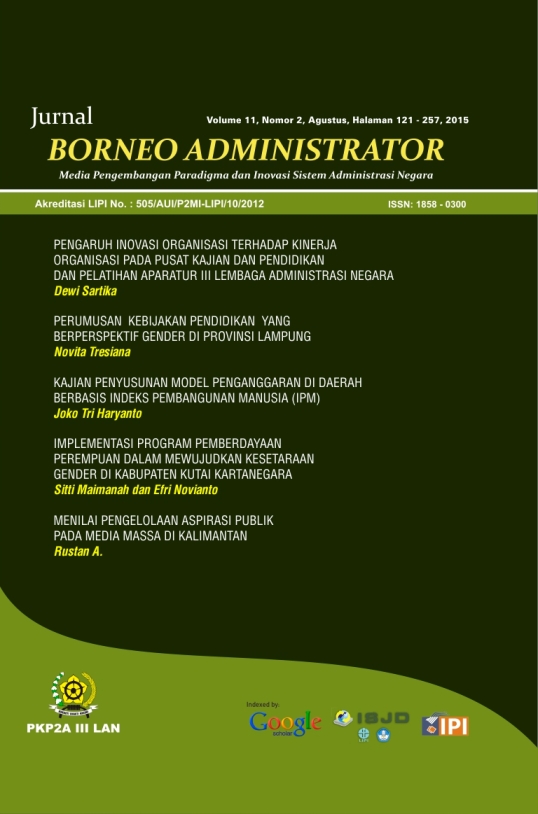
IMPLEMENTASI PROGRAM PEMBERDAYAAN PEREMPUAN DALAM MEWUJUDKAN KESETARAAN GENDER DI KABUPATEN KUTAI KARTANEGARA
DOI:
https://doi.org/10.24258/jba.v11i2.197Abstract
This research aimed to determine the implementation and the results achieved from the women's empowerment program in realizing gender equality in Kutai Kartanegara Regency. This type of research is qualitative deskriftif. Techniques used in determining the source of the data is Nonprobabilty Sampling by the method of Purposive Sampling. For the data collection Techniques used were participant observation, in-depth interviews, and study of the documentation. Data analysis techniques used to use interactive data analysis, as expressed by Miles and Huberman. Based on the results of the research can be inferred that the entire women's empowerment programs have been successfully implemented by the Agency for family planning, women's empowerment and child protection (BKBP3A) District of Kutai Kartanegara, just haven't managed to achieve gender equality in the district Kutai Kartanegara. Factors supporting the implementation of women's empowerment program in realizing gender equality in Kutai Kartanegara Regency, i.e. Regulation that support women's empowerment activities in realizing gender equality, namely Regulation of the Minister of Internal Affairs number 64 in 2011 and Regulation No. 52 Regent by 2013. While the factors restricting implementation of women's empowerment program is lack of budget allocated for financing women's empowerment program, quality of human resources in BKBP3A, limitations information, managing apparatus the attitude and lack of
socialization.
Keywords : Program Implementation, Empowerment of Women, Equality Gender
Penelitian ini ditujukan untuk mengetahui implementasi dan hasil yang dicapai dari program pemberdayaan perempuan dalam mewujudkan kesetaraan gender di Kabupaten Kutai Kartanegara. Jenis penelitian ini adalah kualitatif deskriftif. Teknik yang digunakan dalam menentukan sumber data adalah nonprobabilty sampling dengan metode purposive sampling. Teknik pengumpulan data yang digunakan adalah dengan observasi partisipan, wawancara mendalam dan studi dokumentasi. Teknik analisis data yang digunakan menggunakan analisis data interaktif sebagaimana yang dikemukakan oleh Miles dan Huberman (1992:20). Berdasarkan hasil penelitian bisa disimpulkan bahwa seluruh program pemberdayaan perempuan telah berhasil di implementasikan oleh Badan Keluarga Berencana, Pemberdayaan Perempuan dan Perlindungan Anak (BKBP3A) Kabupaten Kutai Kartanegara, hanya saja belum berhasil mewujudkan kesetaraan gender di Kabupaten Kutai Kartanegara. Faktor pendukung implementasi program pemberdayaan perempuan dalam mewujudkan kesetaraan gender di Kabupaten Kutai Kartanegara yaitu adanya regulasi yang mendukung kegiatan pemberdayaan perempuan dalam mewujudkan kesetaraan gender yaitu Peraturan Menteri Dalam Negeri Nomor 64 Tahun 2011 dan Peraturan Bupati Nomor 52 Tahun 2013. Sedangkan faktor penghambat implementasi program pemberdayaan perempuan adalah minimnya anggaran yang di al okasi kan unt uk membi ayai program pemberdayaan perempuan, kualitas SDM di BKBP3A, keterbatasan informasi, sikap aparatur pelaksana dan kurangnya sosialisasi.
Kata Kunci : Implementasi, Program Pemberdayaan Perempuan, Kesetaraan Gender
Downloads
Downloads
How to Cite
Issue
Section
License
Copyright (c) 2016 Author(s)

This work is licensed under a Creative Commons Attribution-NonCommercial-ShareAlike 4.0 International License.
Policy for Journals That Offer Open Access
Authors who publish with this journal agree to the following terms:
- Authors retain copyright and grant the journal right of first publication with the work simultaneously licensed under a Creative Commons Attribution-NonCommercial-ShareAlike 4.0 International License that allows others to share the work with an acknowledgement of the work's authorship and initial publication in this journal.
- Authors are able to enter into separate, additional contractual arrangements for the non-exclusive distribution of the journal's published version of the work (e.g., post it to an institutional repository or publish it in a book), with an acknowledgement of its initial publication in this journal.
- Authors are permitted and encouraged to post their work online (e.g., in institutional repositories or on their website) prior to and during the submission process, as it can lead to productive exchanges, as well as earlier and greater citation of published work (See The Effect of Open Access).