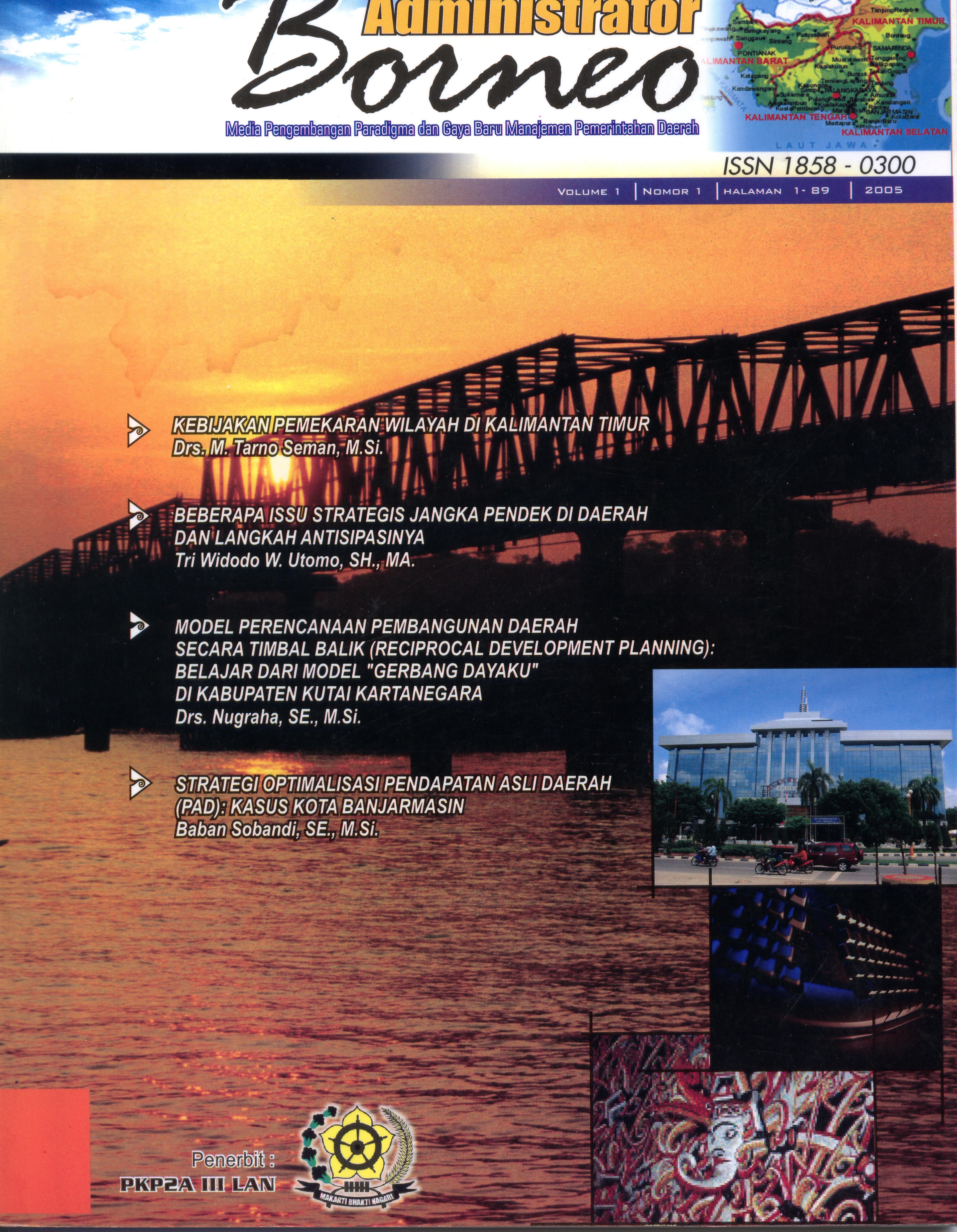
MODEL PERENCANAAN PEMBANGUNAN DAERAH SECARA TIMBAL BALIK (RECIPROCAL DEVELOPMENT PLANNING): Belajar dari Model “Gerbang Dayaku” di Kabupaten Kutai Kartanegara
DOI:
https://doi.org/10.24258/jba.v1i1.2Abstract
The idea of “development from below” (bottom up development planning) has been widely believed as the single answer for the dysfunctional of “development from above” (top-down development planning). Such understanding is not applicable for all cases, however. Empirical evidence shows that the main source of development failures is incompatibility of people’s needs and wants with elite’s decision. In such a case, public participation in the development process has been neglected. As a matter of fact, active participation from the people constitutes one of key successes for the development activities in many countries. Being learnt from the model of “two-stages development planning” in Kutai Kartanegara called Gerbang Dayaku, it can be recapitulated that reciprocal development planning is a requirement to mend the development mechanism stipulated in the Law No. 25/2004 concerning National Development Planning System.Downloads
Download data is not yet available.
Downloads
Published
2014-01-22
How to Cite
Nugraha, D. (2014). MODEL PERENCANAAN PEMBANGUNAN DAERAH SECARA TIMBAL BALIK (RECIPROCAL DEVELOPMENT PLANNING): Belajar dari Model “Gerbang Dayaku” di Kabupaten Kutai Kartanegara. Jurnal Borneo Administrator, 1(1). https://doi.org/10.24258/jba.v1i1.2
Issue
Section
Articles
License
Copyright (c) 2014 Author(s)

This work is licensed under a Creative Commons Attribution-NonCommercial-ShareAlike 4.0 International License.
Policy for Journals That Offer Open Access
Authors who publish with this journal agree to the following terms:
- Authors retain copyright and grant the journal right of first publication with the work simultaneously licensed under a Creative Commons Attribution-NonCommercial-ShareAlike 4.0 International License that allows others to share the work with an acknowledgement of the work's authorship and initial publication in this journal.
- Authors are able to enter into separate, additional contractual arrangements for the non-exclusive distribution of the journal's published version of the work (e.g., post it to an institutional repository or publish it in a book), with an acknowledgement of its initial publication in this journal.
- Authors are permitted and encouraged to post their work online (e.g., in institutional repositories or on their website) prior to and during the submission process, as it can lead to productive exchanges, as well as earlier and greater citation of published work (See The Effect of Open Access).