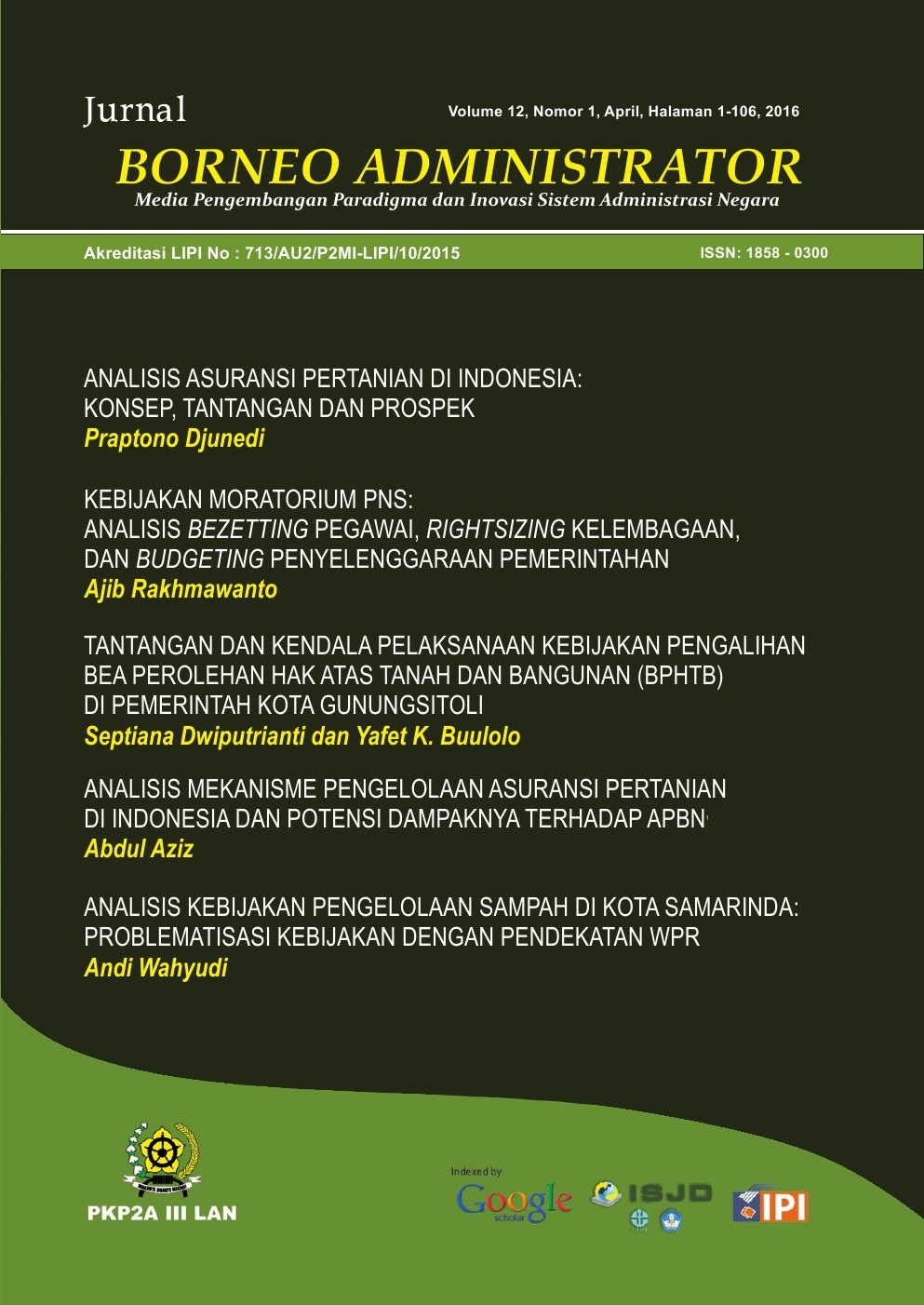
Tantangan dan Kendala Pelaksanaan Kebijakan Pengalihan Bea Perolehan Hak Atas Tanah dan Bangunan (BPHTB) di Pemerintah Kota Gunungsitoli
DOI:
https://doi.org/10.24258/jba.v12i1.211Abstract
The studi aims to review the impact of policy implementation on LandandBuildingAcquisition Tax Transfer (BPHTB) at Gunungsitoli Municipality, based on City Government RegulationNumber 2Year 2011. This study found that there are eight impediments faced by the local government of Gunungsitoli Municipality to implement the new policy of BPHTB, they are: (1) office building that is not feasible to be occupied and functioned as a work place as well as very limited space to serve taxpayers; (2) the local government has not had a proper long-term strategy to explore and enhance the revenue from the tax; (3) the organizational structure and working procedures of the department which are not adjusted with Regulation of Minister of Home Affairs Number 56 Year2010, (4) lack of workload analysis and job analysis, (5) lack of community understanding on BPHTB and payment procedure through the self-assessment system; (6) lack of implementation of the development for employees as well as limited fund for employees training; (7) preparation and formulation of tax regional regulations that are not based on academic study or not involving taxation experts; (8) disagreement between revenue agency and land agency in Nias Regency in conducting the payment receipt verification of BPHTB.
Keywords: local taxes, policy implementation, Gunungsitoli Municipality.
Artikel ini bertujuan untuk menganalisis dampak dari pelaksanaan Peraturan Walikota Gunungsitoli Nomor 2 Tahun 2011 berkaitan dengan pengalihan Bea Perolehan Hakatas Tanah dan Bangunan (BPHTB). Dalam pelaksanaan pengalihan BPHTB di Kota Gunungsitoli mengalami banyak kendala yang meliputi:(1) gedung kantor yang belum layak untuk ditempati dan difungsikan sebagai tempat bekerja, serta sangat terbatas untuk melakukan pelayanan kepada para wajib pajak; (2) pemerintah belum memiliki strategi jangka panjang yang tepat untuk menggali dan meningkatkan pendapatan dari hasil pemungutan pajak; (3) struktur organisasi dan tata kerja dinas yang masih belum disesuaikan dengan Permendagri Nomor 56 Tahun 2010, (4) tidak tersedianya analisis beban kerja dan analisis jabatan, (5) kurangnya pemahaman masyarakat tentang BPHTB dan prosedur pemungutan BPHTB melalui self assessment system; (6) kurangnya pelaksanaan pengembangan pendidikan bagi para pegawai serta keterbatasan anggaran untuk pelaksanaan pelatihan; (7) penyusunan dan perumusan peraturan-peraturan daerah terkait dengan pengelolaan pajak tidak melalui sebuah kajian akademis dari para pakar yang ahli dalam bidang perpajakan;(8) ketidaksepahaman dinas pendapatan dan kantorpertanahan Kabupaten Nias dalam pelaksanaan verifikasi tanda bukti pembayaran BPHTB oleh wajib pajak.
Kata kunci: pajak daerah, implementasi kebijakan, Pemerintah Kota Gunungsitoli.
Downloads
Downloads
How to Cite
Issue
Section
License
Copyright (c) 2016 Author(s)

This work is licensed under a Creative Commons Attribution-NonCommercial-ShareAlike 4.0 International License.
Policy for Journals That Offer Open Access
Authors who publish with this journal agree to the following terms:
- Authors retain copyright and grant the journal right of first publication with the work simultaneously licensed under a Creative Commons Attribution-NonCommercial-ShareAlike 4.0 International License that allows others to share the work with an acknowledgement of the work's authorship and initial publication in this journal.
- Authors are able to enter into separate, additional contractual arrangements for the non-exclusive distribution of the journal's published version of the work (e.g., post it to an institutional repository or publish it in a book), with an acknowledgement of its initial publication in this journal.
- Authors are permitted and encouraged to post their work online (e.g., in institutional repositories or on their website) prior to and during the submission process, as it can lead to productive exchanges, as well as earlier and greater citation of published work (See The Effect of Open Access).