KEWENANGAN DEKONSENTRASI DALAM PENYELENGGARAAN OTONOMI DAERAH DAN PERMASALAHAN PENYELENGGARAANYA* DI DAERAH
DOI:
https://doi.org/10.24258/jba.v4i1.23Abstract
Governance management framework in autonomy framework relies on 3 especial principal, decentralization, dekonsentrasi anda medebewind (Tugas Pembantuan). In the united state corridor, dekonsentrasi and decentralization dekonsentrasi and decentralization cannot be dichotomized, both have to fill and strengthen each other. Dekonsentrasi is often said have strategic function to unify the Republic of Indonesia. Unfortunately, the regulation of dekonsentrasi management is still the minimum grade. This condition has been appropriately generating many problems so that central government have to give serious attention through releasing regulation or policy in synergizing function, institution and programs in dekonsentrasi management so that it can walk as its goals.Key words : Desentralisasi, Dekonsentrasi
Downloads
Download data is not yet available.
Downloads
How to Cite
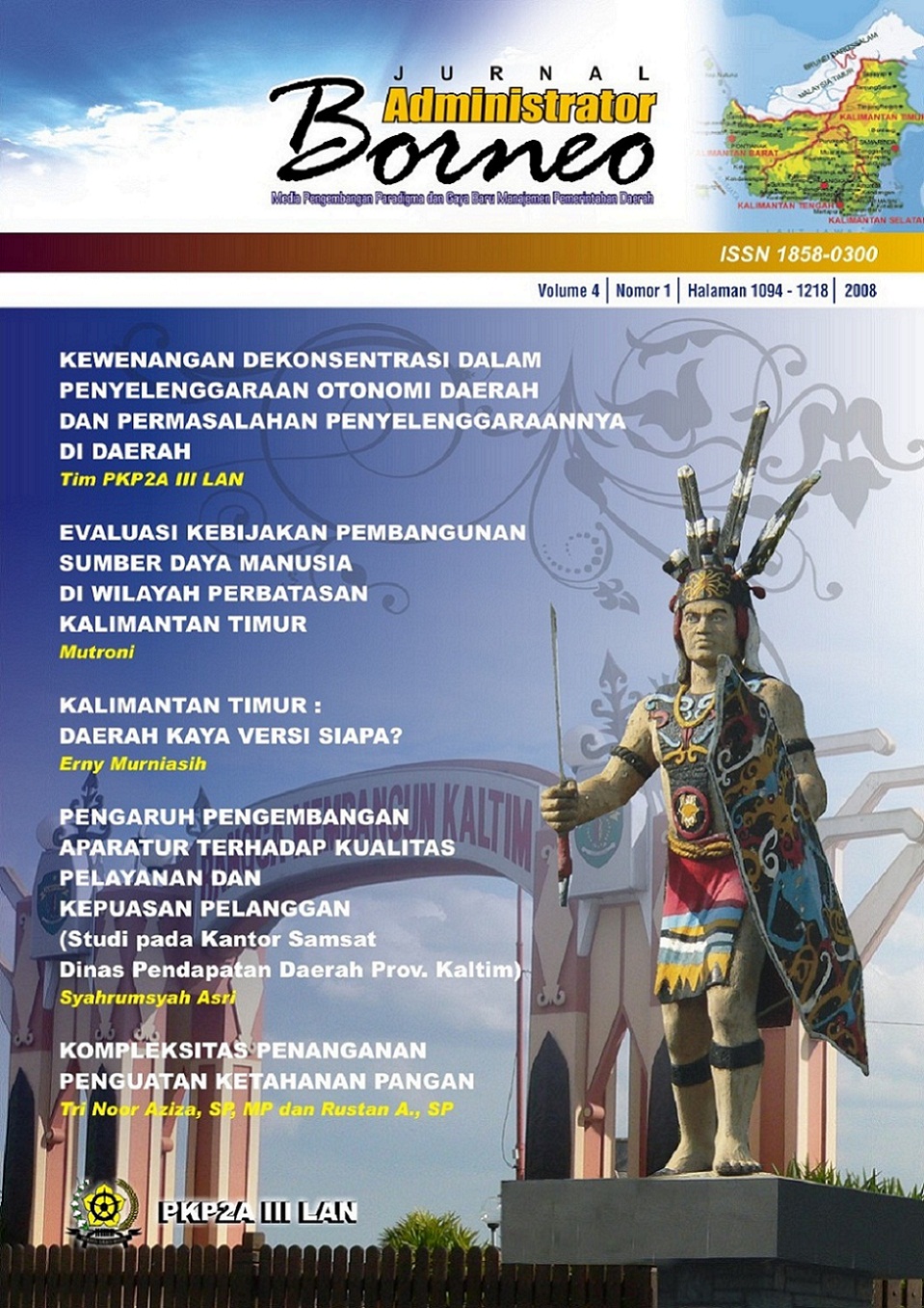
PKP2A III LAN, T. (2014). KEWENANGAN DEKONSENTRASI DALAM PENYELENGGARAAN OTONOMI DAERAH DAN PERMASALAHAN PENYELENGGARAANYA* DI DAERAH. Jurnal Borneo Administrator, 4(1). https://doi.org/10.24258/jba.v4i1.23
Issue
Section
Articles
License
Copyright (c) 2014 Author(s)

This work is licensed under a Creative Commons Attribution-NonCommercial-ShareAlike 4.0 International License.
Policy for Journals That Offer Open Access
Authors who publish with this journal agree to the following terms:
- Authors retain copyright and grant the journal right of first publication with the work simultaneously licensed under a Creative Commons Attribution-NonCommercial-ShareAlike 4.0 International License that allows others to share the work with an acknowledgement of the work's authorship and initial publication in this journal.
- Authors are able to enter into separate, additional contractual arrangements for the non-exclusive distribution of the journal's published version of the work (e.g., post it to an institutional repository or publish it in a book), with an acknowledgement of its initial publication in this journal.
- Authors are permitted and encouraged to post their work online (e.g., in institutional repositories or on their website) prior to and during the submission process, as it can lead to productive exchanges, as well as earlier and greater citation of published work (See The Effect of Open Access).