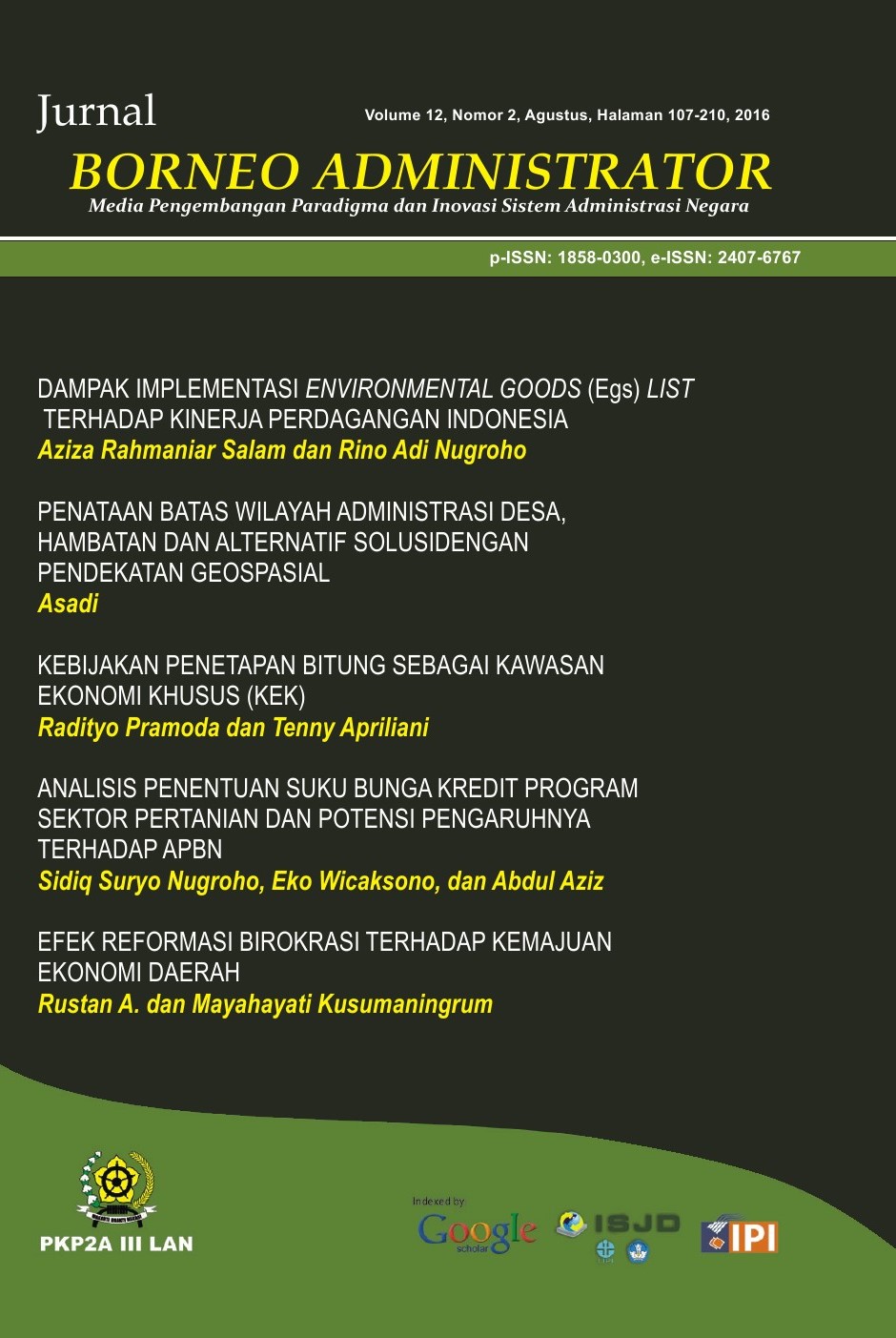
Dampak Implementasi Environmental Goods (EGS) List Terhadap Kinerja Perdagangan Indonesia
DOI:
https://doi.org/10.24258/jba.v12i2.236Abstract
Preparation of Environmental Goods list (EGs) and its implementation plan in international trade among APEC members will have impact on trade flows to the economics of its member, including Indonesia. This analysis aims to determine the potential impact that will be faced by Indonesia’s trade performance. This analysis used a Gravity model on 54 EGs products with GDP, value of imports, the distance and tariffs as variable. The analysis showed that GDP, value of imports and tariffs significantly affect Indonesian exports and imports, while distance has no significant effect either on export or import of Indonesia. Of the 48 products which can be processed, 38 products EGS will impact to increase Indonesia’s imports better rather than other APEC member, which in turn will lead trade balance into deficit. 10 products, providing the possibility of increasing Indonesian exports to APEC. Overall, EGS product is manufactured products produced by developed countries, so the elimination of tariffs provide less incentive for domestic producers to increase production to meet domestic and foreign demand. Indonesia should have initiative to create and strengthen domestic industries that are environmentally friendly, facilitating investment, deregulation of the domestic private sector to build and increase productivity.
Keywords : APEC, Environmental Goods list, Indonesia trade performance
Penyusunan Environmental Goods list (EGs) dan rencana implementasinya dalam perdagangan internasional antar negara APEC akan membawa dampak pada arus perdagangan yang selanjutnya pada perekonomian masing-masing anggota, termasuk Indonesia. Analisis ini bertujuan untuk mengetahui dampak potensial yang dihadapi Indonesia dengan diimplementasikannya EGs list terhadap kinerja perdagangan. Analisis ini menggunakan Gravity model pada 54 produk EGs dengan variabel PDB, nilai impor, jarak dan tarif bea masuk. Hasil analisis menunjukkan bahwa PDB, nilai impor dan tarif signifikan mempengaruhi ekspor dan impor Indonesia akan produk EGs, sedangkan jarak tidak berpengaruh signifikan baik terhadap ekspor maupun impor Indonesia. Dari 48 produk, yang dapat diolah, 38 produk EGs akan memberikan dampak pada meningkatnya impor Indonesia dari anggota APEC lainnya, yang pada akhirnya akan menyebabkan neraca perdagangan menjadi defisit. Sepuluh produk akan memberikan dampak kemungkinan terjadi peningkatan ekspor Indonesia ke negara APEC. Secara keseluruhan, produk EGs merupakan produk manufaktur yang dihasilkan oleh negara maju, sehingga penurunan tarif kurang memberikan insentif bagi produsen domestik untuk meningkatkan produksi dalam memenuhi permintaan domestik maupun asing. Indonesia harus memiliki inisiatif untuk menciptakan dan memperkuat industri domestik yang ramah lingkungan, memfasilitasi investasi, deregulasi untuk membangun sektor swasta domestik dan peningkatan produktivitas.
Kata kunci: APEC, EGs list, Neraca Perdagangan Indonesia
Downloads
Downloads
How to Cite
Issue
Section
License
Copyright (c) 2016 Author(s)

This work is licensed under a Creative Commons Attribution-NonCommercial-ShareAlike 4.0 International License.
Policy for Journals That Offer Open Access
Authors who publish with this journal agree to the following terms:
- Authors retain copyright and grant the journal right of first publication with the work simultaneously licensed under a Creative Commons Attribution-NonCommercial-ShareAlike 4.0 International License that allows others to share the work with an acknowledgement of the work's authorship and initial publication in this journal.
- Authors are able to enter into separate, additional contractual arrangements for the non-exclusive distribution of the journal's published version of the work (e.g., post it to an institutional repository or publish it in a book), with an acknowledgement of its initial publication in this journal.
- Authors are permitted and encouraged to post their work online (e.g., in institutional repositories or on their website) prior to and during the submission process, as it can lead to productive exchanges, as well as earlier and greater citation of published work (See The Effect of Open Access).