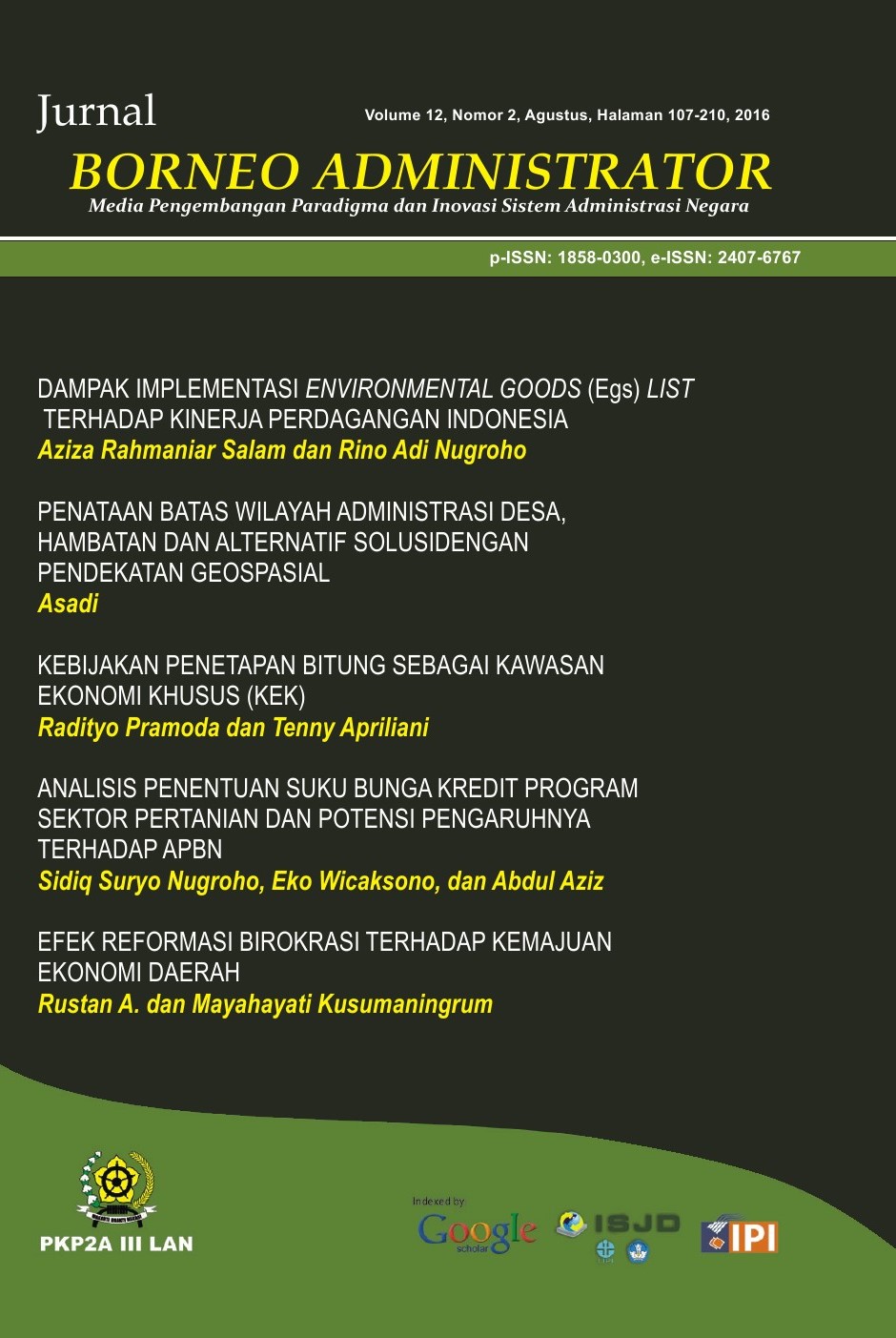
Analisis Penentuan Suku Bunga Kredit Program Sektor Pertanian dan Potensi Pengaruhnya Terhadap APBN
DOI:
https://doi.org/10.24258/jba.v12i2.239Abstract
This study is aimed to investigate the determination of interest rate subsidy provided by the government to help farmers and improve agricultural productivity. One parameter used to determine the interest rate of credit program is the Deposit Insurance Agency (LPS) interest rate. The basis for determining the interest rate credit program is one of the main issues discussed in this study. In addition, other matter discussed in this study is the proportion of interest expense borne each by the debtor and the government. The study is conducted by using mix methods analysis using primary data derived from the survey and secondary data related lending rates. Based on the analysis conducted, there are several conclusions that can be drawn. First, interest rates LPS is appropriate as the basis for determining the interest rate of credit interest rate guarantee program since LPS rate constitutes the largest portion of cost of fund. Second, in the long term the government needs to evaluate patterns of current credit program so that it can both increase the selfreliance of farmers and improve the efficiency and efectivity of government subsidy. Third, for the time being the government can implement a fixed interest rate subsidy to credit the program with regard to the ability of farmers to minimize the fiscal risks exposure in the government budget.
Keywords: Agriculture, credit program, subsidy, fiscal risk, fixed interest rate.
Kajian ini bertujuan untuk melakukan analisis terhadap penetapan subsidi bunga kredit program yang diberikan oleh pemerintah untuk membantu petani dan meningkatkan produktivitas pertanian.Salah satu parameter dalam penentuan tingkat suku bunga kredit program adalah tingkat suku bunga penjaminan Lembaga Penjamin Simpanan(LPS).Dasar penentuan suku bunga kredit program merupakan salah satu permasalahan yang dibahas dalam kajian ini.Selain itu, hal lainnya yang dibahas dalam kajian ini adalah proporsi beban bunga yang ditanggung oleh debitur dan pemerintah.Kajian ini dilakukan dengan menggunakan metode campuran dengan menggunakan data primer yang berasal dari survei serta data sekunder terkait suku bunga kredit.Berdasarkan analisis yang dilakukan terdapat beberapa kesimpulan yang dapat diambil. Pertama, suku bunga penjaminan LPS layak untuk dijadikan dasar penentuan tingkat suku bunga kredit program karena suku bunga penjaminan LPS merupakan salah satu komponen terbesar biaya dana dari perbankan saat ini. Kedua, dalam jangka panjang pemerintah perlu untuk mengevaluasi pola pemberian kredit program saat ini sehingga di satu sisi dapat meningkatkan kemandirian petani dan disisi lain dapat meningkatkan efisiensi dan efektivitas belanja subsidi pemerintah. Ketiga, untuk saat ini pemerintah dapat menerapkan subsidi bunga tetap untuk kredit program dengan tetap memperhatikan kemampuan petani sehingga dapat meminimalkan risiko fiskal dalam APBN.
Kata Kunci: Pertanian, kredit program, subsidi, risiko fiskal, suku bunga tetap.
Downloads
Downloads
How to Cite
Issue
Section
License
Copyright (c) 2016 Author(s)

This work is licensed under a Creative Commons Attribution-NonCommercial-ShareAlike 4.0 International License.
Policy for Journals That Offer Open Access
Authors who publish with this journal agree to the following terms:
- Authors retain copyright and grant the journal right of first publication with the work simultaneously licensed under a Creative Commons Attribution-NonCommercial-ShareAlike 4.0 International License that allows others to share the work with an acknowledgement of the work's authorship and initial publication in this journal.
- Authors are able to enter into separate, additional contractual arrangements for the non-exclusive distribution of the journal's published version of the work (e.g., post it to an institutional repository or publish it in a book), with an acknowledgement of its initial publication in this journal.
- Authors are permitted and encouraged to post their work online (e.g., in institutional repositories or on their website) prior to and during the submission process, as it can lead to productive exchanges, as well as earlier and greater citation of published work (See The Effect of Open Access).