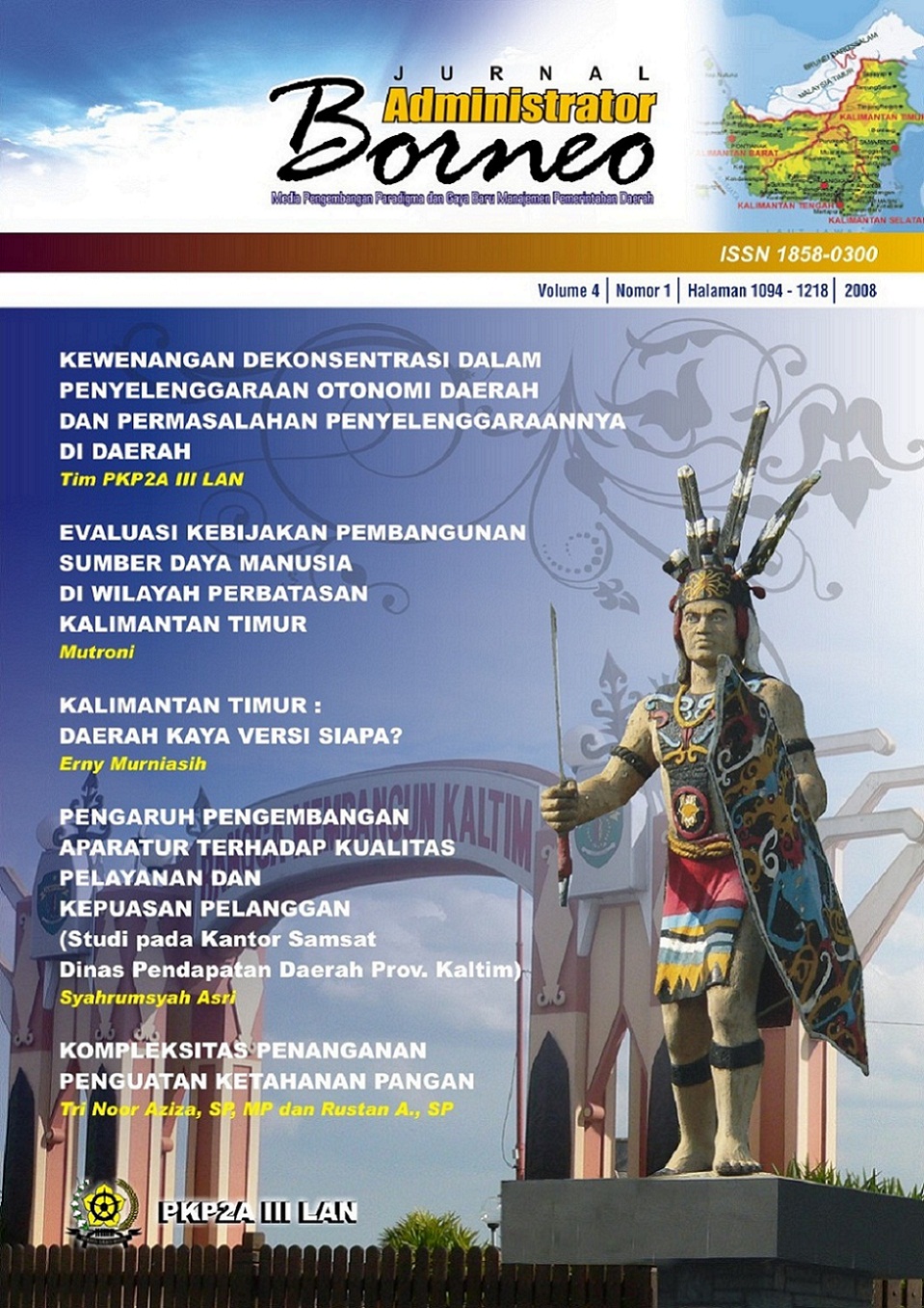
EVALUASI KEBIJAKAN PEMBANGUNAN SUMBER DAYA MANUSIA DI WILAYAH PERBATASAN KALIMANTAN TIMUR
DOI:
https://doi.org/10.24258/jba.v4i1.25Abstract
Frontier region in such of state have high strategic value, evaluated from ideology aspect, political, social, economic, culture, state security and defence. The think mentioned above, now newly get serious attention, after changing over status of Sipadan and Ligitan Island from NKRI to state of Malaysia and also caught up with will grab of Block Ambalat and Karang Unarang by state of Malaysia. This research conducted in order to strengthening regional function frontier of Republic Of Indonesia especially in East Kalimantan Province, passing development of human resource, felt progressively insist on its requirement. In the end this study meant to give recommendation to related other party and government, about strategy and step able to quicken execution of program development of economics in frontier region in general and in area development of human resource especially.Keywords: wilayah perbatasan, pembanguanan sumber daya manusia, Kalimantan Timur.
Downloads
Download data is not yet available.
Downloads
How to Cite
RONI, M. (2014). EVALUASI KEBIJAKAN PEMBANGUNAN SUMBER DAYA MANUSIA DI WILAYAH PERBATASAN KALIMANTAN TIMUR. Jurnal Borneo Administrator, 4(1). https://doi.org/10.24258/jba.v4i1.25
Issue
Section
Articles
License
Copyright (c) 2014 Author(s)

This work is licensed under a Creative Commons Attribution-NonCommercial-ShareAlike 4.0 International License.
Policy for Journals That Offer Open Access
Authors who publish with this journal agree to the following terms:
- Authors retain copyright and grant the journal right of first publication with the work simultaneously licensed under a Creative Commons Attribution-NonCommercial-ShareAlike 4.0 International License that allows others to share the work with an acknowledgement of the work's authorship and initial publication in this journal.
- Authors are able to enter into separate, additional contractual arrangements for the non-exclusive distribution of the journal's published version of the work (e.g., post it to an institutional repository or publish it in a book), with an acknowledgement of its initial publication in this journal.
- Authors are permitted and encouraged to post their work online (e.g., in institutional repositories or on their website) prior to and during the submission process, as it can lead to productive exchanges, as well as earlier and greater citation of published work (See The Effect of Open Access).