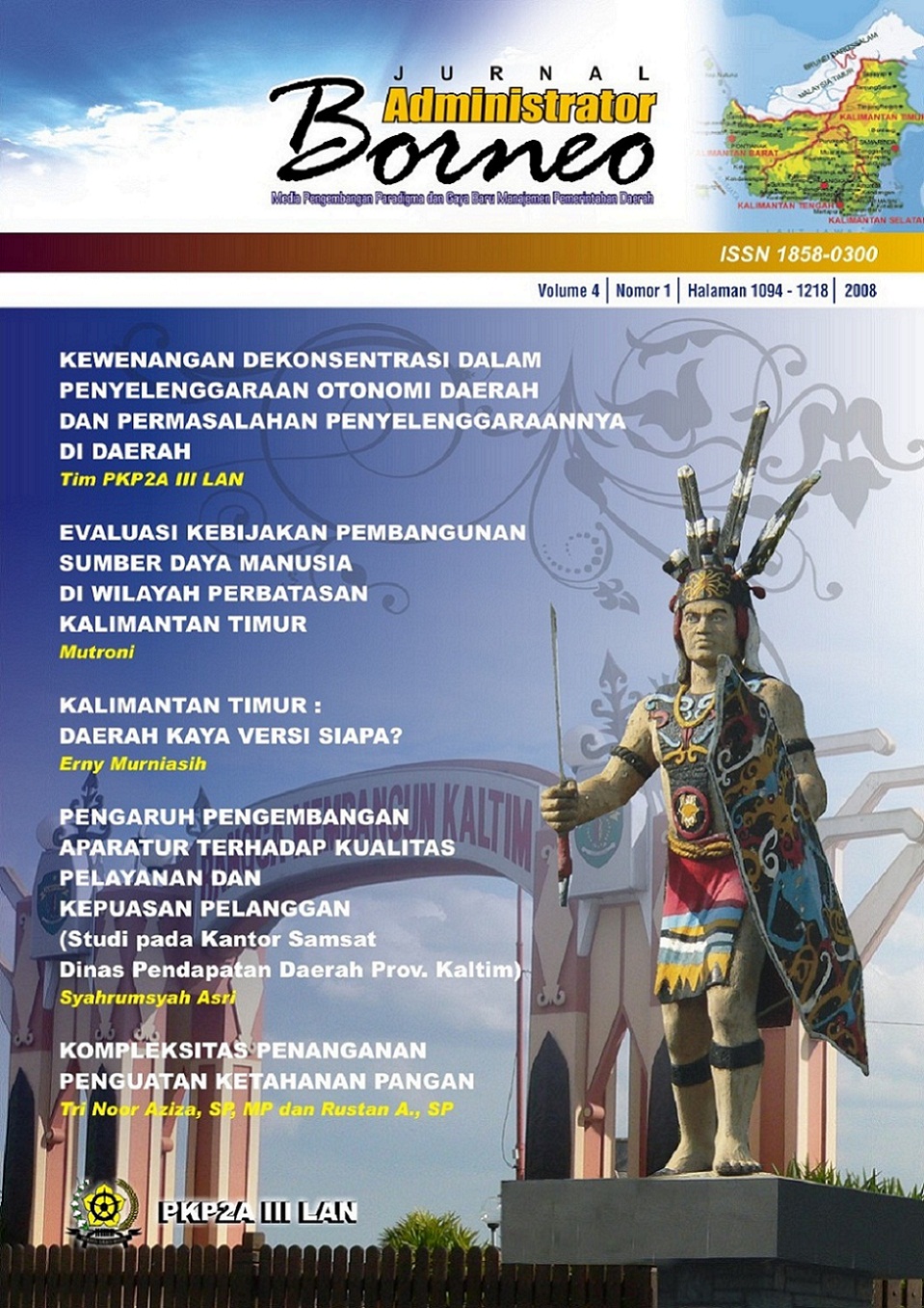
KALIMANTAN TIMUR : DAERAH KAYA VERSI SIAPA?
DOI:
https://doi.org/10.24258/jba.v4i1.26Abstract
The simplest way to understand decentralisation is bringing the government closer to its people. From the economic view, the implementation of decentralisation will improve in economic efficiency, service delivery, and accountability. In Indonesia, decentralisation has developed in form of political, fiscal, and administrative decentralisation. In fiscal decentralisation, the country applies the money follows function principle as a means to give fiscal balance between central and sub-national governments. Therefore,SNG’s are granted with local-own sources and intergovernmental fiscal transfers to finance the assigned functions. The main objective for fiscal decentralisation is to increase welfare at the local level. To what extent that this occur in Province East Kalimantan? The fact that the Province has a substantial revenue from natural resources which makes its GRDP increased. Theoretically, an increase in GRDP will affect on the increase number of employment and on the reduction of the poor. However, what has happened in East Kalimantan is on the reverse side. Increase in GRDP does not necessarily reveal that the people, particularly the poor, would be better-off. This paper tries to analyse the case and provides with possible solution.Keywords : Desentralisasi Fiskal, Dana Perimbangan, Dana Bagi Hasil Sumber Daya Alam
Downloads
Download data is not yet available.
Downloads
How to Cite
Murniasih, E. (2014). KALIMANTAN TIMUR : DAERAH KAYA VERSI SIAPA?. Jurnal Borneo Administrator, 4(1). https://doi.org/10.24258/jba.v4i1.26
Issue
Section
Articles
License
Copyright (c) 2014 Author(s)

This work is licensed under a Creative Commons Attribution-NonCommercial-ShareAlike 4.0 International License.
Policy for Journals That Offer Open Access
Authors who publish with this journal agree to the following terms:
- Authors retain copyright and grant the journal right of first publication with the work simultaneously licensed under a Creative Commons Attribution-NonCommercial-ShareAlike 4.0 International License that allows others to share the work with an acknowledgement of the work's authorship and initial publication in this journal.
- Authors are able to enter into separate, additional contractual arrangements for the non-exclusive distribution of the journal's published version of the work (e.g., post it to an institutional repository or publish it in a book), with an acknowledgement of its initial publication in this journal.
- Authors are permitted and encouraged to post their work online (e.g., in institutional repositories or on their website) prior to and during the submission process, as it can lead to productive exchanges, as well as earlier and greater citation of published work (See The Effect of Open Access).