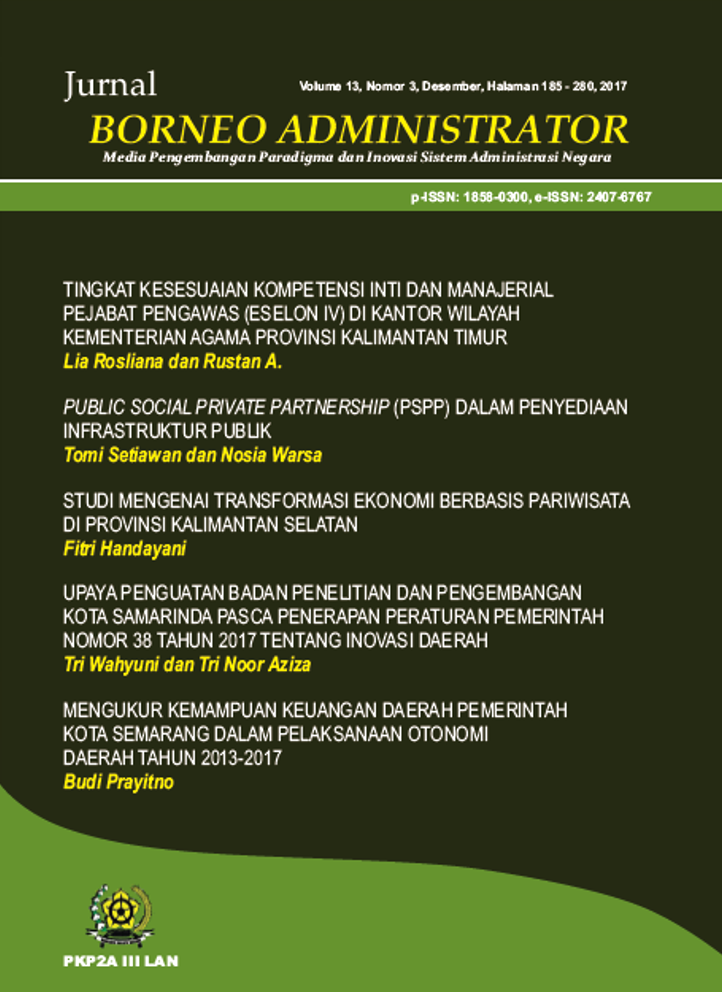
Mengukur Kemampuan Keuangan Daerah Pemerintah Kota Semarang Dalam Pelaksanaan Otonomi Daerah Tahun 2013-2017
DOI:
https://doi.org/10.24258/jba.v13i3.289Abstract
For the last five years, Semarang City has shown significant improvements in its public services, urban planning, and regional development. Local government leaders and most importantly financial performance of Semarang City Local Government are some of the key factors behind its success. This research is aimed to identify fiscal decentralization level of Semarang City Local Government within 2013-2017 by analyzing financial capacity of Semarang City, level of fiscal decentralization, ratio balance between operational and capital expenditure, as
well as contribution of Regional Revenue (PAD) towards its Regional Budget (APBD). The research indicates that Semarang City’s Fiscal Sovereign Rating Position is at Participatory Level. Semarang City Local Government is considered nearly capable in performing regional autonomy matters. Moreover, Fiscal Decentralization Ratio Level shows that the financial capacity of Semarang City is at moderate level with average proportion of 36,53%. Ratio between Daily Expenditure and PAD (Regional Revenue) shows financial capacity of Semarang City is at excellent position. In average, the proportion between daily and development expenditure is 41.27% and 58.73% . Additionally, PAD contribution towards Regional Budget (APBD) gradually increases each year. In general, financial performance of Semarang City Local Government improves every year.
Keywords: regional autonomy, fiscal decentralization, local revenue, financial performance
Kota Semarang sepanjang kurun waktu lima tahun terakhir menunjukkan perubahan yang signifikan, baik dari segi pelayanan, penataan kota, serta pembangunan. Selain tidak lepas dari faktor pemimpin daerah, faktor lain yang tidak boleh dilupakan adalah kinerja keuangan Pemerintah Kota Semarang. Penelitian ini bertujuan untuk mengetahui derajat desentralisasi fiskal Pemerintah Kota Semarang dalam kurun waktu 2013- 2017 dengan menganalisis kemampuan keuangan daerah, derajat desentralisasi fiskal, rasio keserasian antara belanja operasional dengan belanja modal, serta kontribusi PAD terhadap APBD Kota Semarang. Hasil penelitian menunjukkan bahwa Rasio Kemandirian Keuangan Pemerintah Kota Semarang berada pada level Partisipatif. Pemerintah Kota Semarang dianggap sudah mendekati mampu melaksanakan urusan otonomi daerah.
Rasio Derajat Desentralisasi Fiskal juga menunjukkan kemampuan keuangan Pemerintah Kota Semarang dalam level Sedang dengan proporsi rata-rata mencapai 36,53 %. Rasio Pengeluaran Rutin dengan PAD menunjukkan Kemampuan Keuangan Pemerintah Kota Semarang pada posisi Sangat Baik. Jika diproporsi secara rata-rata, proporsi antara belanja rutin dan belanja pembangunan yakni 41,27 % berbanding 58,73 %. Demikian juga kontribusi PAD terhadap total Pendapatan APBD menunjukkan kenaikan secara bertahap dari tahun ke tahun. Secara umum kinerja keuangan Pemerintah Kota Semarang menunjukkan kemampuan yang semakin baik dari tahun ke tahun.
Kata kunci : otonomi daerah, desentralisasi fiskal, pendapatan asli daerah, kinerja keuangan
Downloads
Downloads
Published
How to Cite
Issue
Section
License
Copyright (c) 2018 Author(s)

This work is licensed under a Creative Commons Attribution-NonCommercial-ShareAlike 4.0 International License.
Policy for Journals That Offer Open Access
Authors who publish with this journal agree to the following terms:
- Authors retain copyright and grant the journal right of first publication with the work simultaneously licensed under a Creative Commons Attribution-NonCommercial-ShareAlike 4.0 International License that allows others to share the work with an acknowledgement of the work's authorship and initial publication in this journal.
- Authors are able to enter into separate, additional contractual arrangements for the non-exclusive distribution of the journal's published version of the work (e.g., post it to an institutional repository or publish it in a book), with an acknowledgement of its initial publication in this journal.
- Authors are permitted and encouraged to post their work online (e.g., in institutional repositories or on their website) prior to and during the submission process, as it can lead to productive exchanges, as well as earlier and greater citation of published work (See The Effect of Open Access).