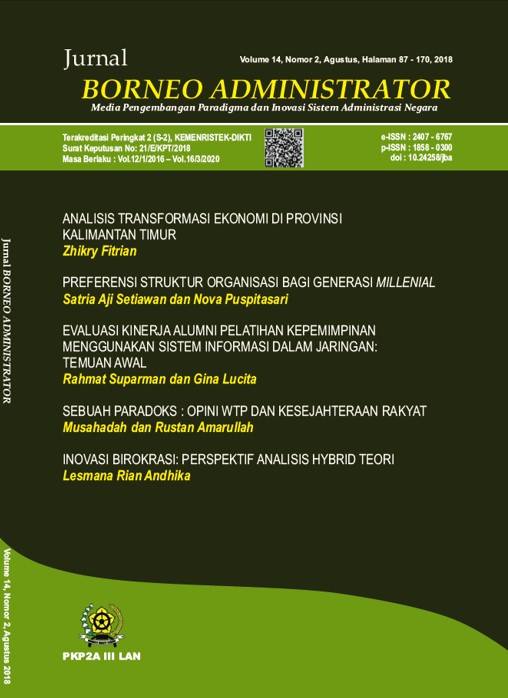
Sebuah Paradoks : Opini WTP dan Kesejahteraan Rakyat
DOI:
https://doi.org/10.24258/jba.v14i2.335Abstract
Unqualified Opinion (WTP) is the audit opinion that will be issued if the financial statements are considered to provide information that is free from material misstatement. This opinion became the dream of all local governments and even become a major performance indicator for the Inspectorate area. Nevertheless, the acquisition of the WTP opinion is still found to be contradictory to the welfare conditions of the people. This study qualitatively seeks to examine the need for an examination of financial governance that also includes indicators of people’s welfare. The hermeneutic method is used to analyze the welfare audit discourse that needs to be carried out by BPK so that each rupiah of local government expenditure is beneficial for the improvement of people’s welfare as well as in harmony with the WTP opinion obtained. The results of the research indicate that BPK needs to include welfare audit in the process of local government financial audit from planning, implementation, to reporting activities that concretely support the achievement of public welfare. Thus, the philosophical management of state/ regional finances is used openly, responsibly, and as much as possible for the welfare of the people can be realized. From the internal side of local government, it is necessary to strengthen the internal control system, as well as strict supervision from the Inspectorate.
Keywords: Society Welfare Audit, Hermeneutical, Unqualified Opinion, Government External Audit
Abstrak
Opini Wajar Tanpa Pengecualian (WTP) adalah opini audit yang akan diterbitkan jika laporan keuangan pemerintah dianggap memberikan informasi yang bebas dari salah saji material. Opini ini menjadi idaman seluruh Pemerintah Daerah bahkan menjadi indikator kinerja utama bagi Inspektorat daerahnya. Namun demikian, perolehan opini WTP tersebut masih ditemukan berkontradiksi dengan kondisi kesejahteraan rakyat. Penelitian ini secara kualitatif berupaya mendalami perlunya pemeriksaan tata kelola keuangan yang juga mengikutsertakan indikator kesejahteraan rakyat.Metode hermeneutik digunakan untuk menganalisis wacana audit kesejahteraan yang perlu dilaksanakan oleh BPK agar setiap rupiah belanja pemerintah daerah bermanfaat bagi peningkatan kesejahteraan rakyat serta selaras dengan opini WTP yang diperoleh. Hasil penelitian menunjukan pemaknaan bahwa BPK perlu memasukkan audit kesejahteraan dalam proses pemeriksaan keuangan pemerintah daerah mulai dari kegiatan perencanaan, pelaksanaan, hingga pada pelaporan yang secara konkrit mendukung pencapaian kesejahteraan masyarakat. Dengan demikian, filosofis pengelolaan keuangan negara/ daerah dipergunakan secara terbuka, bertanggung jawab, dan sebesar-besarnya untuk kemakmuran rakyat dapat diwujudkan. Dari sisi internal pemerintah daerah, diperlukan penguatan atas sistem pengendalian internal, serta pengawasan yang ketat dari Inspektorat.
Kata kunci: Audit Kesejahteraan Rakyat, Hermeneutika, WTP, Pemeriksaan Eksternal Pemerintah
Downloads
Downloads
Published
How to Cite
Issue
Section
License
Copyright (c) 2018 Author(s)

This work is licensed under a Creative Commons Attribution-NonCommercial-ShareAlike 4.0 International License.
Policy for Journals That Offer Open Access
Authors who publish with this journal agree to the following terms:
- Authors retain copyright and grant the journal right of first publication with the work simultaneously licensed under a Creative Commons Attribution-NonCommercial-ShareAlike 4.0 International License that allows others to share the work with an acknowledgement of the work's authorship and initial publication in this journal.
- Authors are able to enter into separate, additional contractual arrangements for the non-exclusive distribution of the journal's published version of the work (e.g., post it to an institutional repository or publish it in a book), with an acknowledgement of its initial publication in this journal.
- Authors are permitted and encouraged to post their work online (e.g., in institutional repositories or on their website) prior to and during the submission process, as it can lead to productive exchanges, as well as earlier and greater citation of published work (See The Effect of Open Access).