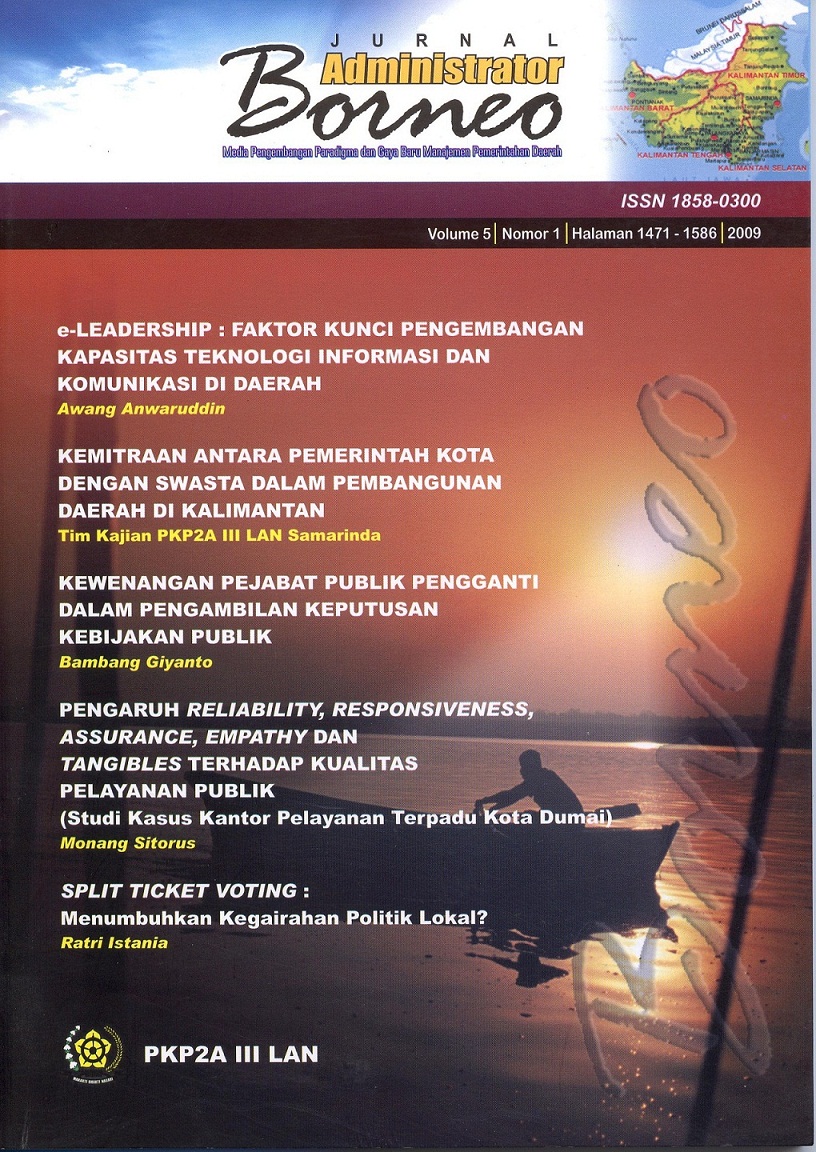
e-LEADERSHIP: Faktor Kunci Pengembangan Kapasitas Teknologi Informasi dan Komunikasi di Daerah
DOI:
https://doi.org/10.24258/jba.v5i1.37Abstract
Leadership is not limited to a position or job; it is a worldview and a way of being in the world. It takes vision and imagination as well as knowledge, to be a leader. We define leadership as the ability to bring people, tools and resources together to solve problems and achieve results. In the world today, we need to bring people together across national, geographic, cultural and other boundaries, using communications technologies tools to achieve results. e-Leadership means a balancing many roles and carrying them out via communications technologies. Thus, e-Leadership is no different from any other form of effective leadership except that in e-leadership you have no option but to be very good at it. It requires a high level of transformational leadership because of the highly participative nature of the e-world between e-organisations and e-customers and the interconnectedness between leader and follower with the ever-increasing reality of the blurred lines between the two(Robert Burke: 2008).
Key Word: e-Leadership, e-Government, Kepemimpinan transformasional, Virtual tim, Komunikasi multilevel, Profesionalitas
Downloads
Download data is not yet available.
Downloads
How to Cite
Anwaruddin, A. (2014). e-LEADERSHIP: Faktor Kunci Pengembangan Kapasitas Teknologi Informasi dan Komunikasi di Daerah. Jurnal Borneo Administrator, 5(1). https://doi.org/10.24258/jba.v5i1.37
Issue
Section
Articles
License
Copyright (c) 2014 Author(s)

This work is licensed under a Creative Commons Attribution-NonCommercial-ShareAlike 4.0 International License.
Policy for Journals That Offer Open Access
Authors who publish with this journal agree to the following terms:
- Authors retain copyright and grant the journal right of first publication with the work simultaneously licensed under a Creative Commons Attribution-NonCommercial-ShareAlike 4.0 International License that allows others to share the work with an acknowledgement of the work's authorship and initial publication in this journal.
- Authors are able to enter into separate, additional contractual arrangements for the non-exclusive distribution of the journal's published version of the work (e.g., post it to an institutional repository or publish it in a book), with an acknowledgement of its initial publication in this journal.
- Authors are permitted and encouraged to post their work online (e.g., in institutional repositories or on their website) prior to and during the submission process, as it can lead to productive exchanges, as well as earlier and greater citation of published work (See The Effect of Open Access).