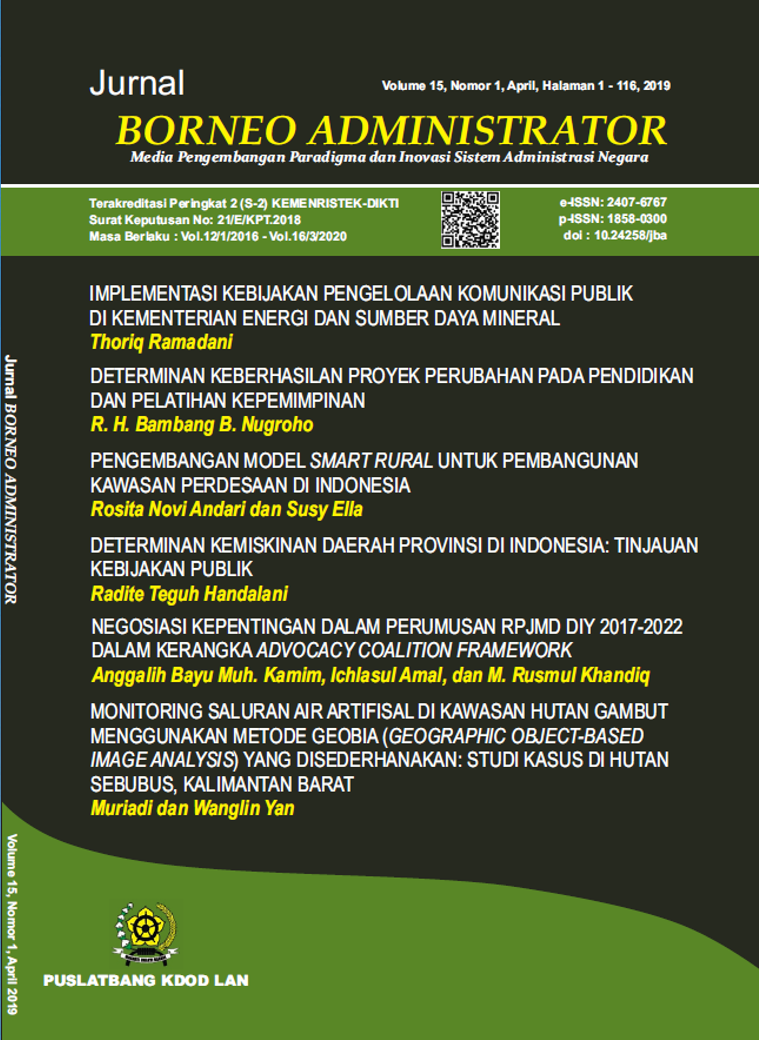
Determinan Kemiskinan Daerah Provinsi di Indonesia: Tinjauan Kebijakan Publik
Determinant of Poverty in Indonesian’s Province: A Review of Public Policy
DOI:
https://doi.org/10.24258/jba.v15i1.373Abstract
This study aims to analyze poverty which is complex and multidimensional in terms of several aspects: physical and demographic, economic, social and behavioral aspect. However, the study of poverty problems often constrained by incompleteness and data integrity and it causes limitations on variables and aspects to be studied. Unlike some previous studies, the variables examined in this study not only underlie the study of poverty on the economic aspects and the concept of growth. However, this study was also included demographic aspects and physical mastery of resources, social aspects on education and human development index and aspect of behavior (lifestyle). This approach was applied to avoid hinder on poverty alleviation analysis due to data limitation with an adequate spectrum and dimensions so as to produce a representative model in finding determiner of poverty alleviation in Indonesia and its alternative policies. The method used in this study was carried out with a series of tests and multiple regression analysis using the ordinary least squares (OLS) method. Findings from study which used thirteen variables on related aspect of demographic, economic, social and behavioral aspects generated four variables that significantly influence the decline in the number of poor people in Indonesia.
Keywords: Poverty Alleviation, Ordinary Least Squares (OLS), Determinant of Poverty, Multiple Regression Analysis
Abstrak
Penelitian ini bertujuan untuk melakukan kajian tentang kemiskinan yang bersifat kompleks dan multidimensi ditinjau dari beberapa aspek kehidupan yaitu: aspek fisik dan demografi, ekonomi, sosial dan aspek budaya (perilaku). Namun, kajian masalah kemiskinan, seringkali terkendala oleh ketidaklengkapan dan integritas data sehingga menyebabkan keterbatasan pada variabel dan aspek yang hendak diteliti. Berbeda dengan beberapa penelitian sebelumnya variabel yang dikaji dalam penelitian ini tidak hanya melandasi kajian tentang kemiskinan hanya pada aspek ekonomi dan konsep pertumbuhan. Namun penelitian ini juga memasukan aspek demografi dan penguasan fisik sumber daya, aspek sosial berupa pendidikan dan indeks pembangunan manusia dan aspek perilaku (gaya hidup). Pendekatan ini dilakukan dengan tujuan agar keterbatasan data tidak menghalangi analisis tentang upaya pengentasan kemiskinan dengan spektrum dan dimensi yang memadai, sehingga dapat menghasilkan model yang representatif dalam menemukan variabel determinan dalam pengentasan kemiskinan di Indonesia beserta alternatif kebijakannya. Metode yang digunakan dalam penelitian ini dilakukan dengan serangkaian pengujian dan analisis regresi berganda menggunakan metode ordinary least squares (OLS). Temuan dalam penelitian yang menggunakan 13 variabel yang terkait aspek demografi, ekonomi, sosial dan perilaku terdapat empat variabel berpengaruh signifikan terhadap penurunan jumlah penduduk miskin di Indonesia.
Kata Kunci: Pengentasan Kemiskinan, Ordinary Least Squares (OLS), Determinant of Poverty, Regresi Berganda
Downloads
Downloads
Published
How to Cite
Issue
Section
License
Copyright (c) 2019 Author(s)

This work is licensed under a Creative Commons Attribution-NonCommercial-ShareAlike 4.0 International License.
Policy for Journals That Offer Open Access
Authors who publish with this journal agree to the following terms:
- Authors retain copyright and grant the journal right of first publication with the work simultaneously licensed under a Creative Commons Attribution-NonCommercial-ShareAlike 4.0 International License that allows others to share the work with an acknowledgement of the work's authorship and initial publication in this journal.
- Authors are able to enter into separate, additional contractual arrangements for the non-exclusive distribution of the journal's published version of the work (e.g., post it to an institutional repository or publish it in a book), with an acknowledgement of its initial publication in this journal.
- Authors are permitted and encouraged to post their work online (e.g., in institutional repositories or on their website) prior to and during the submission process, as it can lead to productive exchanges, as well as earlier and greater citation of published work (See The Effect of Open Access).