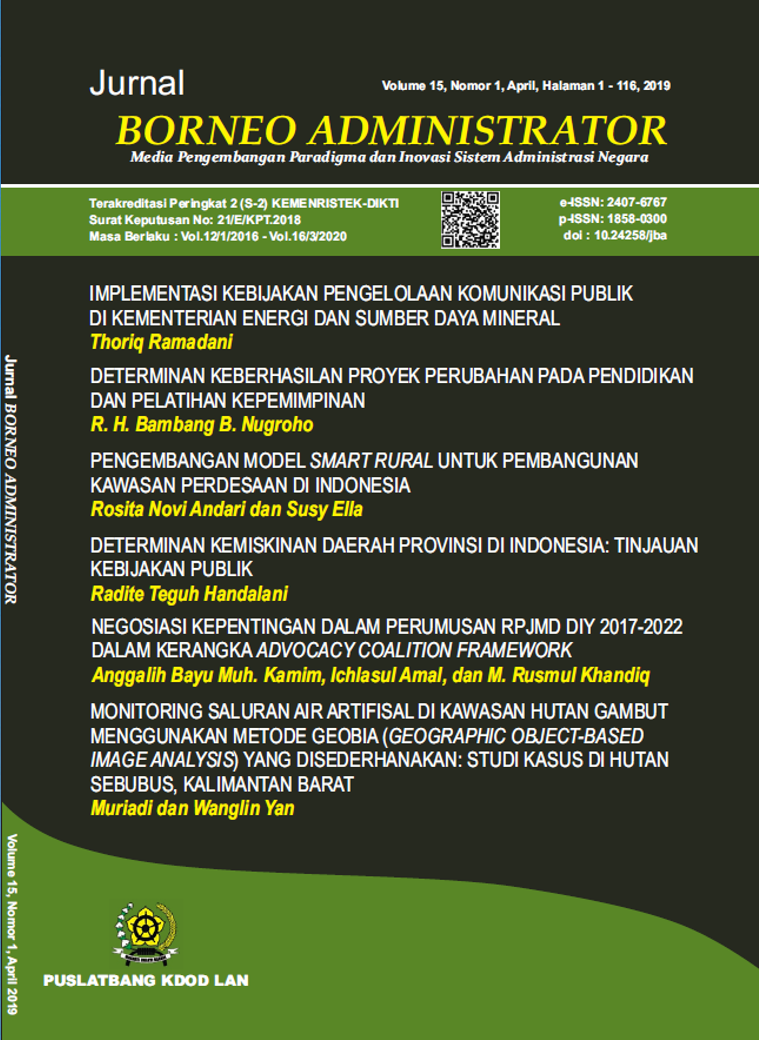
Pengembangan Model Smart Rural untuk Pembangunan Kawasan Perdesaan di Indonesia
Developing A Smart Rural Model for Rural Area Development in Indonesia
DOI:
https://doi.org/10.24258/jba.v15i1.394Abstract
Urbanization in Indonesia tends to increase every year. In 2014, data from United Nations showed that 53 percent of Indonesia’s population lived in urban areas, and by 2050, 71 percent of Indonesia’s population is projected to be urban. The main factor determining the high rate of urbanization in Indonesia is poverty in the rural areas. Therefore, the government uses rural development approach to reduce the number of rural people migrate to urban. Nevertheless, the government has stipulated a policy about rural area development in Law number 6/2014 concerning Village. However, this policy has given none applicable development model and improved village initiative. This study used a qualitative approach with a study of documentation for collecting data and interactive analysis model for data analysis. The results showed that smart rural development model can be developed in Indonesia through an ecosystem approach, which consist of five (5) dimensions and seven (7) phases with bottom-up planning process as the main approach and the collaborative governance model as the key executor.
Keywords: Rural, Rural Development, Smart Rural, Participatory
Abstrak
Urbanisasi di Indonesia cenderung meningkat setiap tahunnya. Pada tahun 2014, data dari United Nations menunjukkan bahwa 53% populasi di Indonesia tinggal di daerah perkotaan, dan pada tahun 2050 diproyeksikan akan naik menjadi 71%. Faktor utama yang menentukan tingginya tingkat urbanisasi di Indonesia adalah kemiskinan di daerah perdesaan. Oleh karena itu, pemerintah menggunakan pendekatan pembangunan perdesaan untuk mengurangi jumlah penduduk perdesaan yang bermigrasi ke perkotaan. Namun demikian, sekalipun pemerintah sudah menetapkan kebijakan pembangunan kawasan perdesaan melalui UU No 6/2014 tentang Desa, tetapi sejauh ini kebijakan tersebut belum memberikan model pembangunan yang aplikatif dan mampu menumbuhkan inisiatif desa. Penelitian ini menggunakan pendekatan kualitatif dengan studi dokumentasi untuk pengumpulan data serta model analisis interaktif untuk analisis data. Hasil penelitian ini menunjukkan bawah model smart rural dapat dikembangkan di Indonesia melalui pendekatan ekosistem yang terdiri dari lima (5) dimensi dan tujuh (7) tahapan dengan proses perencanaan dari bawah ke atas (bottom-up planning process) sebagai pendekatan utama dan model tata kelola yang kolaboratif sebagai pelaksana kuncinya.
Kata Kunci: Perdesaan, Pembangunan Perdesaan, Smart Rural, Partisipatif
Downloads
Downloads
Published
How to Cite
Issue
Section
License
Copyright (c) 2019 Author(s)

This work is licensed under a Creative Commons Attribution-NonCommercial-ShareAlike 4.0 International License.
Policy for Journals That Offer Open Access
Authors who publish with this journal agree to the following terms:
- Authors retain copyright and grant the journal right of first publication with the work simultaneously licensed under a Creative Commons Attribution-NonCommercial-ShareAlike 4.0 International License that allows others to share the work with an acknowledgement of the work's authorship and initial publication in this journal.
- Authors are able to enter into separate, additional contractual arrangements for the non-exclusive distribution of the journal's published version of the work (e.g., post it to an institutional repository or publish it in a book), with an acknowledgement of its initial publication in this journal.
- Authors are permitted and encouraged to post their work online (e.g., in institutional repositories or on their website) prior to and during the submission process, as it can lead to productive exchanges, as well as earlier and greater citation of published work (See The Effect of Open Access).