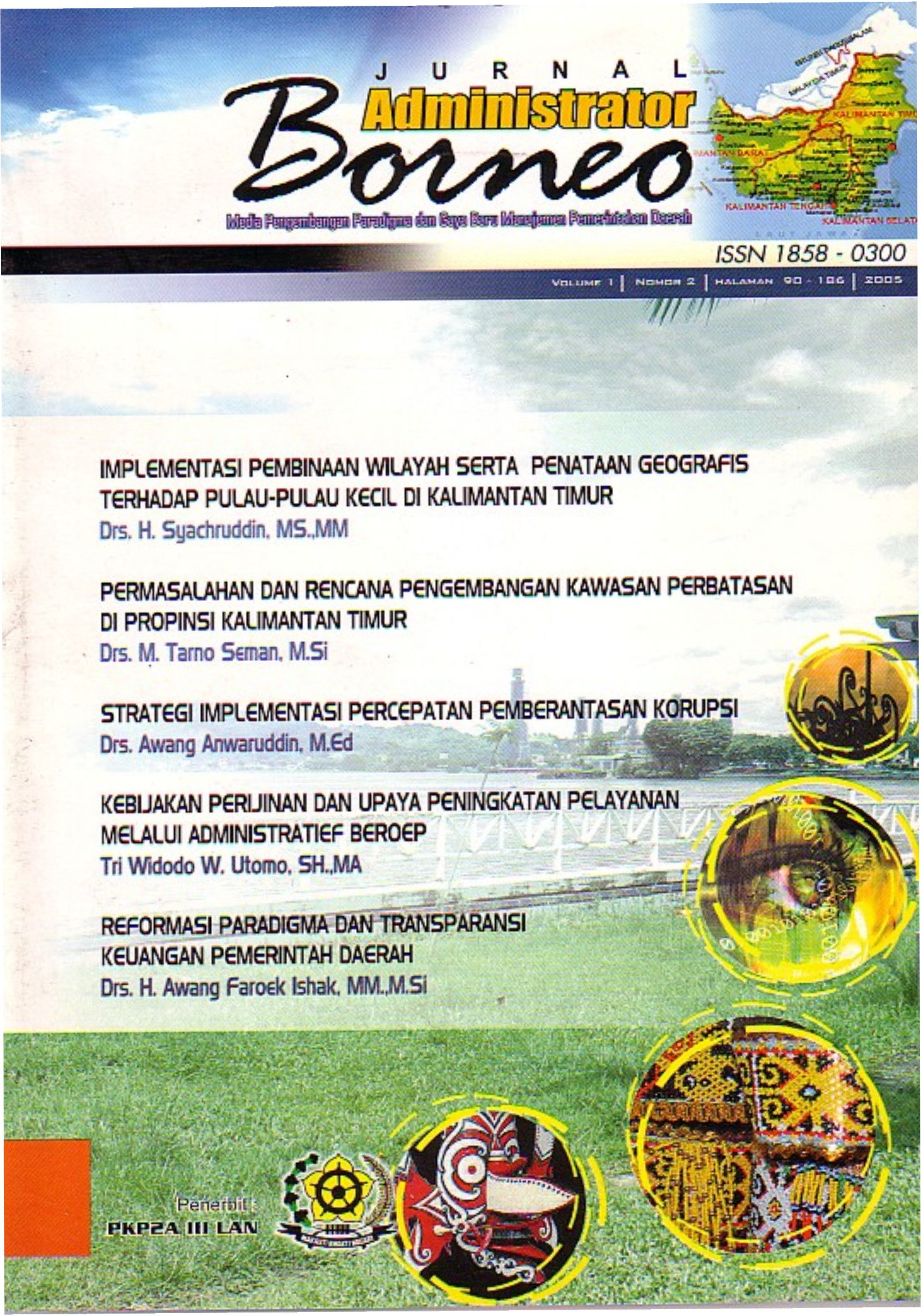
IMPLEMENTASI PEMBINAAN WILAYAH SERTA PENATAAN GEOGRAFIS TERHADAP PULAU-PULAU KECIL DI KALIMANTAN TIMUR
DOI:
https://doi.org/10.24258/jba.v1i2.4Abstract
The north side of East Kalimantan Province is characterized by harsh bordering areas, both land and sea. There are 386 islands in East Kalimantan territory; and 138 of those are unanimous. Such condition requires suitable policy to manage and optimize natural resources as well as to accelerate socio economic development and people’s prosperity. It also aims at protecting environmental quality and preventing from alien’s threat and intervention. This paper elucidates the implementation of East Kalimantan Provincial Government’s territorial policy based on the strategic study (SWOT Analysis). It also explicates the principles and procedures of giving names to unanimous islands.Downloads
Download data is not yet available.
Downloads
Published
2014-01-22
How to Cite
Syachruddin, D. H. (2014). IMPLEMENTASI PEMBINAAN WILAYAH SERTA PENATAAN GEOGRAFIS TERHADAP PULAU-PULAU KECIL DI KALIMANTAN TIMUR. Jurnal Borneo Administrator, 1(2). https://doi.org/10.24258/jba.v1i2.4
Issue
Section
Articles
License
Copyright (c) 2014 Author(s)

This work is licensed under a Creative Commons Attribution-NonCommercial-ShareAlike 4.0 International License.
Policy for Journals That Offer Open Access
Authors who publish with this journal agree to the following terms:
- Authors retain copyright and grant the journal right of first publication with the work simultaneously licensed under a Creative Commons Attribution-NonCommercial-ShareAlike 4.0 International License that allows others to share the work with an acknowledgement of the work's authorship and initial publication in this journal.
- Authors are able to enter into separate, additional contractual arrangements for the non-exclusive distribution of the journal's published version of the work (e.g., post it to an institutional repository or publish it in a book), with an acknowledgement of its initial publication in this journal.
- Authors are permitted and encouraged to post their work online (e.g., in institutional repositories or on their website) prior to and during the submission process, as it can lead to productive exchanges, as well as earlier and greater citation of published work (See The Effect of Open Access).