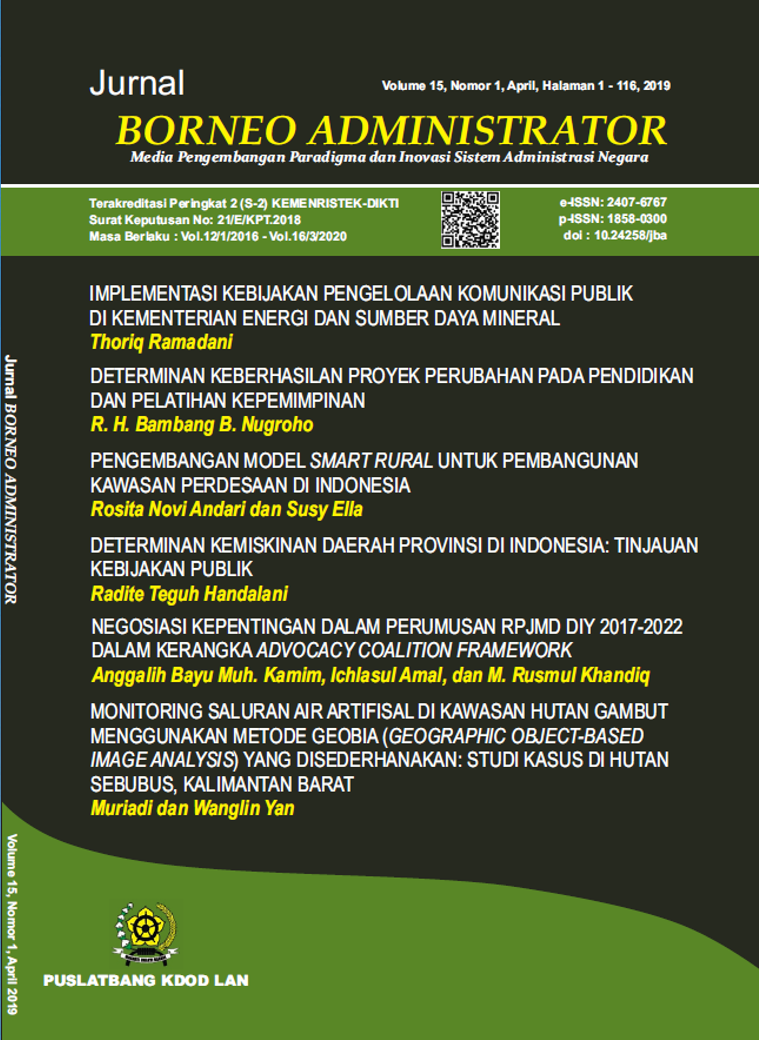
Negosiasi Kepentingan Dalam Perumusan RPJMD DIY 2017-2022 Dalam Kerangka Advocacy Coalition Framework
Negotiation of Interest in RPJMD DIY 2017-2022 Policy Formulation Using Advocacy Coalition Framework
DOI:
https://doi.org/10.24258/jba.v15i1.404Abstract
An exploration of policy changes and learning and interest negotiation in formulating policy are useful for mapping the process of compromising between the authorities and citizens. The study aims to explore the relations of external actors and local governments as a reflection of the state in the formulation of 2017-2022 DIY development planning policies to ensure no policies that favor the interests of certain groups. This research was conducted in qualitative research methods. This research was framed by a case study method. The research was conducted in agencies/ companies/ academics/ donor institutions/ parliament and the community involved and affected in the process of formulating DIY development planning policies. Research showed that there were some disadvantages of ACF model. The first disadvantage related to the inability of the ACF to explain the position of one of the "plural-faced" parties. The next disadvantage was the fact that ACF could not explain in detail the exact reason behind the formation of a coalition. The last disadvantage was that the ACF could not explain the dispersal of movements in a coalition.
Keywords: RPJMD DIY 2017-2022, Advocacy Coalition Framework, Policy Coalition
Abstrak
Penggalian policy change and learning serta negosiasi kepentingan dalam perumusan kebijakan berguna untuk memetakan proses kompromi penguasa dan warga. Studi untuk menggali dan mendalami relasi aktor eksternal dan pemerintah daerah sebagai cerminan negara dalam perumusan kebijakan perencanaan pembangunan DIY 2017-2022 menjadi penting untuk memastikan tidak adanya kebijakan yang berpihak pada kepentingan kalangan tertentu. Penelitian ini dilakukan dengan metode penelitian kualitatif. Penelitian ini dibingkai dengan metode studi kasus. Penelitian dilakukan di instansi/perusahaan/kalangan akademisi/lembaga donor/parlemen serta kalangan masyarakat yang terlibat dan terdampak dalam proses perumusan kebijakan perencanaan pembangunan DIY. Penelitian menunjukan bahwa dalam model ACF terdapat beberapa kekurangan. Kekurangan pertama berkaitan dengan ketidakmampuan ACF untuk menjelaskan posisi salah satu pihak yang “berwajah majemukâ€. Kekurangan berikutnya adalah ACF tidak dapat menjelaskan dengan detail alasan terbentuknya sebuah koalisi secara pasti. Kekurangan terakhir yaitu ACF tidak dapat menjelaskan terpencarnya gerakan dalam suatu koalisi.
Kata Kunci : RPJMD DIY 2017-2022, Advocacy Coalition Framework, Koalisi Kebijakan
Downloads
Downloads
Published
How to Cite
Issue
Section
License
Copyright (c) 2019 Author(s)

This work is licensed under a Creative Commons Attribution-NonCommercial-ShareAlike 4.0 International License.
Policy for Journals That Offer Open Access
Authors who publish with this journal agree to the following terms:
- Authors retain copyright and grant the journal right of first publication with the work simultaneously licensed under a Creative Commons Attribution-NonCommercial-ShareAlike 4.0 International License that allows others to share the work with an acknowledgement of the work's authorship and initial publication in this journal.
- Authors are able to enter into separate, additional contractual arrangements for the non-exclusive distribution of the journal's published version of the work (e.g., post it to an institutional repository or publish it in a book), with an acknowledgement of its initial publication in this journal.
- Authors are permitted and encouraged to post their work online (e.g., in institutional repositories or on their website) prior to and during the submission process, as it can lead to productive exchanges, as well as earlier and greater citation of published work (See The Effect of Open Access).