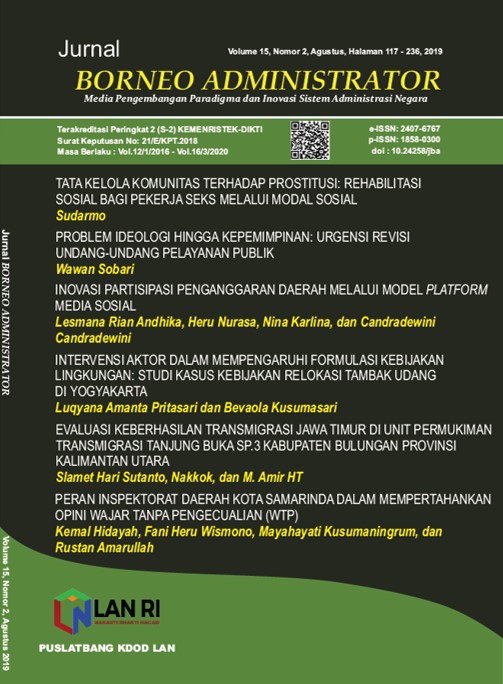
Community Governance of Prostitution: Social Rehabilitation for Sex Workers through Social Capital
Tata Kelola Komunitas Terhadap Prostitusi: Rehabilitasi Sosial Bagi Pekerja Seks Melalui Modal Sosial
DOI:
https://doi.org/10.24258/jba.v15i2.446Abstract
The Indonesian government has closed entire prostitution sites, one of them is Sunan Kuning with 500 sex workers in 2019. The study aims to investigate the implementation of social rehabilitation programs for its members through different networks covering social capital in bonding, bridging and linking social capital. This study used ethnographic method and showed that since the zone was covered by uncompromising Islamist group in 1998, the government was reluctant to manage prostitution and the area was reopened in 2003 after hundreds poor sex workers and procurers approached to local authorities and other parties to support them. Since then, the city government delegated authority to the society to manage it as a prostitution rehabilitation site. To be successful, the community required its members to obey established rules and created networks horizontally and vertically to diverse groups to provide health and social service and empowerment. However, the program implementation of social rehabilitation was ineffective because of limited networks and resources; community inconsistency to define prostitution rehabilitation, members’ inconstancy to follow agreed rules; lack of government responsiveness to the community conditions, and failure to define the substance problem. To solve this complex problem, it required continuing and synergistic collaborative governance with diverse stakeholders to resolve the problems.
Keywords: Community Governance, Social Capital, Social Rehabilitation, Sex Workers.
Abstrak
Pemerintah Indonesia sudah memutuskan untuk menutup semua lokasi prostitusi, salah satunya adalah Sunan Kuning dengan jumlah hampir 500 pelacur, pada 2019. Tujuan dari penelitian ini adalah untuk menelaah secara rinci bagaimana komunitas pekerja seks, Sunan Kuning Semarang mengimplementasikan program rehabilitasi sosial bagi para anggotanya melalui bentuk-bentuk jaringan yang mencakup modal sosial secara bonding, bridging dan linking. Dengan menggunakan metode etnografi, studi ini memperlihatkan bahwa sejak zona tersebut ditutup oleh kelompok Islam yang tidak kenal kompromi pada tahun 1998, pemerintah kota enggan untuk menangani prostitusi, dan area tersebut dibuka kembali pada tahun 2003 setelah ratusan pelacur miskin dan mucikari mendekati para tokoh lokal dan pihak lain untuk mendukung mereka. Sejak itu, pemerintah kota melimpahkan otoritas kepada komunitas untuk mengelolanya sebagai wilayah rehabilitasi sosial bagi para pekerja sex. Agar rehabilitasi sosial berhasil, komunitas mengharuskan anggotanya untuk mematuhi peraturan yang berlaku dan membuat jaringan secara horizontal dan vertikal ke berbagai kelompok untuk menyediakan layanan kesehatan dan sosial dan pemberdayaan. Namun implementasi program rehabilitasi sosial tersebut tidak efektif karena keterbatasan jaringan dan sumberdaya; ketidakkonsistenan komunitas dalam memaknai rehabilitasi prostitusi; ketidakkonsistenan anggota untuk mengikuti aturan yang disepakati; kurangnya responsivitas pemerintah terhadap kondisi komunitas; dan kegagalan dalam mendefinisikan substansi masalah dengan tepat. Untuk memecahkan masalah yang sangat kompleks ini secara efektif memerlukan collaborative governance yang melibatkan berbagai pemangku kepentingan secara berkesinambungan dan inergis.
Kata Kunci: Tata Kelola Komunitas, Modal Sosial, Rehabilitasi Sosial, Pekerja Sex.
Downloads
Downloads
Published
How to Cite
Issue
Section
License
Copyright (c) 2019 Author(s)

This work is licensed under a Creative Commons Attribution-NonCommercial-ShareAlike 4.0 International License.
Policy for Journals That Offer Open Access
Authors who publish with this journal agree to the following terms:
- Authors retain copyright and grant the journal right of first publication with the work simultaneously licensed under a Creative Commons Attribution-NonCommercial-ShareAlike 4.0 International License that allows others to share the work with an acknowledgement of the work's authorship and initial publication in this journal.
- Authors are able to enter into separate, additional contractual arrangements for the non-exclusive distribution of the journal's published version of the work (e.g., post it to an institutional repository or publish it in a book), with an acknowledgement of its initial publication in this journal.
- Authors are permitted and encouraged to post their work online (e.g., in institutional repositories or on their website) prior to and during the submission process, as it can lead to productive exchanges, as well as earlier and greater citation of published work (See The Effect of Open Access).