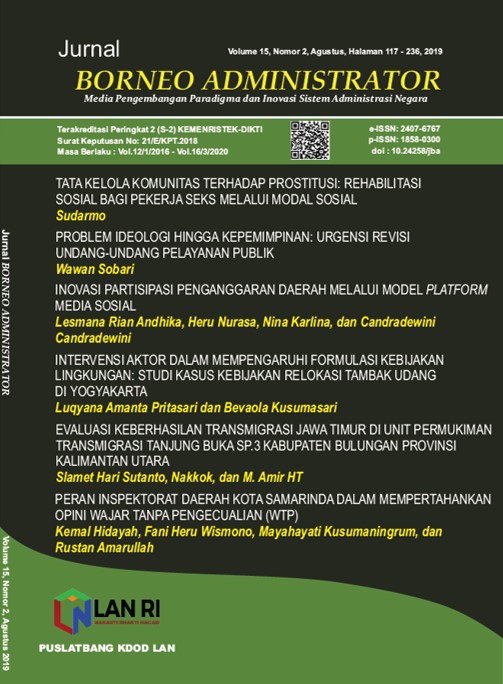
Problem Ideologi Hingga Kepemimpinan: Urgensi Revisi Undang-Undang Pelayanan Publik
The Ideological Problems Until Leadership: Urgency of Public Service Law Revision
DOI:
https://doi.org/10.24258/jba.v15i2.501Abstract
This study aims to critically examine the content of Law Number 25/2009 concerning Public Service and contribute to highlight four main points of amendment. A decade of law implementation achieved some advancement to public. One of them is the development of various service breakthroughs that fulfilled demand and needs of users. However, public service implementation still faces compliance problems with service standards at all levels of government. Furthermore, public service has to deal with the integrity problem. This study applies a textual/documentary analysis method and is operationally carried out through qualitative content analysis of the text of Law 25/2009. The study also reveals four other problems that must be responded to the amendment to the law, namely ideology, publicness, leadership, and ethics. The principan of spirituality is an important part of ideology to meet the religious rights of users and providers and encourage to run the integrated public services. In order to assure dynamics and adaptability to change, it is necessary to shift the public service leadership approach towards political entrepreneurship. Finally, to minimize the ethical risk of leaders’ policy behavior, the revision must include regulation of public service leaderships ethics.
Keywords: ideology, publicness, political entrepreneurship, ethics, public service.
Abstrak
Studi ini bertujuan mengkaji secara kritis konten Undang-Undang Nomor 25 Tahun 2009 Tentang Pelayanan Publik (UU 25/2009) dan berkontribusi menuangkan pokok-pokok pikiran perubahannya. Satu dekade pelaksanaan UU 25/2009 mencapai sejumlah kemajuan pelayanan yang bermanfaat bagi publik. Salah satunya melalui lahirnya berbagai terobosan pelayanan publik yang merespon kebutuhan dan permintaan pengguna. Namun, penyelenggaraan pelayanan publik masih menghadapi masalah pemenuhan kepatuhan standar pelayanan publik pada seluruh tingkatan pemerintahan. Selain itu, terdapat problem integritas dalam penyelenggaraan pelayanan publik. Studi ini menggunakan metode analisis tekstual/dokumenter dan secara operasional dilaksanakan melalui analisis isi kualitatif teks UU 25/2009. Studi ini menemukan empat masalah yang harus direspon dalam perubahan UU 25/2009 di luar persoalan kepatuhan terhadap standar dan integritas, yaitu terkait ideologi, derajat/kualitas publik (publicness), kepemimpinan pelayanan publik, dan etika kepemimpinan pelayanan publik. Asas spiritualitas penting agar pelayanan publik memenuhi hak-hak spiritual pengguna dan penyelenggara dan mendorong bekerjanya pelayanan publik yang berintegritas. Demi menjamin publicness, dibutuhkan reorientasi prinsip-prinsip publik dalam penyelenggaraan pelayanan publik yang terikat dengan nilai-nilai Pancasila. Dalam merespon dinamika dan kemampuan adaptasi terhadap perubahan, maka perlu perubahan kepemimpinan pelayanan publik menuju paradigma kewirausahaan politik. Terakhir, guna meminimalisir risiko etis perilaku kebijakan pemimpin, maka revisi harus mencakup pengaturan etika kepemimpinan pelayanan publik.
Kata Kunci: ideologi, publicness, kewirausahaan politik, etika, pelayanan publik.
Downloads
Downloads
Published
How to Cite
Issue
Section
License
Copyright (c) 2019 Author(s)

This work is licensed under a Creative Commons Attribution-NonCommercial-ShareAlike 4.0 International License.
Policy for Journals That Offer Open Access
Authors who publish with this journal agree to the following terms:
- Authors retain copyright and grant the journal right of first publication with the work simultaneously licensed under a Creative Commons Attribution-NonCommercial-ShareAlike 4.0 International License that allows others to share the work with an acknowledgement of the work's authorship and initial publication in this journal.
- Authors are able to enter into separate, additional contractual arrangements for the non-exclusive distribution of the journal's published version of the work (e.g., post it to an institutional repository or publish it in a book), with an acknowledgement of its initial publication in this journal.
- Authors are permitted and encouraged to post their work online (e.g., in institutional repositories or on their website) prior to and during the submission process, as it can lead to productive exchanges, as well as earlier and greater citation of published work (See The Effect of Open Access).